ANCIENT AMERICAN

Collection Info
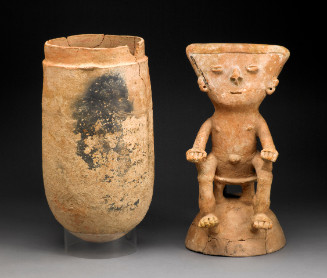
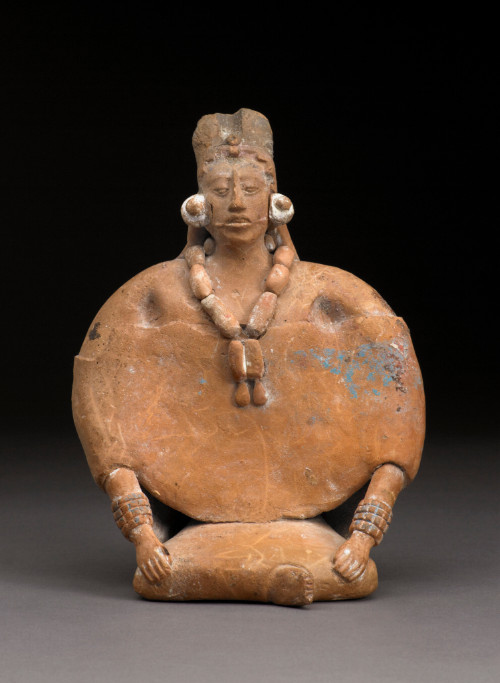
Seated hand-fashioned female figure, large wedged nose extending from center of forehead to full lips, almond-shaped eyes, large earrings with white slip, pilled necklace, mantle around shoulders down to waist, small arms with hands attached to folded legs, heavy bracelets on arms; white, red, and blue traces of paint.

Ancient American objects in the collection are primarily from Mesoamerica, Central America and the Central Andes. There is a strong collection of West Mexican ceramic figures from Nayarit, Colima and Jalisco areas. Other Mesoamerican works include a small Olmec head, Mayan ceramic vessels and jade adornments, and a small collection of Maya stucco portrait heads. The Harn also has a small collection of Toltec and Zapotec ceramics and two Aztec stone feathered serpents. Central American objects, mainly from Costa Rica, include a collection of ceramic vessels, whistles, grinding stones and jade adornments.

The Andean collection includes objects from Moche, Chavin and Chimu cultures of the North Coastal area, and Inca and Nazca from the Southern Coast. Most notable among these are polychrome ceramics and textiles. The museum also has a collection of Taino stone, ceramic and coral sculpture from Puerto Rico and the Dominican Republic.
Sort:
467 results
Seated hand-fashioned female figure, large wedged nose extending from center of forehead to full lips, almond-shaped eyes, large earrings with white slip, pilled necklace, mantle around shoulders down to waist, small arms with hands attached to folded legs, heavy bracelets on arms; white, red, and blue traces of paint.
Maya Artist
550-830
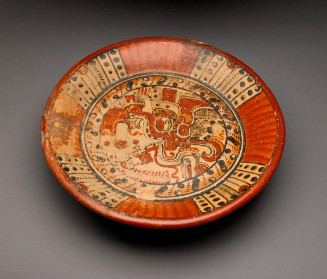
Large tripod plate with hieroglyphic in center bordered by geometric black and red feather-type forms, left side slightly eroded, hollow legs with rattles, calcification on one edge of surface
Maya Artist
700-830
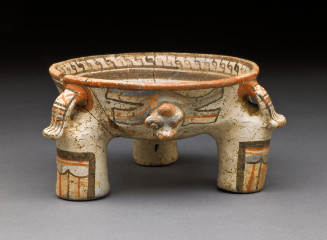
Tripod bowl with cylindrical legs with jaguar effigy and eagle head feet, in fine polychrome decoration
Chorotegan Artist
1200-1350
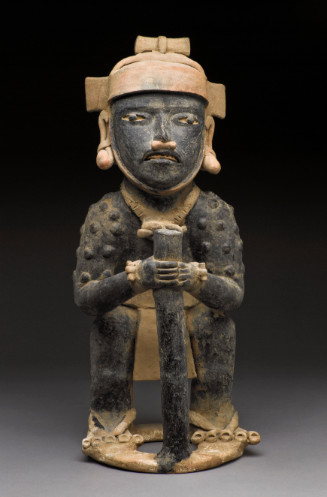
Holding a club to the front, wearing costume and helmet, painted black
Totonac Artist
150-450
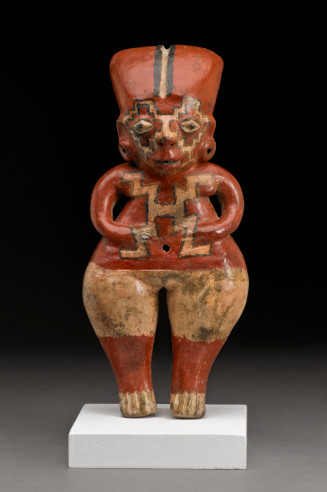
With wide hips; hands held to the front; tall coiffure, and red/brown and cream polychrome decoration.
Chupícuaro Artist
300-100 BCE
Lid surmounted by a seated figure on a stool, ovoid body, pigment
Mosquito Artist
c. 1200-1500
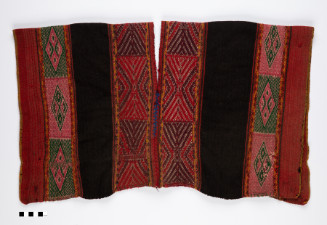
Two woven panels are joined, leaving an opening for the head in the center, the weaving consists of eight vertical panels of alternating geometric design and plain weaving of a single color.
Quechua Artist
c. 1500-1900
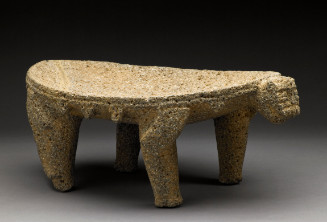
four legged metate with oval shaped grinding plate, at one end is a jaguar head, at the other a tail, around the rim are images of trophy heads
Costa Rican Artist
Period VI, Late Period, 1000-1522
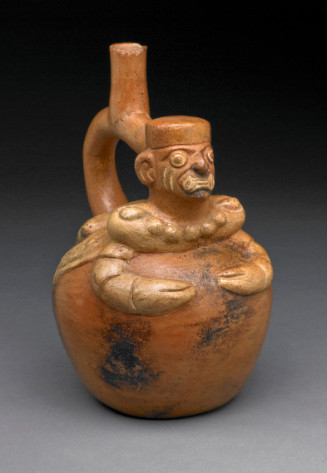
Stirrup spout vessel, flat bottom with spherical body, figure of crab-man lying on top of vessel - body of crab with claws looped around in front, human or frog legs in back, human head with bared teeth and fangs, flat-disk cap, stirrup spout running from back of head down into vessel of body
Moche Artist
Early Intermediate period, 200-300
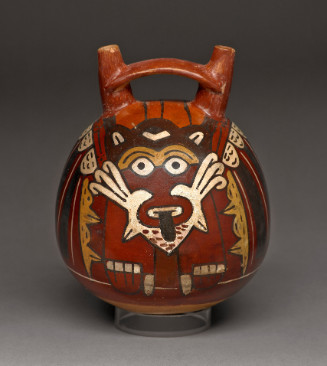
Spherical vessel, bottom slightly widened, top slightly tapered with 2 tubular spouts rising around center of top, connected by wide flat band to make a handle. Painted in burnished polychrome of feline figure and head on one side with connecting body over top and trophy head on other side, at base of tail, wall segmented by thin white lines and black vertical bands.
Nazca Artist
300–500 CE
null