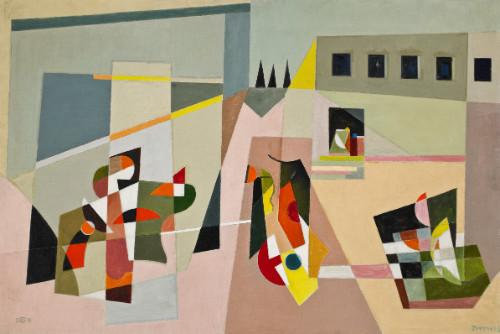
Abstract rendering of figures against the backdrop of a perspectival architectural study. Likely inspired by Botticelli's Three Miracles of St. Zenobius (1500–1510, tempura on wood) in the collection of the Metropolitan Museum of Art since 1911.
Composition after Botticelli
Courtesy of the Harn Museum of Art, Photography by Randy Batista

Composition after Botticelli

Artist Werner Drewes (American, born Germany, 1899-1985)
Date1938
Place of originUnited States, North and Central America
MediumOil on canvas
Dimensions20 x 30 in. (50.8 x 76.2 cm)
ClassificationsPaintings
Credit LineMuseum purchase, funds provided by Dr. and Mrs. David A. Cofrin with additional funds provided by exchange, gift of Helen Sawyer Farnsworth
Object number2006.5
Collections
Visual DescriptionAbstract rendering of figures against the backdrop of a perspectival architectural study. Likely inspired by Botticelli's Three Miracles of St. Zenobius (1500–1510, tempura on wood) in the collection of the Metropolitan Museum of Art since 1911.
Abstract, non-representational design of geometric shapes in browns, blues and reds.
Werner Drewes
1985
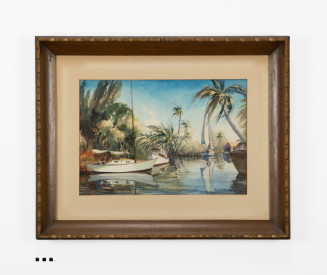
Boats
Hulda Werner
undated
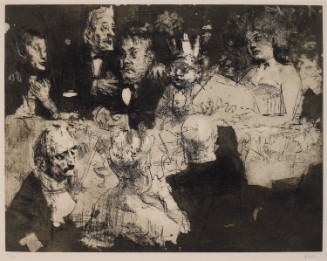
Election Night
Jack Levine
1969
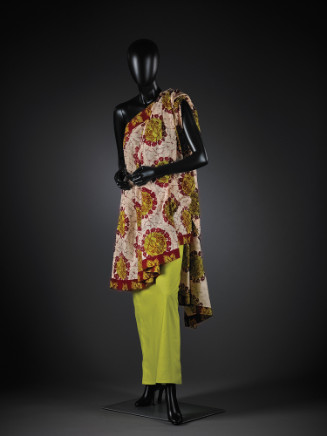
Wax print cloth (commercial cloth) with burgundy and lime green floral motifs, burgundy border around neckline and hem; to be worn with one shoulder exposed; knee length

The Akwadzan is sewn from wax print fabric, likely produced by Ghana Textiles Production, a Ghanaian company that Chez Julie officially collaborated with during the late 1960s and early 1970s.  The background of the wax print is a light shade of coral/salmon, with a repeated medallion pattern of a bird on a branch, surrounded…
Juliana Kweifio-Okai
late 1960s
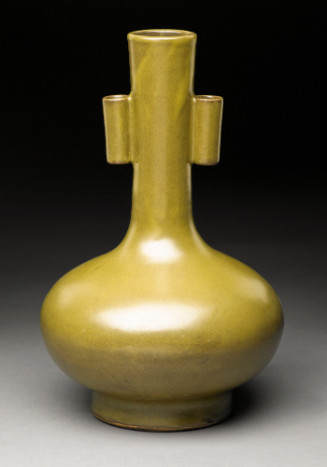
Yellowish-green glazed ceramic vase with a bulbous body and a long neck featuring two tubular handles on either side.
Chinese Artist
Qing Dynasty (1644 - 1911), late 18th-19th century
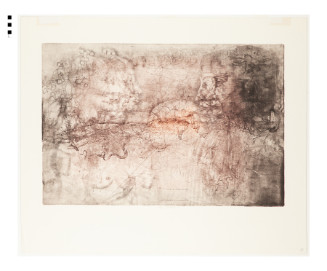
A sepia-toned artwork featuring multiple overlapping, sketched human profiles facing each other from the left and right. A dense, chaotic web of intricate, swirling lines and small circular patterns covers the figures and the space between them.
Jiri Anderle
1978
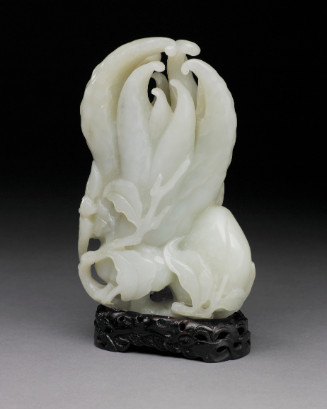
The emphasis on the smooth sensuous surface, fluidity of lines and the attention to detail are all typical elements of the eighteenth century carving tradition.  Fashioned of a pure white jade, the citron is entwined with leaves and accompanied by a bat and a peach. The long delicately carved tendrils bend gracefully at the tips, resembling Buddha's hand in the classic position. The citron symbolizes wishes for longevity as well as wealth, since it illustrates the gesture of grasping money. The …
Chinese Artist
18th-19th century
A black and white photograph where two pairs of legs dangle from an overhead pipe. Below, pedestrians and bicyclists navigate a street backed by heavily ruined, crumbling buildings.
James Nachtwey
1996
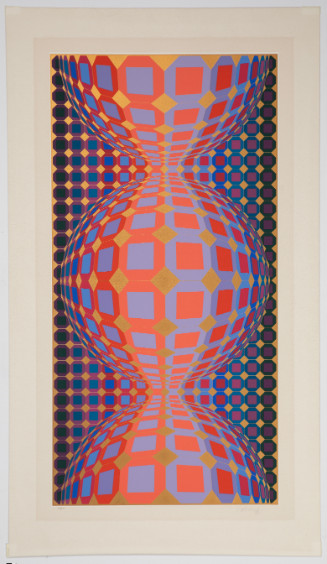
Op art geometric image with multiple square shapes in blue, purple, pink, red, gold and black.
Victor de Vasarely
1969
Large fruit still life in aquatint, soft colors - blues, greens, violet and black background, with numbers in reverse in horizontal band.
Wanda Mihuleac
1973
Op art geometric image with multiple circular shapes.
Victor de Vasarely
undated
null