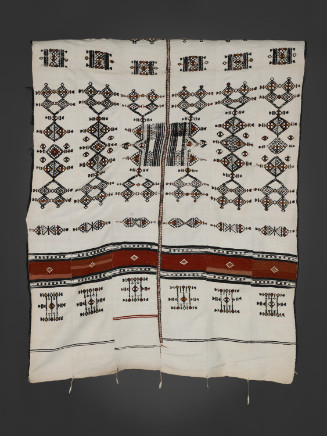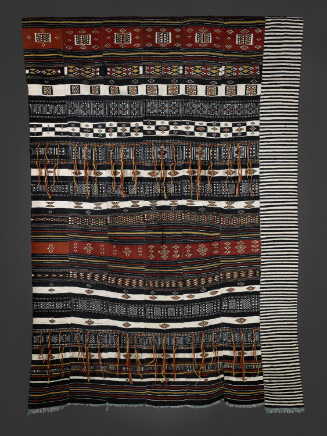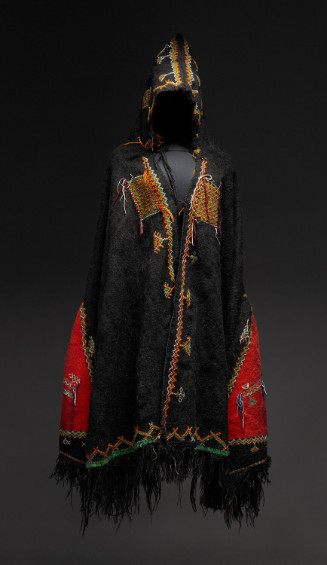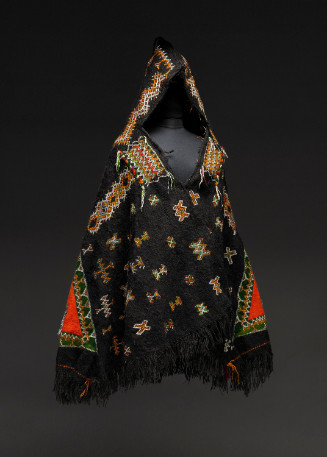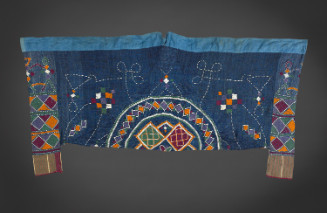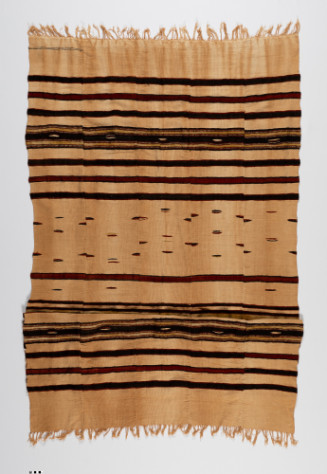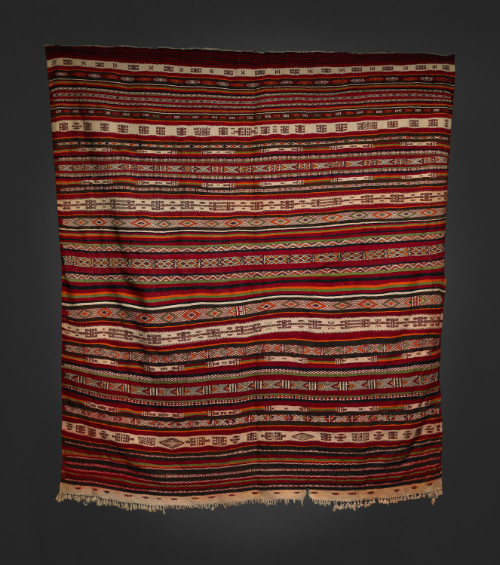
White wool warp with narrow separate bands, 1-5 cm. of geometric patterns in diamonds, clusters, comb-like design (compare to women's tattoo designs). Loose weaving on reverse (not kilim). Black strip on back for hanging.
Tapestry, (Ksaya)
Courtesy of the Harn Museum of Art, Photography by Randy Batista

Tapestry, (Ksaya)

Maker Amazigh Artist , Tatouine, Tunisia
Datec. 1973
Place of originTunisia, Africa
MediumWool
Dimensions6 ft. 11 7/8 in. x 6 ft. 7 1/8 in. (213 x 201 cm)
ClassificationsTextiles
Credit LineMuseum purchase, funds provided by the Caroline Julier and James G. Richardson Acquisition Fund
Object number2009.32.4
Collections
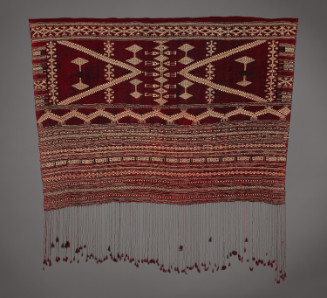
Visual DescriptionWhite wool warp with narrow separate bands, 1-5 cm. of geometric patterns in diamonds, clusters, comb-like design (compare to women's tattoo designs). Loose weaving on reverse (not kilim). Black strip on back for hanging.
Woman's shawl fine spun wool and cotton mixed dyed burgundy warp and weft, weft-faced designs in white cotton, black wool: bottom third section is made up of  a series of bans with geometric shapes including: knucklebones, bread, snakes, scorpion, remainder of piece has designs including sash, jewel, snake with comb. Top fringe is tufted and bottom fringe in long and tufted
Amazigh Artist
20th century
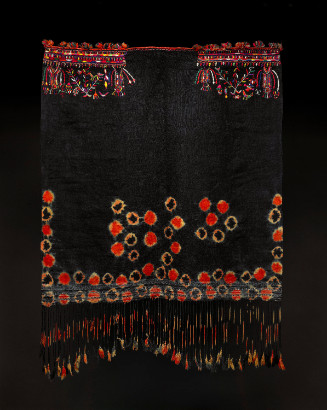
"Tajira", blue dyed wool with tie-dyed circles in red/orange/yellow mainly along the bottom. Lower edge fringe (long) is twisted and tufted and dyed in above-mentioned colors; the upper edge fringe (short) at the corners is made of small tufts in pink, blue, turquoise, and orange. The lower border is adorned with bands of geometric motifs such as "snake with eyes" and knucklebone" in white (cotton) and black (wool); the upper border is adorned in the corners with embroidered motifs of abstracted…
Amazigh Artist
late 20th century
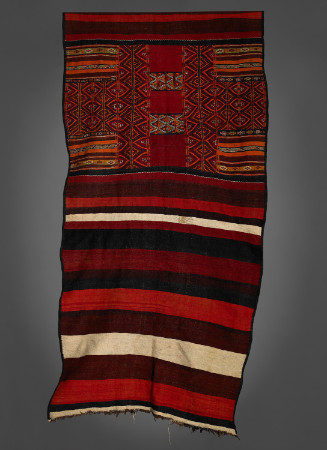
Carpet constructed in strips: one meter of design towards the middle section. Stripes of red, white and brown natural colors with intricate design in center.
Amazigh Artist
20th century
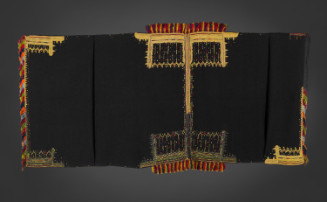
Two panels (handsewn together with red silk) in fine spun wool dyed black with heavy embroidery at the four corners in gold thread, yellow, green, red, blue silk. Embroidered patterning consists of geometric motifs resembling an architectural setting (gables and columns) or a jeweled crown with pendants; along the borders, linking the heavy inlay at the corners are small silk crosses in the above-mentioned colors. Fringes at either end are made of twisted silk threads in red, orange, mauve, gree…
Amazigh Artist
20th century
Handspun and handwoven strips, white cotton warp with wool weft, band of red on either end; floating weft patterns, geometric designs in black, red and ocher. Some loss of weft patterns and side finishing of black looped threads
Malian Artist
20th century
Wall Covering (arkilla kereka)
Fulani Artist
20th century
Dark blue cloak with orange red "eye" pattern in center; weave is elaborated with supplementary weft patterning and geometric designs. Extensive embroidering in rear insert is bright red-orange.
Amazigh Artist
c. 1973
Man's Hooded Cape (akhnif)
Amazigh Artist
c. 1973
Blue handwoven cotton cloth, hand stitched, wide waist with narrow legs. Hand embroidery of geometric and arabesque motifs in orange, green, burgundy, and white wool thread; waistband lined with light blue commercial cotton sheeting.
Hausa Artist
20th century
Rectangular blanket made from 5 strips, 9 in. each; fringes on each end.  Stripes and lozenge patterns; black, reddish brown and yellow ochre on white field.  Front is discolored (brownish) but back is white.
Fulani Artist
20th century
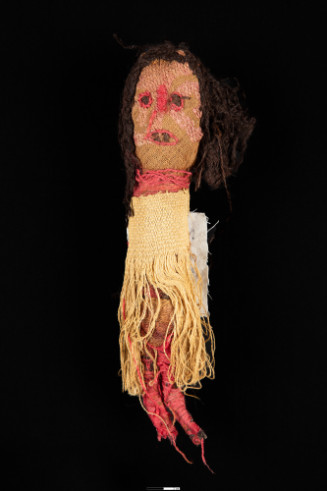
Figure made with woven fibers (probably wool, possibly camelid); large head with embroidery on face (pink) some loss of threads; features on face defined by black thread, possibly camelid wool; black threads for hair; white tunic with fringe; legs taper to two points, and are covered with pink and red patterned wool; threads seem friable and hair is tangled; stuffing seems to be bundled fiber.
Chancay Artist
1000-1450
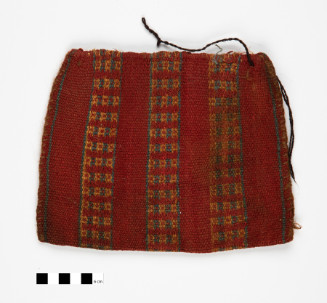
Originally framed in bottom position, formed by folding a rectangular weaving and stitching up the sides and adding a strap for carrying.
Chancay Artist
Late Intermediate period, 1200-1450
null