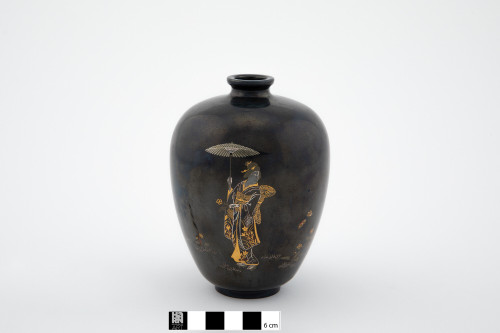
With an ovoid body finely worked in flat inlay (hon-zogan) in gold, silver, copper, shibuichi and shakudo with a bijin standing holding a parasol
Shakudo Vase
Courtesy of the Harn Museum of Art, Photography by Foad Seyed Mohammadi

Shakudo Vase

Maker Japanese Artist
Datec. 1900
Place of originJapan
MediumGold, silver, copper
DimensionsHeight x Diameter: 4 1/2 x 3 3/16 in. (11.4 x 8.1 cm)
ClassificationsFurnishings and Equipment
Credit LineBequest of Dr. David A. Cofrin
Object number2009.48.47
Collections
Visual DescriptionWith an ovoid body finely worked in flat inlay (hon-zogan) in gold, silver, copper, shibuichi and shakudo with a bijin standing holding a parasol
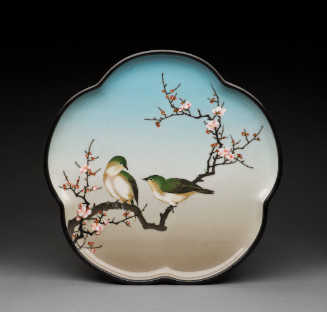
Meiji period (19th century). Modeled in the outline of a plum blossom and designed in silver and gold wire–outlined cloisonne and wireless enamel with two birds perched on a branch of flowering pink plum, the lower portion of the background shaded gray and the sky area shaded blue, the underside decorated with chocolate-brown cherry florets outlined in gold wire on a dark brown ground, rim in gold and copper shakudo metal.
Namikawa Sosuke
c. 1900-1910
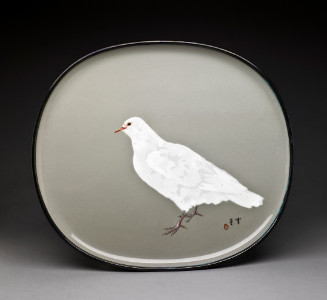
An oval cloisonne enamel tray with a white dove depicted in 'musen' (the wireless technique) and the wired technique on pale ground. His beak, eye and legs with finely detailed wire technique. The tray rim of 'shakudo.' The underside of the tray with characteristic stylized blossoms and silver wire signature.
Namikawa Sosuke
c. 1895-1905
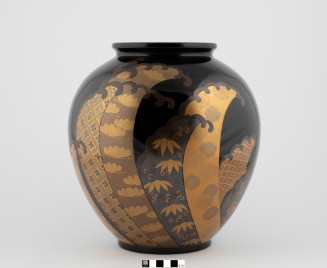
A lacquer vase by Heian Zohiko, with an ovoid body of roiro lacquer worked in gold hiramaki-e with a design of stylized waves each enclosing patterns of leaves and geometric motifs. With an interior metal liner.
Heian Zohiko Studio
late 1920s-1930s
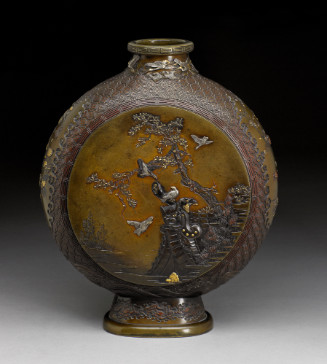
A flask with brown patina and a short neck, everted rim, splaying foot, and flat base. Decorated with roundels of waterfowls in a pond with birds and flowers.
Miyabe Atsuyoshi
Meiji period (1868-1912)
Covered container on a raised foot decorated with multi-colored fern shoots and silver nail heads.
Japanese Artist
Edo period (1615-1868), 18th-19th century
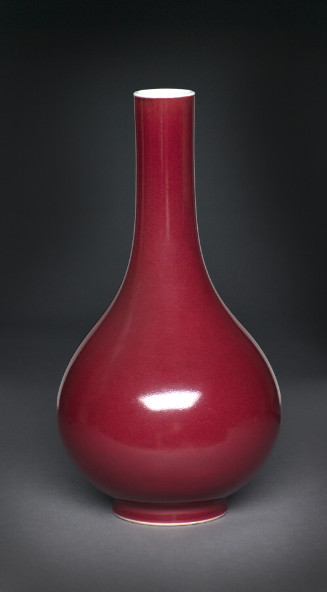
A smooth, glossy deep red vase with a wide, bulbous body that tapers upward into a long, narrow neck. The flat rim at the top opening and the bottom edge of the short foot are both white.
Chinese Artist
Qing dynasty (1644-1911), Qianlong reign (1736-1795)
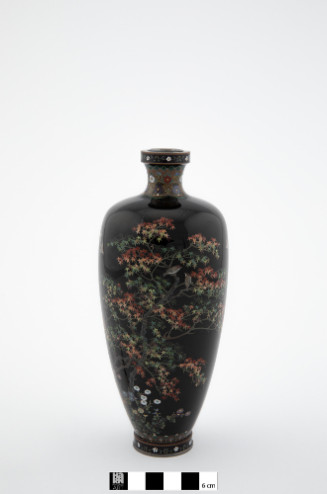
The slender vase with an elongated neck and set on a raised foot and decorated in polychrome enamels worked in silver wire with birds in maple trees above chrysanthemums against a black ground, the neck decorated with scrolling vines and flowers on a brown ground
Japanese Artist
Meiji Period (1868–1912)
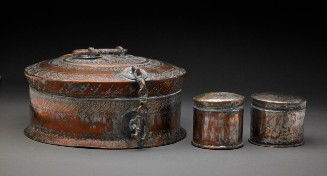
A large, round, lidded copper container with a handle and latch sits next to two smaller, matching cylindrical jars. The larger container has intricately patterned decorations on the lid and around the body.
Indian Artist
20th century
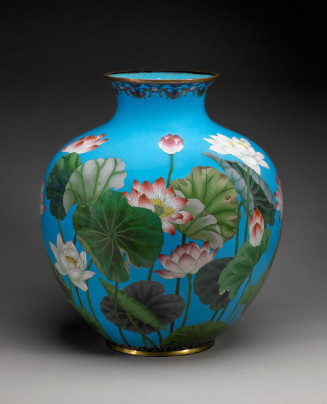
Large globular vase with lotuses on a blue background.
Japanese Artist
late 19th Century
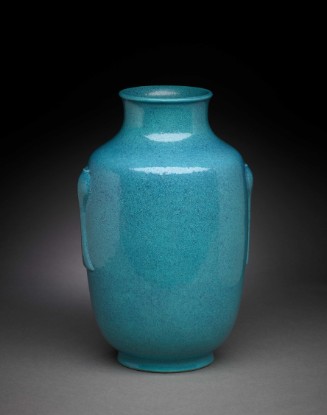
The vase is ovoid form resting on a slightly splayed foot, applied with a moulded, inverted, vase-shaped handle on each side of the body below the high shoulder, covered with a finely speckled glaze of turquoise and lapis-blue tone continuing over the slightly lipped rim to the interior and on the base
Chinese Artist
Qing Dynasty, Daoguang Period (1821-1850)
null