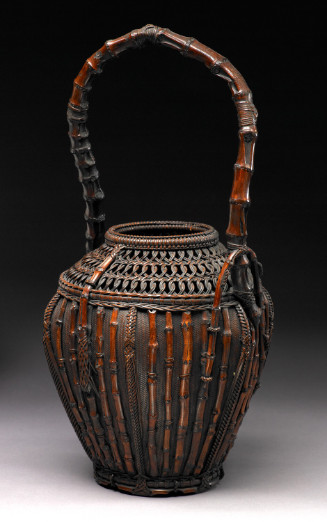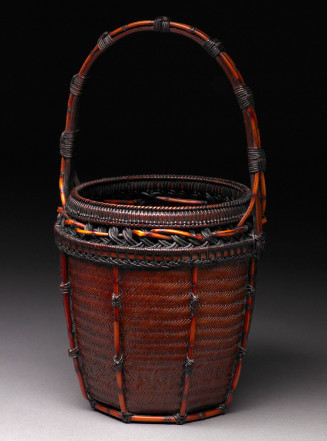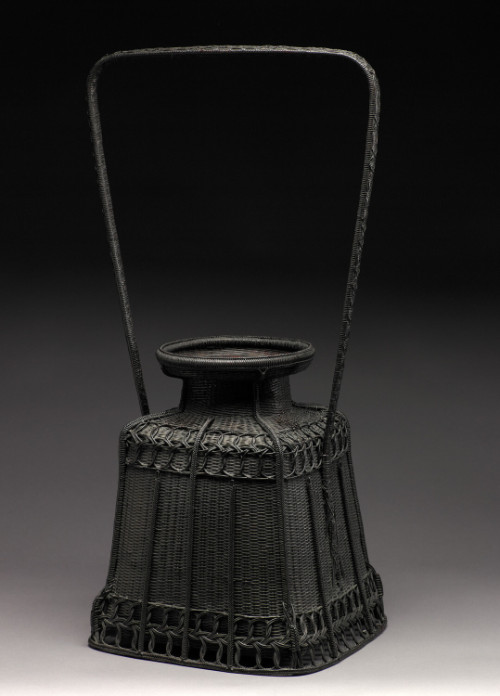
Flying Cranes Antiques: Rare ikebana basket of unusual form. Reminiscent of ancient bronze vessels, it has an elegant, tall and removable trapezodial handle sculpted with geometric wrapping. The flared skirt and neck are woven closely with thin strips of sooted bamboo, elaborate wraps and unique knots in the form of shrimp bordering the lower four sides at the base. Original kiriwood tombako signed "Made by Chikuyuusai I, karamono utsushi with handle, Tokugawa Family."
Basket
Courtesy of the Harn Museum of Art, Photography by Randy Batista

Basket

Artist Chikuyuusai I (Japanese)
Datec. 1910-1920
Place of originJapan, Asia
MediumBamboo
Dimensions26 5/8 x 14 5/16 x 11 5/16 in. (67.6 x 36.4 x 28.7 cm)
ClassificationsBasketry
Credit LineBequest of Dr. David A. Cofrin
Object number2009.48.162
Collections
Visual DescriptionFlying Cranes Antiques: Rare ikebana basket of unusual form. Reminiscent of ancient bronze vessels, it has an elegant, tall and removable trapezodial handle sculpted with geometric wrapping. The flared skirt and neck are woven closely with thin strips of sooted bamboo, elaborate wraps and unique knots in the form of shrimp bordering the lower four sides at the base. Original kiriwood tombako signed "Made by Chikuyuusai I, karamono utsushi with handle, Tokugawa Family."

Christie's: With round mouth, extended handle and square base, the flared skirt and indented neck woven closely with thin strips of bamboo, elaborate wraps and intricate knots, the removable handle wrapped by geometric pattern, signed "Made by Chikuyuusai I, karamono utsushi with handle, Tokugawa Family."
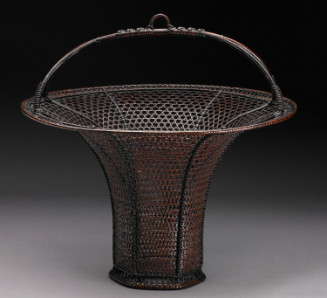
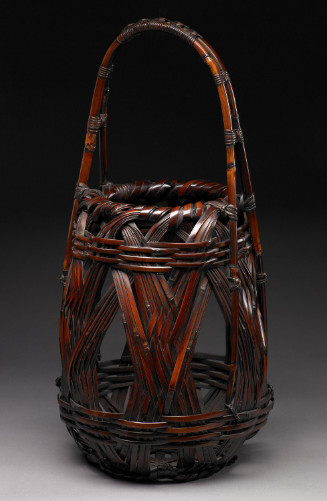
With thin strips of lacquered bamboo in open hexagonal weave, the double reed handle knotted with butterfly knots and insect wrapping, signed chikuunsai II.
Chikuunsai II
Showa Period (1926-1989)
A karamono style bamboo basket of hexagonal form with seven jewel design at neck, curved bamboo segment handle and intricate knots.
Japanese Artist
Meiji period (1868-1912)
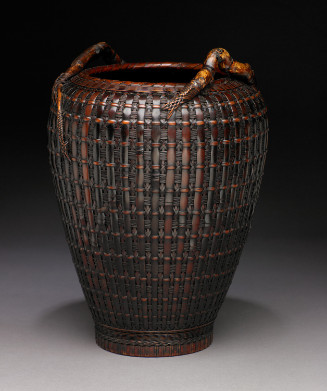
Of ovoid form in modified lozenge plaiting, with two low handles of bamboo root attached to the lip with insect wrapping and intricate knots, shoots from the rhizome descending from one handle and woven into the body of the basket on the shoulder, signed Chikushunsai.
Chikushunsai
undated
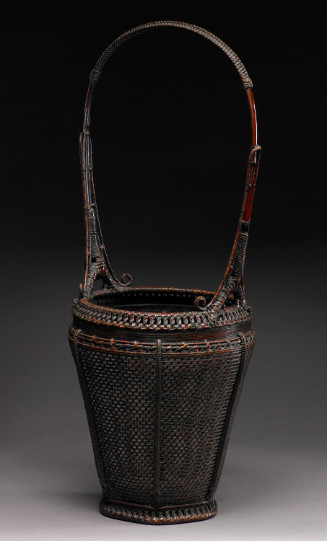
A six sided Ryu-Rikyo style flower basket with shoulder and foot banded by elaborate weaves, the body of open hexagonal weave with insect stitching and butterfly knots. Chikuunsai I signature, with lacquered owner's box, dated 1922
Tanabe Chikuunsai I
Taisho period (1912-1926), 1922
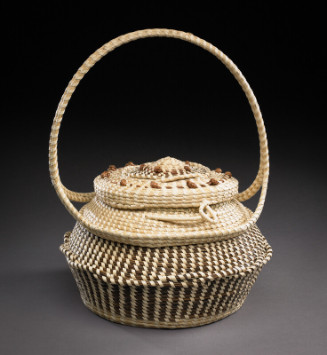
Round basket with handle and flat lid, hinged with coiled loops and clasp; adorned with pine needle knots on top and sides, dark fibers (bulrush) on bottom half, light colored fibers (sweetgrass) on shoulder and lid. Coils are sewn together with palm leaf strips.
Linda F. Blake
2012
Material: Madake, bamboo roots of Echigo Tagami Take, and rattan
Technique: Amimono
Bottom: Chiyoda-ami
Body: Ajiro with decorative rattan loops
Rim: Atebuchi and nishin-maki
Handle: Bamboo and bamboo root handle with decorative butterfly and spiral knots
Kosuge Fuunsai Kogetsu
2005
The sooted bamboo gathered and wrapped in a large, openwork pattern, the double reed handle with intricate wraps, signed Iizuka Hosai
Iizuka Hosai
Taisho Period (1912-1926)
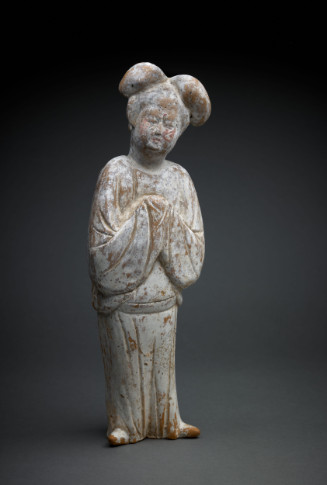
A fine pottery figure of an elegant court lady, standing, wearing a loosely fitted robe tied at the waist with a belt, the feet protruding from underneath the hen, the hands covered by the long sleeves. She tilts her head at an angle, the hair is dressed in two elaborate top knots. The buff pottery covered with a thin layer of white slip, the face with the remains of red pigment.
Chinese Artist
Tang dynasty (618–906), 8th century
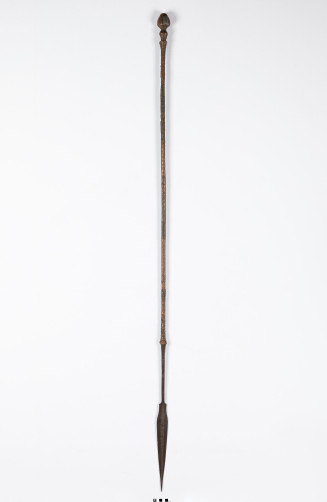
Thin iron spear blade, with long wooden handle wrapped with strips of copper, ending in a knob wrapped with copper sheeting; some detached sheeting due to wear.
Congolese Artist (Democratic Republic of Congo)
19th-20th century
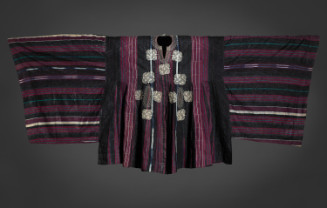
A long sleeve caftan/dress sewn from strips of wax print fabric likely Chinese imports and Woodin (a company that locally produces fabric in Ghana).  The bodice of the caftan features horizontal strips, whereas the skirt of the dress relies on vertical strips.  Each strip is formed from a mixture of long strips of fabric, interspersed with small squares of fabric.  The caftan includes a designer label, which states: “Cloth on cloth designs by Tei Huagie, made in Ghana”.
Tei Mensah Huagie
2000
null