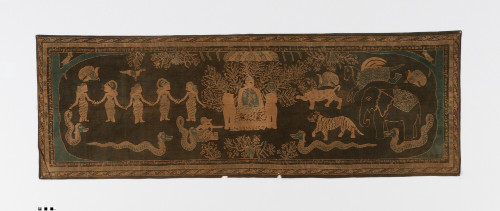
A highly unusual batik from North Java form the 19th century made for ceremonial use. It depicts mythological creatures surrounding the enthroned figure in a court with wild animals and servants, all in act of homage to this central figure.
Altar Cloth
Courtesy of the Harn Museum of Art, Photography by Foad Seyed Mohammadi

Altar Cloth

Maker Javanese
Date19th century (possibly older)
Place of originIndonesia
MediumCotton, natural pigments, thread
Dimensions20 1/4 x 59 1/4 in. (51.4 x 150.5 cm)
ClassificationsTextiles
Credit LineGift of Norma Canelas Roth and William D. Roth
Object number2010.95.6
Collections
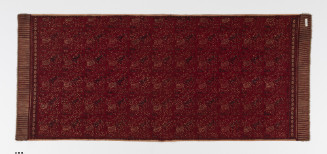
Visual DescriptionA highly unusual batik from North Java form the 19th century made for ceremonial use. It depicts mythological creatures surrounding the enthroned figure in a court with wild animals and servants, all in act of homage to this central figure.
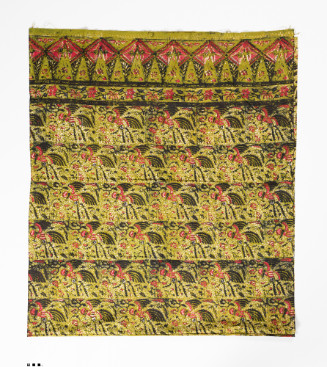
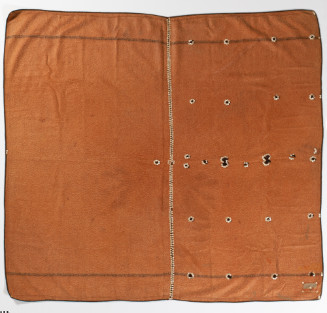
Cotton cloth with batik designs in orange, black and gold; printed patterns are off-register
Javanese
late 20th century
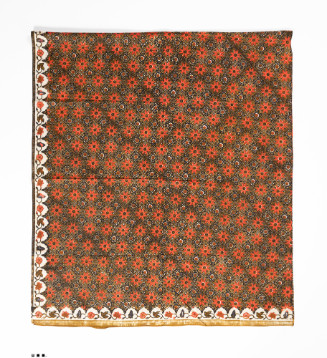
Cotton cloth with batik designs in green, black and red; printed patterns are off-register
Javanese
late 20th century
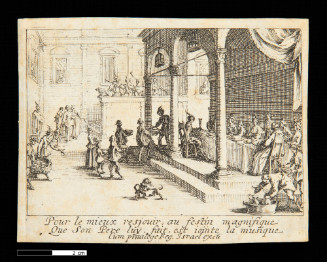
Black and white print of a banquet. Guests dine at a table under a colonnade while servants carry dishes up steps. Musicians play on a background balcony. A monkey sits in the foreground. At bottom French text reads: "Pour le mieux resjouir, au festin magnifique Que Son Pere luy fait, est iointe la musique. Cum privilege Reg. Israel excu"
Jacques Callot
c. 1624
Seated figure on red throne attended by two servants, one with fan and other holding an image (possibly a calligraphy)
Indian Artist
18th century
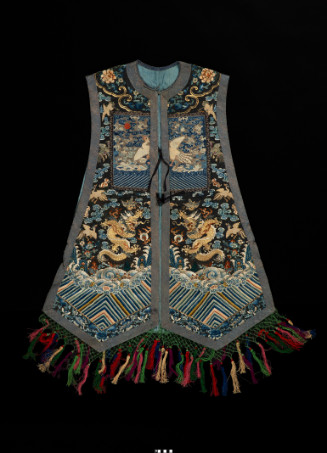
This embroidered hanging bears scenes of a gathering of immortals.  The individuals are separated into four sections, each on a different level, with the top ones descending from the clouds, the second in a building, the third on a boat, and the fourth on the ground level.
Chinese Artist
late 18th-early 19th century
The Fengu blankets are similiar to those of the Xhosa. This one has the fur trim which the Fengu prefer as well as the older mother-of-pearl buttons. There is also the fine black wool embroidery work and the delicate use of the glass bead-work. The blanket would have been worn partially folded over by about one third the width. The origin is Mazizini.
Zulu Artist
1850-1950
A long sleeve caftan/dress sewn from strips of wax print fabric likely Chinese imports and Woodin (a company that locally produces fabric in Ghana).  The bodice of the caftan features horizontal strips, whereas the skirt of the dress relies on vertical strips.  Each strip is formed from a mixture of long strips of fabric, interspersed with small squares of fabric.  The caftan includes a designer label, which states: “Cloth on cloth designs by Tei Huagie, made in Ghana”.
Tei Mensah Huagie
2000
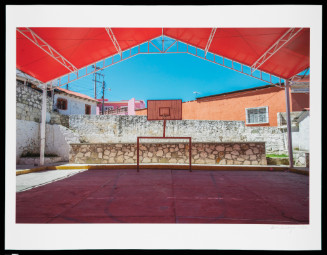
A basketball hoop in a community court is framed by vibrant colors of an orange overhead awning, surrounding adobe and pink buildings and a flawless blue sky.
Bill Bamberger
2015; print date: 2023
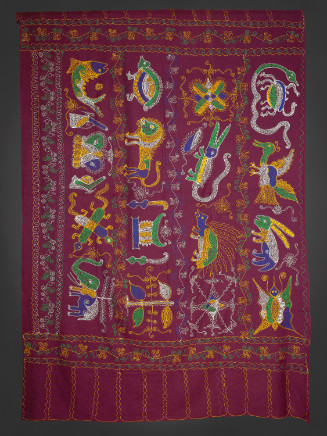
Maroon wool cloth "Akunitan" w/ chief's seat, lion, lizard, porcupine, snake, elephant with gold, green, blue and white threads machine embroidered.
Asante Artist
late 20th century
null