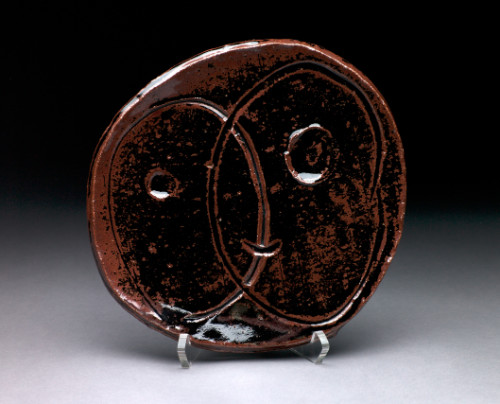
Round plaque with abstracted human face. Accompanied by outer and inner boxes with ink signatures and applied title papers to box.
Human Face Form Plaque
Courtesy of the Harn Museum of Art, Photography by Randy Batista

Human Face Form Plaque

Artist Isamu Noguchi (Japanese/ American, 1904 - 1988)
Date1952
Place of originJapan
MediumShigaraki-type stoneware with applied black iron-oxide glaze
Dimensions9 1/2 x 10 x 7/8 in. (24.1 x 25.4 x 2.2 cm)
ClassificationsSculpture
Credit LineMuseum purchase, funds provided by The David A. Cofrin Fund for Asian Art
Object number2011.38
Collections
Visual DescriptionRound plaque with abstracted human face. Accompanied by outer and inner boxes with ink signatures and applied title papers to box.
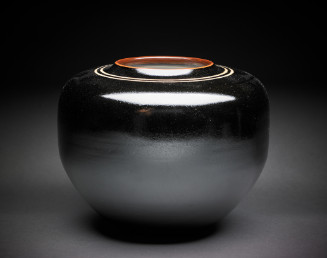
Vase in a flattened globe with circular, linear ornamentation at the shoulder and mouth. Of porcelain with a deep iron-oxide black glaze, the lines on the shoulder carved and inlaid with white glaze that glows gold on the edges.
Miyanohara Ken
Showa Period (1926 – 1989), c. 1968
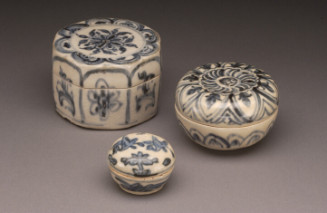
Three white ceramic lidded boxes with blue painted decoration. One is octagonal with floral panels; two are round, featuring radiating and scrolling geometric patterns.
Vietnamese
Le-Mac Dynasty (1428-1682), 16th century
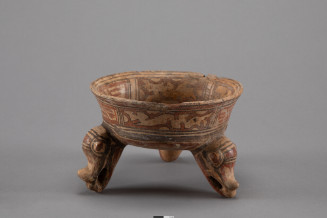
Bowl with slightly rounded bottom curving into wall with slight outward slope and slight flare at rim. Supported by tripod legs formed to resemble animal heads with cranial bulge, protruding eyes at side, tapering to pointy upturned snout with mouth formed by firing slits on sides, rattles inside. Decoration of black bordered red boxes and triangles with jagged "teeth" pointing upward, red and black bands surrounding rim and bottom, with vertical and horizontal lines on legs outlining face circl…
Nicarao Artist
1350-1550
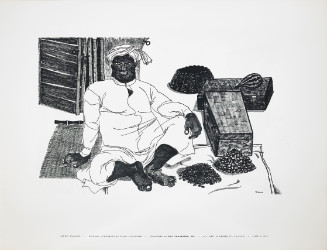
A man seated on the ground, wearing a head covering (turban), with piles of coins next to boxes on a cloth; one of 35 original lithographs in a spiral-bound portfolio.
Franz Altschuler
1954
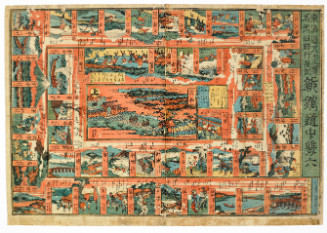
Two paper sheets joined together with multiple boxes overall with different scenes from along the Tokaido Road. This is a game.
Keisai Eisen 渓斎英泉
circa 1840s
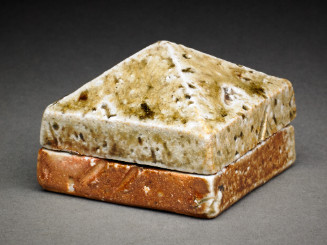
An incense container in the shape of a wayside shrine. Wayside shrine (called Tsuji-do in Japanese) is a general architectural term describing a small and free-standing building.
Takahashi Rakusai III 高橋樂齋(三代)
Showa period (1926-1989)
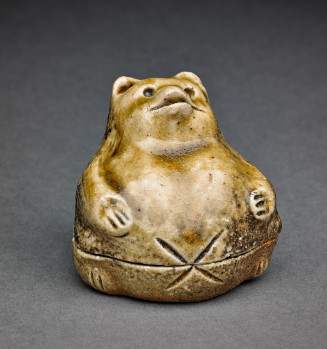
An incense container in the shape of a tanuki, a raccoon-dog.
Takahashi Rakusai IV 高橋樂齋(四代)
Showa period (1926-1989)
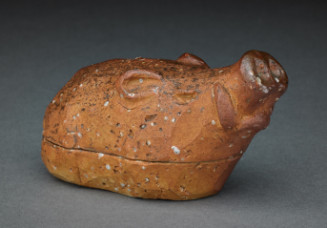
An incense container in the shape of a sitting boar (inoshishi).
Kizu Sozen
Meiji period (1868-1912)
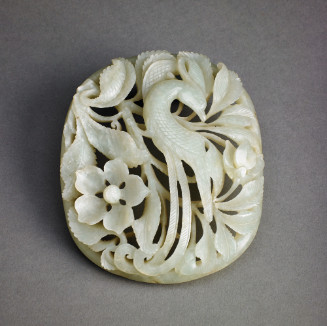
An oval white nephrite plaque, finely cut and pierced with a design of a long-tailed bird with half opened wings and crested head, perched amid the branches of a flowering leafy tree. With a later elaborate wood stand.
Chinese Artist
Ming dynasty (1368-1644)
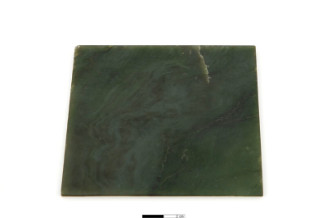
Green plaque with small chip in corner.
Chinese Artist
20th century
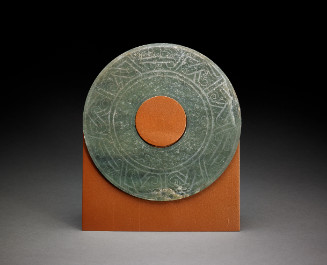
Carved from a light green jade with black inclusions, both sides of the disc are divided into two finely executed concentric decor zones. The inner band contains a grid of low relief curls within elevated hexagonal units, bordered by three "Bucraniums" that embellish the outer band. They stylized dragon forms are fluidly shaped from thick and thin incisions in a curvilinear pattern and separated by incised double brackets. Consistent with the practice of the time, cinnabar was applied to enhance…
Chinese Artist
Han Dynasty (206 BCE-220 CE)
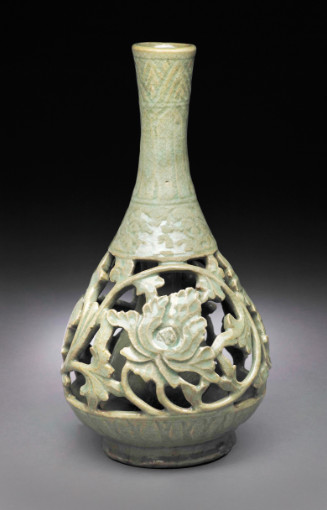
Double-walled vase, the outer wall carved with an openwork floral design. The whole vase covered with a bluish-green celadon glaze.

A rare reticulated 'Longquan' celadon bottle vase, the pear shaped body set with a tall neck carved with flowers and upright leaf lappets, the belly pierced through to the smaller inner vase to reveal on the exterior two elegant peonies borne on an undulating leafy stem, applied overall with an unctuous bluish-green glaze pooling in the recesses, all supported on…
Chinese Artist
Ming Dynasty (1368-1644)
null