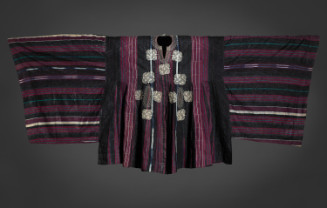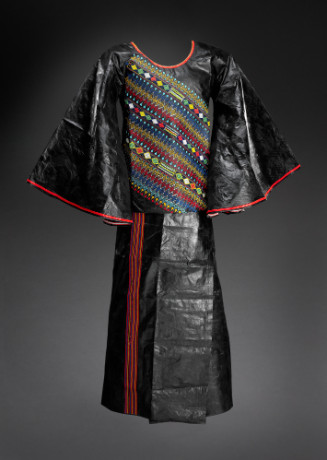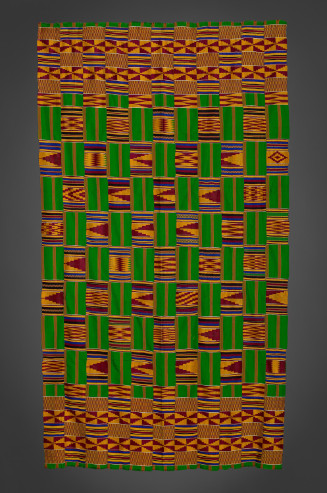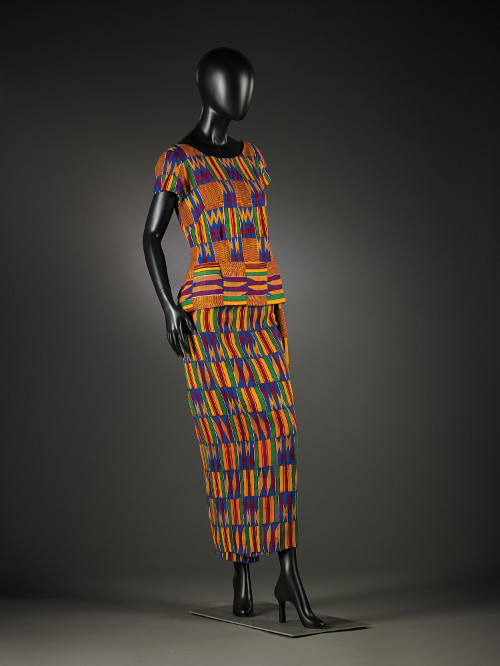
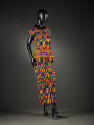
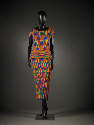
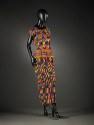
Tunic is tailored, with a scoop neck and short sleeves, fitted at waist then flares to the hips. It is constructed from kente cloth, which is strip-woven with gold, blue, red and green yarns. Strips are sewn together at selvedges.
Kente kaba
Courtesy of the Harn Museum of Art, Photography by Randy Batista

Kente kaba

Artist Juliana Kweifio-Okai (Ghanaian, 1933 - 1993)
DateLate 1960s
Place of originAccra, Ghana
MediumRayon
DimensionsVariable: 22 3/4 × 23 1/2 × 1 in. (57.8 × 59.7 × 2.5 cm)
ClassificationsClothing and accessories
Credit LineGift of Edith François
Object number2015.1
Collections
Visual DescriptionTunic is tailored, with a scoop neck and short sleeves, fitted at waist then flares to the hips. It is constructed from kente cloth, which is strip-woven with gold, blue, red and green yarns. Strips are sewn together at selvedges.
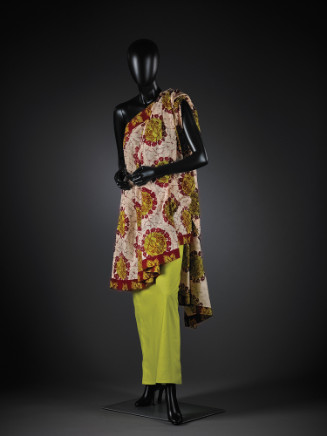
Wax print cloth (commercial cloth) with burgundy and lime green floral motifs, burgundy border around neckline and hem; to be worn with one shoulder exposed; knee length

The Akwadzan is sewn from wax print fabric, likely produced by Ghana Textiles Production, a Ghanaian company that Chez Julie officially collaborated with during the late 1960s and early 1970s.  The background of the wax print is a light shade of coral/salmon, with a repeated medallion pattern of a bird on a branch, surrounded…
Juliana Kweifio-Okai
late 1960s
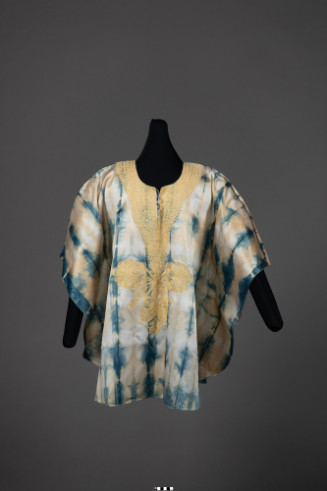
Off white, yellow, and blue tie dye tunic. On model, the garment appears to end right above the upper thigh.
Juliana Kweifio-Okai
c. 1950-1970
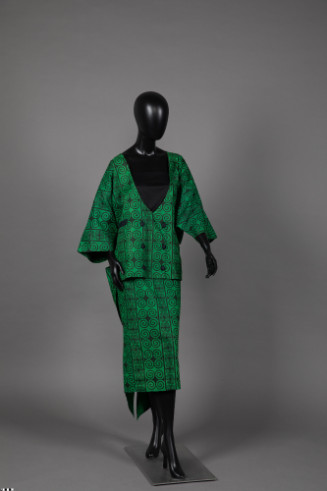
Two-piece suit including a jacket and skirt. The jacket has exaggerated tails and cut-outs which are mirrored by the skirt, which also has tails. This work is green and black.
Juliana Kweifio-Okai
1986
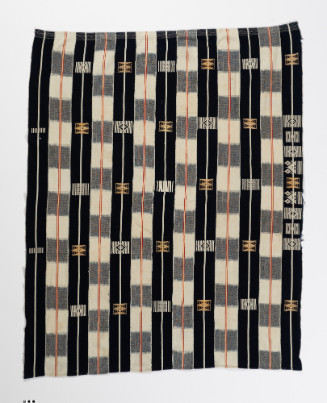
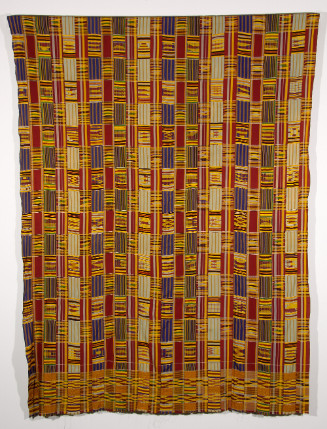
White, blue dominant striped pattern; strip woven cloth hand sewn at selvedges; indigo dyed yarns, and synthetic dyes; red, yellow; machine stitching. Scrolling design on one border with muslin cloth backing.
Senufo Artist
20th century
22 panels, all originally sewn together by hand. Some have been resewn with a sewing machine "zigzag" stitch. Both the warp and weft are rayon. Nine colors of yarn were employed in the making of this piece.
Asante Artist
1920-1940
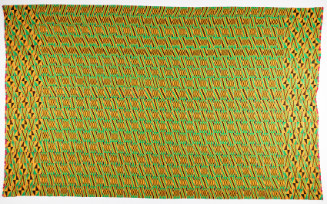
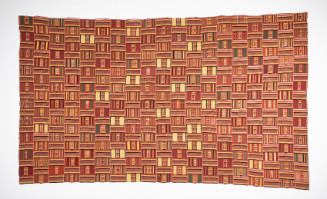
Strip woven cloth hand sewn at selvedges; red, yellow, tan, green and black; warp and weft patterns, some floating weft designs and openwork. Elaborate warp and weft patterns. Weft patterns include hands, fish and geometric abstract motifs that may be identifiable by experts.
Ewe Artist
20th century
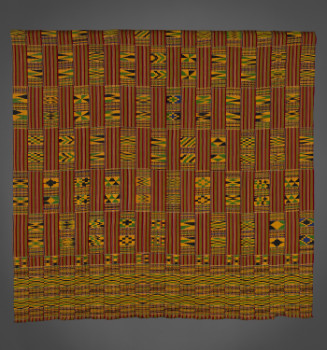
Stripwoven cloth, sewn at selvedges, red, green and gold, 11 weft designs, one warp design
Asante Artist
20th century
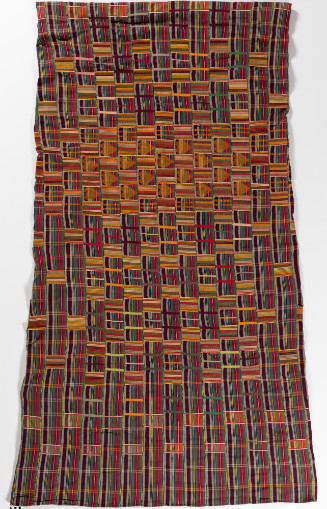
19 panels, all hand sewn. Medium wieght all cotton cloth with orange/gold rayon overshot yarn to fabricate the kola nut leaf motifs. Ten yarn colors were used, in addition to the overshot, with colored warps and wefts creating an additional secondary palette of colors.
Ewe Artist
1940s
A tightly woven cloth; strips sewn together by hand; colors include green, gold, burgundy and black.
Asante Artist
1950-1960s
null