Straight sides, iron red and blue with green enamel dots in "Imari" style.
Bowl
Courtesy of the Harn Museum of Art, Photography by Randy Batista

Bowl

Maker Chinese Artist
DateQing dynasty (1644-1911), 19th century
Place of originChina
MediumPorcelain
Dimensions2 3/8 × 5 × 5 in. (6 × 12.7 × 12.7 cm)
ClassificationsFurnishings and Equipment
Credit LineGift of Dr. Don Q. and Beverly Vining
Object number2016.15.25
Collections
Visual DescriptionStraight sides, iron red and blue with green enamel dots in "Imari" style.
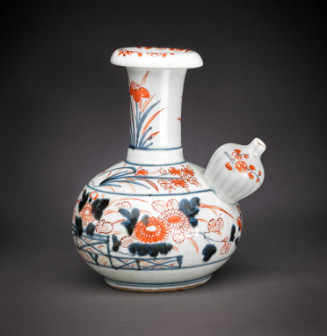
Tall neck with roll-over collar, iron red and blue florals in "Imari" style.
Chinese Artist
Qing dynasty (1644-1911), 19th century
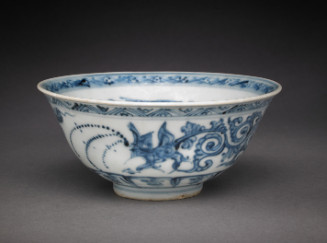
Round deep bowl w slightly everted lip, body flares inward at base to medium ring foot. White clay body, cobalt blue underglaze, clear gloss glaze except base.  Inside:  5 circular parallel lines and 2 on cavetto, one on each side of band of alternating patterns of dots and diaper patterns (triangle work).  Scrollin ribbon w alternating conch-shell symbols and pine needles.  2 lines encircling one dragon w long foliated tail.  Outside:  6 circular parallel lines : 2 near lip serving as upper bor…
Chinese Artist
Ming dynasty (1368-1644)
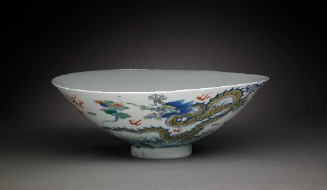
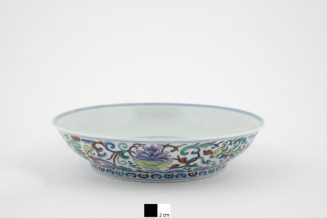
Doucai Bowl with Dragon Design
Chinese Artist
Qing dynasty (1644-1911), Yongzheng reign (1723-1735)
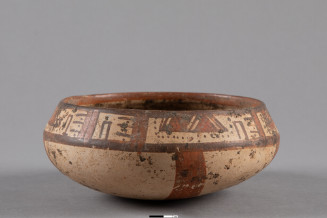
Bowl with rounded bottom curving up into wall, rounding inward at 1/3 height to straight wall with inward slope to rim; upper wall sectioned into panels with black bands around rim and shoulder, panels have biangular motifs surrounded by dots with horizontal hatch marks on side, four large bands of red section bottom into quadrants
Costa Rican Artist
1200-1550
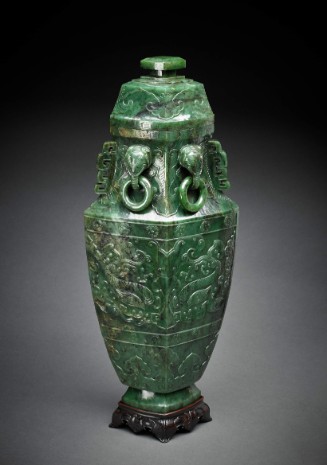
Carved with archaistic motifs
Chinese Artist
19th century
A small, squat white ceramic jar with a short neck. It features blue painted decorations, primarily large dots and a framed panel containing a stylized deer.
Chinese Artist
Ming dynasty (1368-1644)
Interior of dish decorated with design of three phoenixes surrounding a stylized lotus blossom; the exterior also decorated with a band of phoenixes; six-character mark on base.

With shallow rounded sides rising to a slightly everted rim, brightly enameled with a central medallion of three archaistic phoenixes encircling a stylized lotus blossom borne on curling stems repeated in a frieze on the exterior, a border of C-shaped motifs enclosing a dot encircling the foot.
Chinese Artist
Qing dynasty (1644-1911), Daoguang reign (1821-1850)
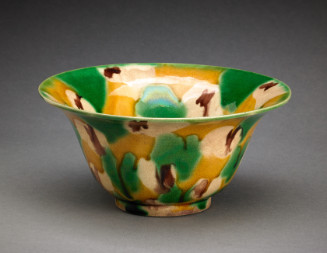
Bowl with sloped sides and striking vivid mustard yellow and green abstractly patterned glaze on interior and exterior. Thinly-potted, with flaring lip, well-formed footring, with minute crackle in glaze overall.
Chinese Artist
Qing dynasty (1644-1911), 18th-19th century
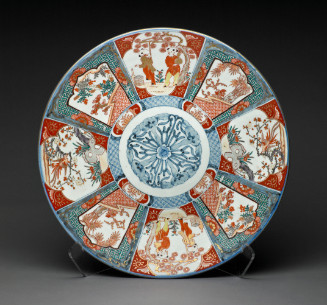
Meiji era; palette and decor standard for Imari ware; four large cartouche areas with figures or birds as focus, and four smaller cartouches with balustrade and flower motifs; charger size and impact of palette always impressive.
Japanese Artist
Meiji period (1868-1912)
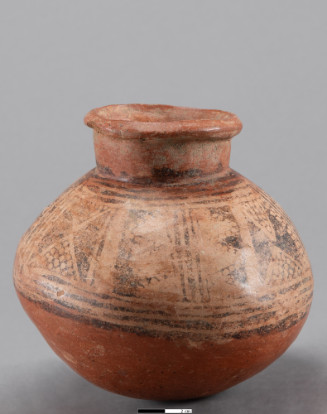
Small globular jar with rounded bottom curving into wall, turning at half height, straight neck with outward flared rim, rounded on exterior. Three-color negative paint with geometric alligators. Brown ware with red slip, upper half of wall painted black with resist pattern in buff - two large panels separated by bordered break, multiple lined border around squares with triangle patterns filled or surrounded with dots.
Diquis Artist
1000-1500
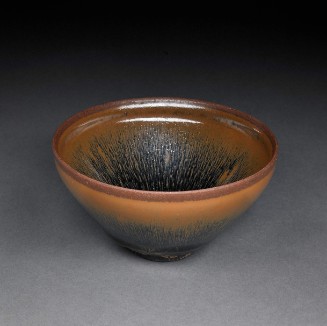
Thickly potted, flaring sides, covered inside and out with a lustrous blackish glaze densely streaked in russet with hare's fur markings falling short in a pooled line above the shallow, circular foot exposing the dark gray stoneware, the indented mouth rim covered with a matte, iron-rich slip.
Chinese Artist
Southern Song Dynasty (1127-1279)
null