
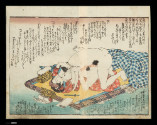
Shunga print
Artist
Japanese Artist
Date19th century
Place of originJapan, Asia
MediumWoodblock print on paper
Dimensions8 1/2 x 11 in. (21.6 x 27.9 cm)
ClassificationsPrints
Credit LineGift of William Knight Zewadski
Object number2022.26.7
Visual DescriptionA shunga woodblock print. Curatorial RemarksShunga 春畫 (spring pictures) is one of the subgenres of ukiyo-e 浮世絵, pictures of the floating world. It was a natural outgrowth of Japanese society in the Edo period (1603-1868) when sex industry and entertainment culture flourished in burgeoning urban centers to cater to the increased male migrants that greatly outnumbered female residents. Known for its explicit depictions of sexual imagery, shunga was a popular commodity enjoyed by both men and women of all social classes, as sex has long been regarded as a natural and enjoyable experience in Japanese culture. Created in the woodblock print medium, the most popular art form in Edo Japan, shunga prints often portray couples, mainly urban commoners, engaging in explicit sexual activities in sometimes comical or even satirical ways. Nudity was not itself considered erotic in this type of works because nude bodies were commonly seen in mixed communal baths at that time. Instead, clothing helps to identify the subject’s gender and social status and draw attention to the exposed body parts. Genitals are typically exaggerated, partly a fantasy, partly for better visibility in a small-sized print. Objects with symbolic significance are also featured in shunga prints. For example, plum blossoms represent virginity, and bonsai trees are indications of a male’s erect penis. Although the Tokugawa Shogunate repeatedly censored sexual content in ukiyo-e after 1722, shunga continued to be made by almost all the leading ukiyo-e artists, such as Utagawa Kuniyoshi 歌川國芳 (1798-1861) and Utagawa Kunisada 歌川國貞 (1786-1865), who are both represented in the Harn’s collection. It was not until the 1850s, when Christian beliefs surrounding moral shame and stigma about sex were introduced to Japan, that attitudes towards the explicit depiction of sex changed from tolerance to banishment. Shunga was suppressed during the Meiji period (1868-1912) and has remained a sensitive subject in Japanese society since then.