White cloth strip with pile weave central panel and fringed ends.
Baby wrapper
Courtesy of the Harn Museum of Art, Photography by Foad Seyed Mohammadi

Baby wrapper

Artist Bernice Olufemde of Iyere, Nigeria
Date1973
PurchasedOwo, Ondo, Niger, Africa
Place of originOwo, Ondo, Nigeria, Africa
MediumCotton, bast
DimensionsOverall: 12 in. x 519 ft. 7 in. (30.48 cm x 158 m 36.93 cm)
ClassificationsClothing and accessories
Credit LineGift of Robin and Donna Poynor
Object number2023.30.11
Collections
Visual DescriptionWhite cloth strip with pile weave central panel and fringed ends.
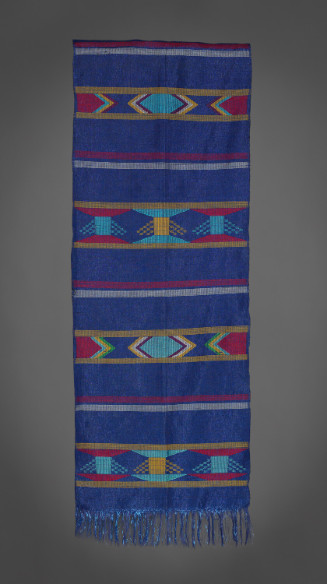
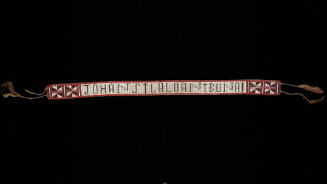
Rectangular strip; woven glass beads; white ground, red edges; "JOHANS LALOAN BUNAI" in black; blue and black pinwheel panels at ends; cord ties with tassels; tan canvas backing
Papua New Guinea
undated
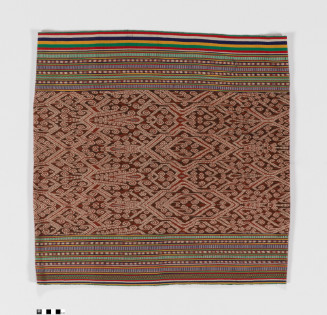
Woman's sarong- rectangular strip hand sewn at ends to form tube; ikat-dyed cotton; main panel- red, brown and white geometric design of diamonds and teardrop shapes with curlicues everywhere; horizontal bands top and bottom of commercial red, green, blue, and yellow threat with ikat stripes between; Iban, Sarawak; 1963; just starting to go out of style as daily clothing and being reserved for fancy dress
Iban Artist
1963
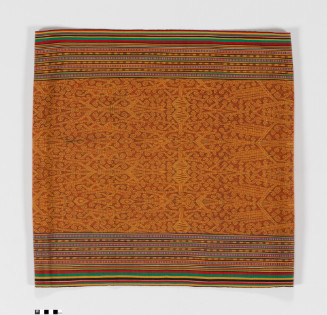
Woman's sarong- rectangular strip hand sewn at ends to form tube; ikat-dyed cotton; main panel- red, yellow, and black design of voided diamonds and teardrop linked with flecked diagonal lines, all with curliques; occasional diamond centers of grey (blue dye over yellow); border bands of commercial red, yellow, green, blue, and black thread with ikat stripes between
Iban Artist
no date
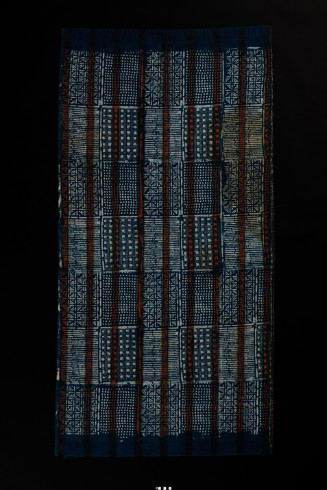
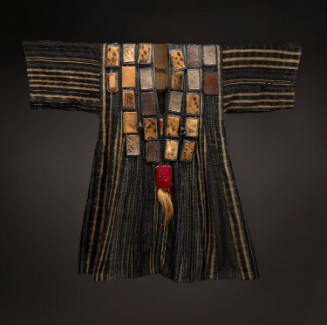
Striped commercial cloth with stenciled geometric patterns of blue, red and white.
Yoruba Artist
1973
A long sleeve caftan/dress sewn from strips of wax print fabric likely Chinese imports and Woodin (a company that locally produces fabric in Ghana).  The bodice of the caftan features horizontal strips, whereas the skirt of the dress relies on vertical strips.  Each strip is formed from a mixture of long strips of fabric, interspersed with small squares of fabric.  The caftan includes a designer label, which states: “Cloth on cloth designs by Tei Huagie, made in Ghana”.
Tei Mensah Huagie
2000
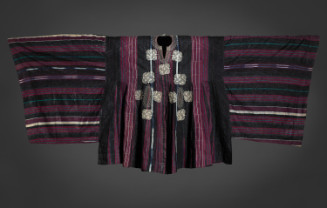
Black cotton dyed gauze bands (possibly medical strips?) with hand embroidery. Neck opening shaped by middle band being cut to make opening. Chain stitched embroidery covering cloth in red, yellow, orange, white and green (colors faded). Thin cotton border in white all around garment.
Wodaabe Artist
late 20th century
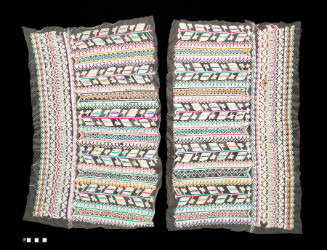
White openwork cloth (mesh) with polychrome overstitching/embroidery with floral motifs in green, orange, turquoise, black and pink on white background and center strip of blue, black and red stripes; rows of zigzags on cuffs.
Tunisian Artist
late 20th century
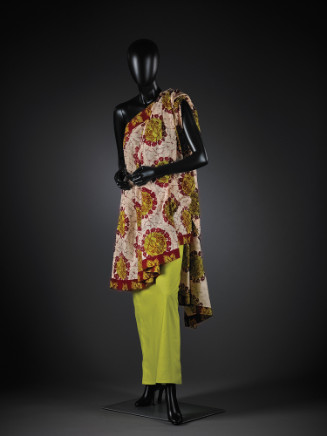
Wax print cloth (commercial cloth) with burgundy and lime green floral motifs, burgundy border around neckline and hem; to be worn with one shoulder exposed; knee length

The Akwadzan is sewn from wax print fabric, likely produced by Ghana Textiles Production, a Ghanaian company that Chez Julie officially collaborated with during the late 1960s and early 1970s.  The background of the wax print is a light shade of coral/salmon, with a repeated medallion pattern of a bird on a branch, surrounded…
Juliana Kweifio-Okai
late 1960s
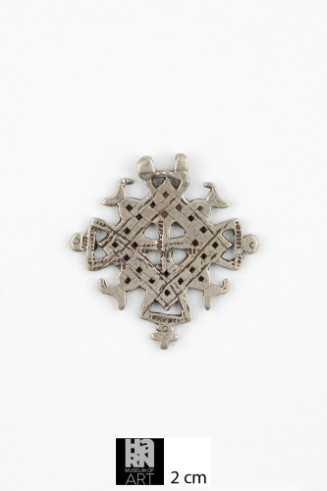
Solid silver cross with equilateral arms; has a central diamond shape that has a pierced cross shape in the center and an incised design of pierced squares and incised lines; the ends of the arms extend beyond the diamond; on the outer rim of the diamond are four finial bird shapes, a pierced crown shape with a half-circle on both ends of the shorter arm, and a cross shaped finial on the lower end of the superior arm; superior arm has a ring for suspension; signs of wear
Ethiopian Artist
undated
null