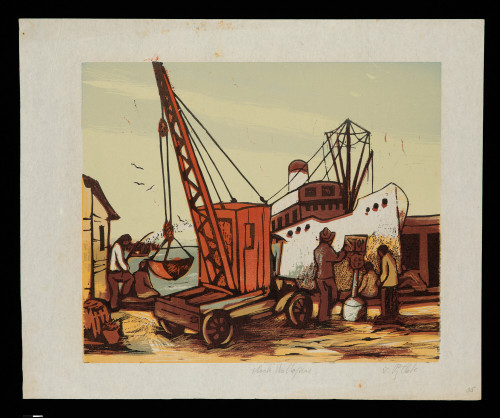
Scene of a boatyard with drydock ship, men working with heavy equipment found around shipyards.
Dock Wallopers
Courtesy of the Harn Museum of Art, Photography by Foad Seyed Mohammadi

Dock Wallopers

Artist Leonard Pytlak (American, 1910-1998)
Publisher/Publishing House Works Progress Administration - Federal Arts Project (1935 - 1943)
Date1936-1943
MediumColor woodcut
Dimensionssheet: 14 7/8 x 18 1/8 in. (37.8 x 46 cm)
image: 11 3/4 x 14 1/8 in. (29.8 x 35.9 cm)
ClassificationsPrints
Credit LineGift of Dr. and Mrs. Corbin S. Carnell, in memory of E. Muriel Adams.
Object number1992.11.113
Collections
Visual DescriptionScene of a boatyard with drydock ship, men working with heavy equipment found around shipyards; earthy colors- ochre, sienna, amber, green and white.
Color print of a dock with an orange truck-mounted crane with a suspended bucket. A large white and brown ship is moored in the background. Several figures stand around the dock, one beside a "STOP" sign.
Leonard Pytlak
c. 1939-1940
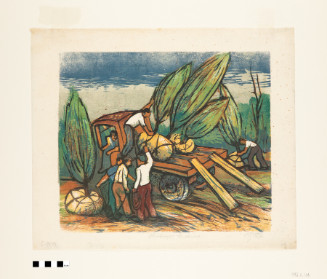
Men are working to unload trees that have their roots bundled off a truck bed and are placing them in a landscape.
Leonard Pytlak
c. 1936-1941
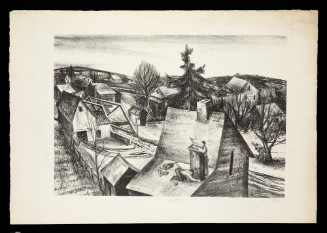
Men are working to fix a chimney on a roof; scattered barns and houses describe a rural area with deciduous and evergreen trees in hilly terrain.
Leonard Pytlak
1936-1943
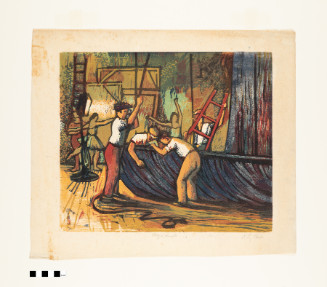
In the foreground, men work backstage to hoist a curtain while dancers (female and male) practice in the background. One man holds a red ladder.
Leonard Pytlak
c. 1936-1941
Uptown
Leonard Pytlak
c.1935
Bonfire
Leonard Pytlak
c.1935
Quick Lunch
Leonard Pytlak
c.1935
Five-Thirty
Leonard Pytlak
c.1935
Looking Underground
Leonard Pytlak
1935-1942
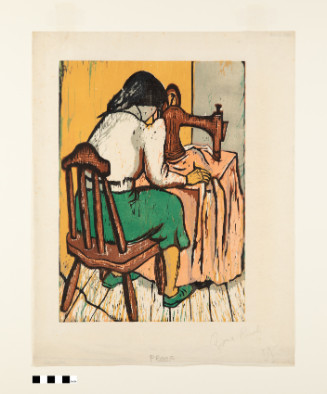
A woman is sitting at a sewing machine working; colors are ochre, brown, black, green, flesh and grey.
Rosa Rush
c. 1935-1943
Portrait of a woman in abstract color and high value, black, grey, olive green, ochre, sienna inks.
Richard Steinmetz
1976
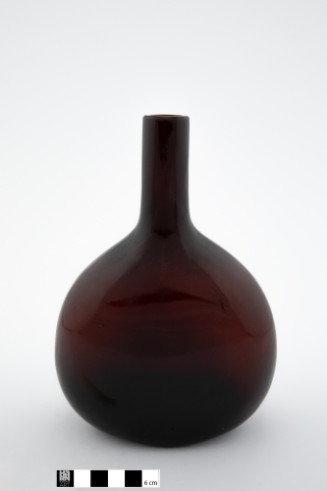
The translucent, deeply colored amber colored glass imitates the dark amber found in nature. The walls of the vase are thickly formed with swirling striations that are typical of the period. A slight crizzling is evident on the inner surface of the vase and may also be seen on the exterior surface.
The body of the vase is of a flattened circular form with a tubular neck and finished with a beveled lip. Unpolished grinding marks about the shoulders of the vase are evidence of the carving process…
Chinese Artist
Yongzheng Period (1723-1735)
null