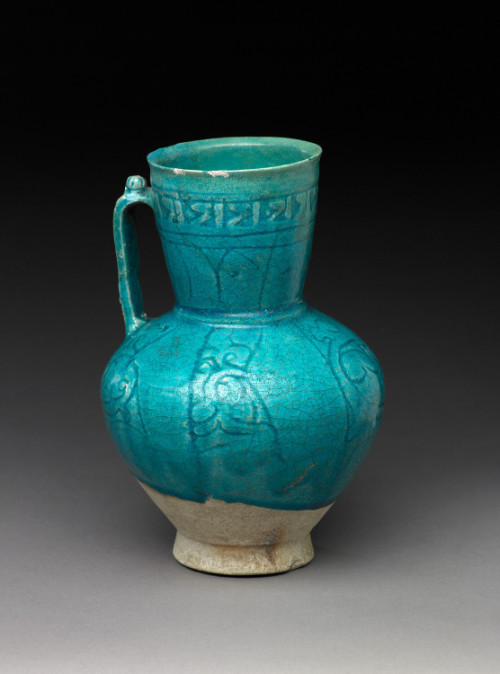
A bright turquoise-glazed ceramic pitcher with a single handle, flared neck, and rounded body. Faint relief carvings decorate the neck and body. The glaze stops unevenly near the bottom, exposing an unglazed tan base.
Jug or Ewer
Courtesy of the Harn Museum of Art, Photography by Randy Batista

Jug or Ewer

Maker Iranian
DateSeljuk period, 12th-13th century
Place of originIran, Asia
MediumEarthenware
Dimensions8 5/8 x 6 x 6 in. (21.9 x 15.2 x 15.2 cm)
ClassificationsFurnishings and Equipment
Credit LineMuseum purchase, gift of Dr. and Mrs. David A. Cofrin
Object number1994.5.2
Collections
Visual DescriptionA bright turquoise-glazed ceramic pitcher with a single handle, flared neck, and rounded body. Faint relief carvings decorate the neck and body. The glaze stops unevenly near the bottom, exposing an unglazed tan base.
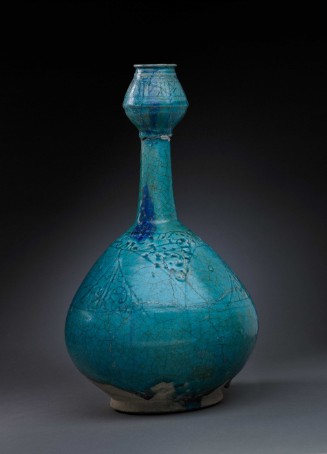
A bulbous ceramic bottle with a tall, slender neck and an angular, flared mouth. It features a bright turquoise glaze with a dark blue drip near the neck. The glaze ends unevenly above a plain, unglazed base.
Iranian
Seljuk period (12th - 13th century)
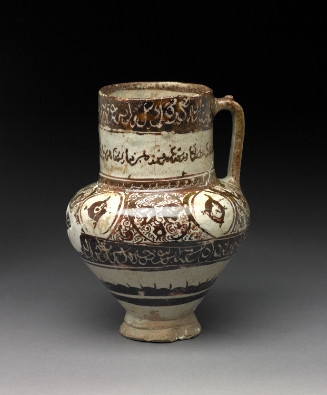
A ceramic pitcher with a side handle, wide cylindrical neck, and bulbous body tapering to a small base. It features horizontal cream, brown, and black bands decorated with intricate scrolling patterns, large circular motifs, and Persian text.
Iranian (Kashan)
Seljuk period, 13th century
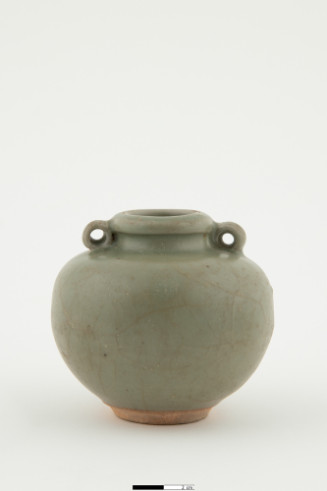
Small, bulbous, grey-green ceramic vessel with two small loop handles on opposite sides of a short neck. The glaze stops just above a reddish-brown, unglazed circular base.
Chinese Artist
Ming dynasty (1368-1644)
A footed ceramic bowl with off-white glaze and dark brown decorations. Large script-like markings encircle the exterior. The interior features a wide, densely patterned band punctuated by circular motifs near the rim.
Iranian (Kashan)
Seljuk period (13th century)
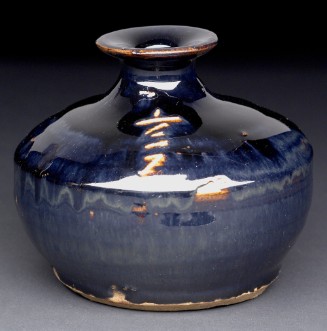
 A squat ceramic vessel with a narrow neck and flared rim, covered in a glossy dark blue glaze. The glaze thins near the base, exposing unglazed brown clay. Chinese characters of "Xian" and "Yan" are inscribed on the shoulder of the bottle.
Chinese Artist
Yuan Dynasty (1279-1368)
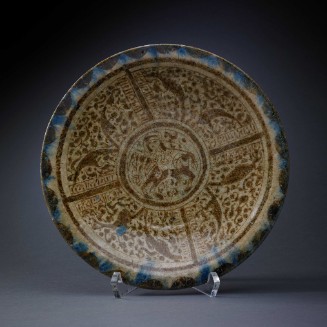
A round ceramic plate on a clear stand. The tan surface is decorated with intricate brown designs, featuring a central stylized creature. Six radial sections contain abstract leaf-like shapes, bordered by a dashed blue and brown rim.
Iranian (Kashan)
Seljuk period (13th century)
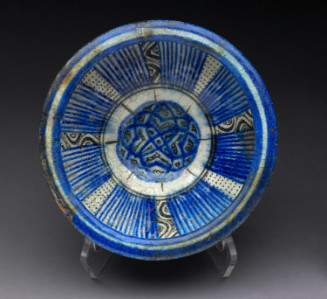
vertical stripe pattern inside and out
Iranian
13th-14th century
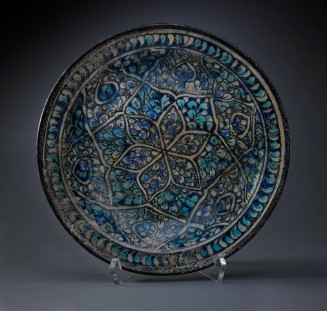
geometric tile pattern
Iranian
13th-14th Century
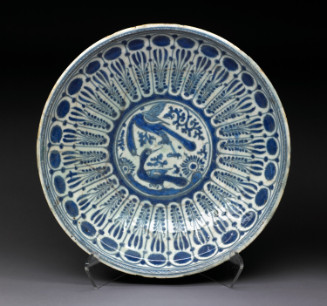
A round blue and white ceramic plate on a clear stand. The central medallion features an abstracted bird design, surrounded by a wide band of radiating, elongated floral shapes. The outer rim is decorated with solid blue ovals.
Iranian
Timurid period (1370-1506)
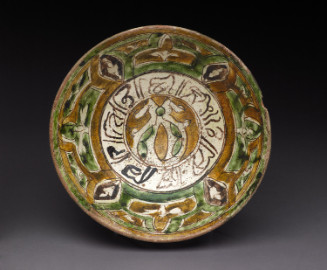
Top-down view of a ceramic bowl. Its white interior features a central abstract motif, encircled by a band of dark Arabic script. The wide border is decorated with a geometric and leaf-like pattern in green, yellow-brown, and black.
Iranian (Nishapur)
Abbasid period (ca. 9th - 10th century)
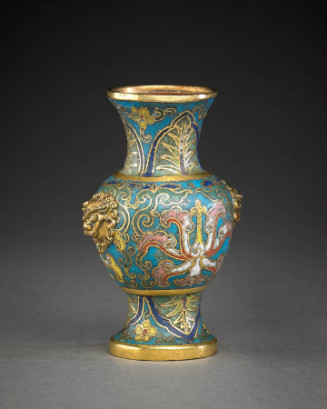
A fine miniature cloisonné enamel vase of baluster form, the rounded body set with two high relief gilt-bronze mask handles and decorated with lotus flowers and leaves, the tall flared foot decorated with flower heads and leaf lappets, the tall flared neck similarly decorated. All enameled in red, yellow, white, light and dark green, pink, and lapis blue on a turquoise blue ground.
Chinese Artist
18th Century
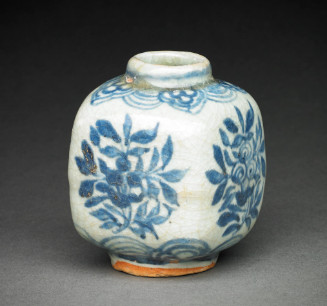
Underglaze blue, thick crackle celadon glaze, each of four sides with floral design, neck and base above foot with waves, unglazed and shaped foot ring and base exposing red-burning clay.
Vietnamese
15th-16th century
null