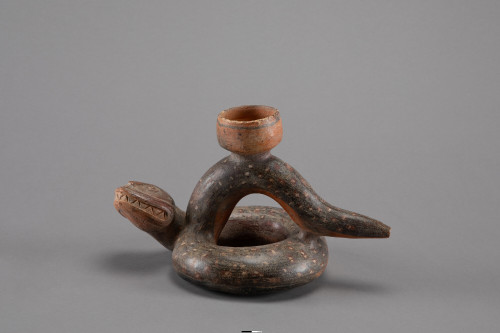
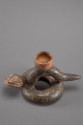
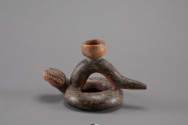
Vessel in form of coiled serpent, with tail looped over one coil of body, end extending opposite head, wide triangular head with broad mouth open showing clenched triangular teeth, circular eyes and nose ridge on top of head, small globular cup on top of tail loop, opening into hollow body.
Serpent cup
Courtesy of the Harn Museum of Art, Photography by Foad Seyed Mohammadi

Serpent cup

Maker Inca Artist
Date1400–1530
Place of originPeru, South America
MediumCeramic with pigments
Dimensions6 5/8 x 11 x 6 in. (16.8 x 27.9 x 15.2 cm)
ClassificationsFurnishings and Equipment
Credit LineMuseum collection, University Gallery purchase
Object numberC-74-3
Collections
Visual DescriptionVessel in form of coiled serpent, with tail looped over one coil of body, end extending opposite head, wide triangular head with broad mouth open showing clenched triangular teeth, circular eyes and nose ridge on top of head, small globular cup on top of tail loop, opening into hollow body.
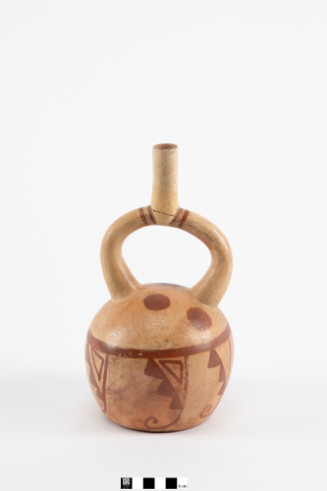
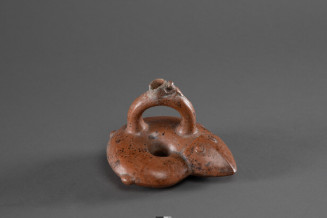
Vessel in form of fish with flattened tubular body, shaped in a loop with tail attached to side of triangular head, small round eyes sit close together on top of head with center ridge, crescent mouth incised underneath head with teeth depicted, stirrup loop rises from back, spout broken off with small monkey at joint.
Inca Artist
1400-1530
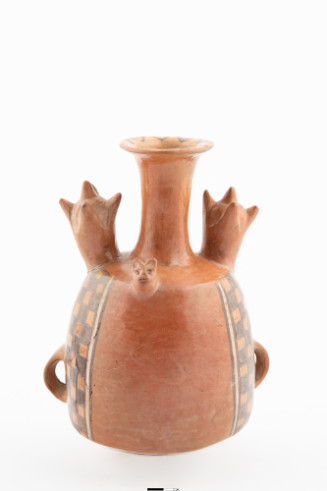
Jar in shape of a shell with rounded bottom curving to a flattened peak in center, walls rise with slight inward curve, angling steeply inward at two-thirds height to base of long tubular neck with flared rim, two small loop handles near bottom, attached spikey clubs on upper wall with small feline head attached in between; burnished light brown slip with dark brown pigment painted in zigzag around interior of rim, two large vertical panels of checker-board motif, placed in front of handles, bor…
Inca Artist
1450 - 1530
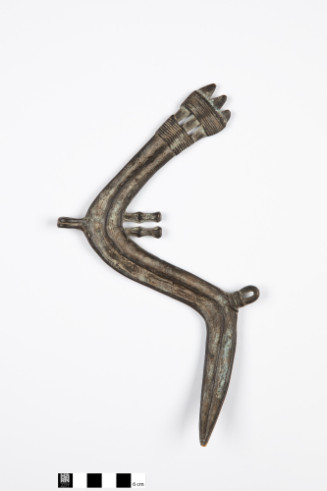
Two or three headed serpent form, made of a plate with raised lines in shape of a stretched out N, with splayed ends; areas on the ends have twisted wire wrapping in two sections. Two knobs on the large inside curve, and a loop on the opposing side, similar loop on the top of the tail end. Color varies from silvery to bronze; surface has whitish patina and material appears to be a lost-wax casting using cuprous metal.
Lobi Artist
20th century
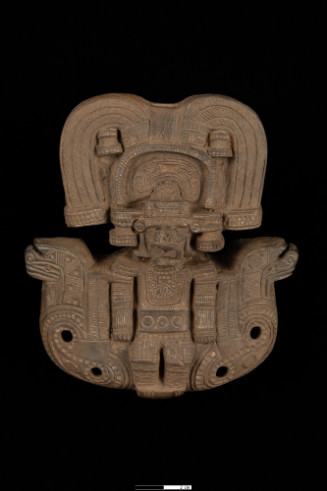
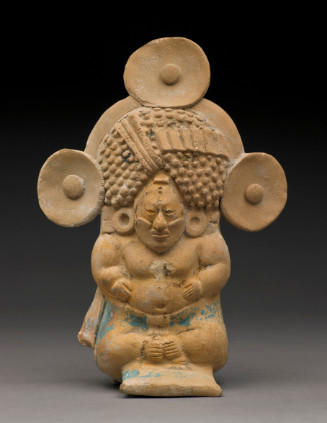
Mold-made hollow figurine of fat male, possibly a dwarf, sitting cross-legged with hands placed on abdomen, wears shirt with long loin cloth extending underneath legs. Large ear spools, huge headdress covered with small clay pills, lateral crest ridge with three large disks at top and sides, whistle in back bottom. Yellow pigment on upper face and body, blue pigments on shirt and loin cloth.
Maya Artist
700-950
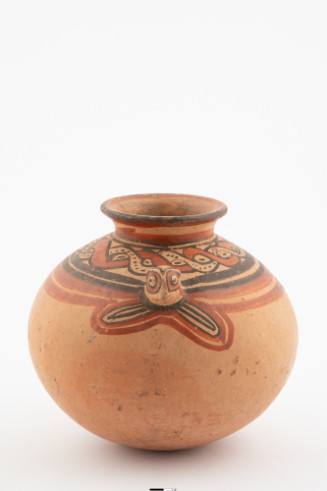
Globular jar with hemispherical bottom curving up into wall, smoothly curving inwards at 1/2 height to neck with outward flaring rim attached animal head to side of upper wall, oblong head with pointy snout, small raised circles for eyes and ears.

Black and red bands around rim and neck, entwined ropes, serpents motif on panel below neck, bordered by 2 wide black lines on bottom then 2 wide red lines red and black almond circles painted around eyes of head two wings or legs extending diagonal…
Costa Rican Artist
1200-1550
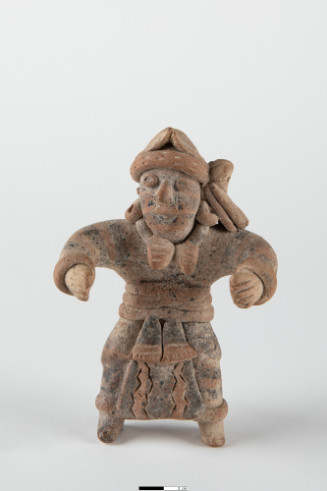
Standing male figure with arms held out as in an embrace wearing long skirt with wrapped sash that hangs in front ending in tassels, has small triangular "tail", shell like object protruding from middle of upper back, conical headdress with small peak in front, animal skull hanging from sash on right side of head.   Face painted in horizontal black stripes arms and legs painted in black stripes skirt and sash painted with black to correspond to pattern inscribed of zig zag bands
Mexican Artist
100-200
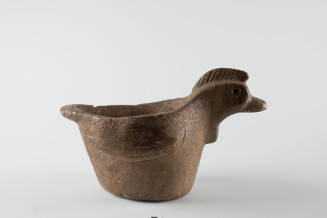
Stone bowl, flat bottom, circular, with walls sloping slightly outwards, effigy form of duck with crescent extension on rear rim for tail, raised panels shaped as wings wrap around upper side, head extending from front with rounded beak, drilled eye-holes, feather crest on head; carved lines delineating wings and tail, circling eyes, feather ridge, mouth opening.
Mississippian Artist
1000-1300
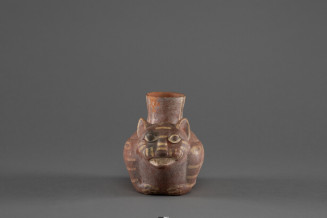
Urn in the shape of a crouching jaguar - flat bottom, basically round body with front and back legs slightly raised, swelling of shoulder, large feline head with teeth bared, separation line from effigy to dome over back with tall spout, flaring towards rim, red slip with yellow painted as stripes on legs, tail and face, ellipses in yellow on body, eyes bordered with yellow, teeth yellow, edges of eyes, three groupings of three vertical yellow lines on spout.
Moche Artist
200-300
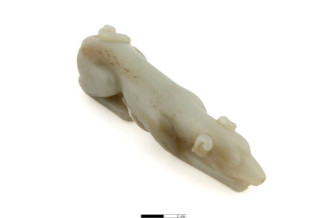
Carved as an elongated hound lying with its head resting between the out stretched front legs, the spine and folds on either side of the body articulated with delicate lines and ridges ending to the rear with a coiled tail, the underside  with well-carved details depicting the paw.
Chinese Artist
Ming dynasty (1368-1644) or earlier
null