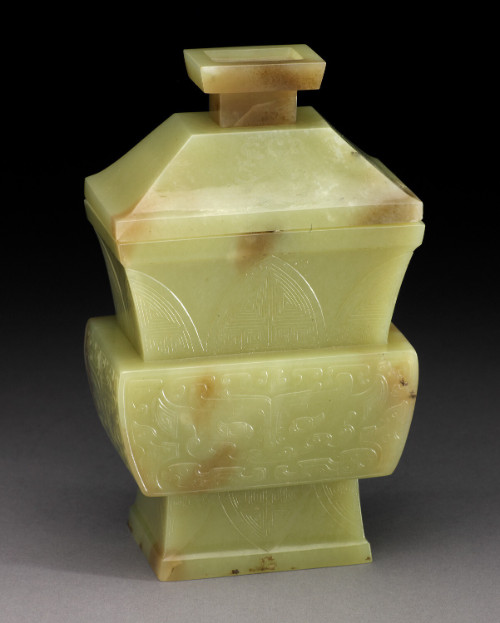
Of fang-gu form, the central section, well carved on each rounded side with a taotie mask, between leaf tip blades infilled with dense geometric motifs, the fitted, angled cover with rectangular knop, the stone of greenish yellow with splashes of taupe
Vase and Cover
Courtesy of the Harn Museum of Art, Photography by Randy Batista

Vase and Cover

Artist Chinese Artist
DateQing dynasty (1644 - 1911), 18th century
Place of originChina
MediumNephrite
Dimensions6 1/2 in. (16.5 cm)
ClassificationsFurnishings and Equipment
Credit LineBequest of Dr. David A. Cofrin
Object number2009.48.205
Collections
Visual DescriptionOf fang-gu form, the central section, well carved on each rounded side with a taotie mask, between leaf tip blades infilled with dense geometric motifs, the fitted, angled cover with rectangular knop, the stone of greenish yellow with splashes of taupe
Bowl and Cover
Chinese Artist
late 19th- early 20th century
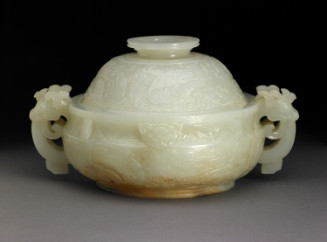
The bowl carved in archaistic style on each side with broad taotie masks on a leiwen ground, divided by dragon heads issuing loop handles, the domed cover with matching motif below a stepped knop, the thick white stone with a pale cloudy amber patch in the interior of the bowl
Chinese Artist
Qing dynasty (1644 -1911), 18th century
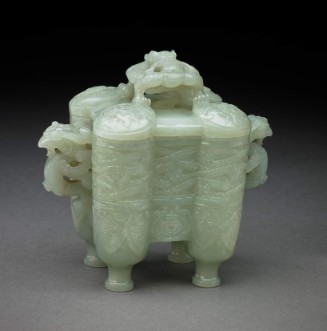
Well-hollowed with columnar corners and well-carved around the exterior with a wide band of numerous thin dragons, their finely incised scaly bodies intermeshing around the sides, above archaistic pendant leaves around the rounded corners, tapering sharply to the hollowed pad feet, two side with a ji character, the other two side with winged phoenix-form handles, the fitted cover of conforming shape with a central reticulated dragon-form knop, the claw on and extending to the four corners, the g…
Chinese Artist
Qing dynasty (1644-1911), 18th century
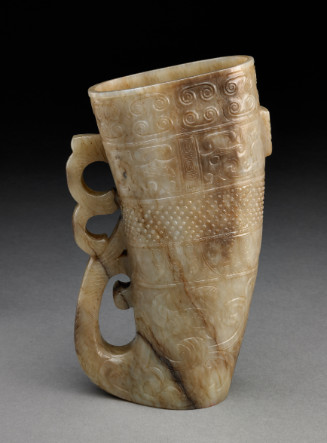
The well hollowed vessel carved in shallow relief with four bands of archaistic designs, including confronted C-scrolls, taotie masks separated by a taotie mask carved in high relief, bosses and mask-filled blades, all divided by rope twist borders and positioned above a phoenix and a dragon confronted on a vertical, keyfret band with a scrolling bird-like tail rising off center up one side from a pattern of intertwined swirls carved in a flat base, the stone of pale grayish brown color suffused…
Chinese Artist
Ming dynasty (1368-1644)
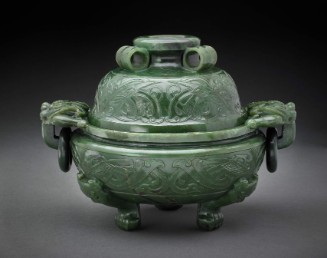
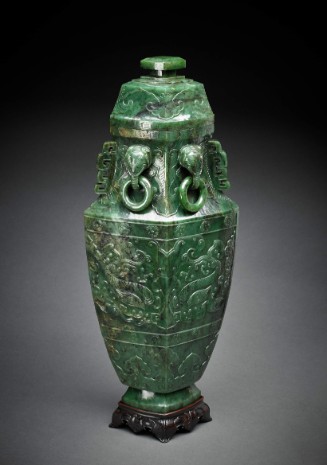
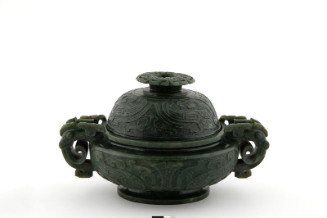
Raised on three monster mask and claw feet, well carved around the sides with three spaced foliate masks, interrupted by two horned monster mask handles suspending loose rings, the fitted, domed cover with matching decoration, encircling the hollowed ring knop with three tubular tabs, the dark green stone with typical black inclusions and white rivering.
Chinese Artist
18th-19th century
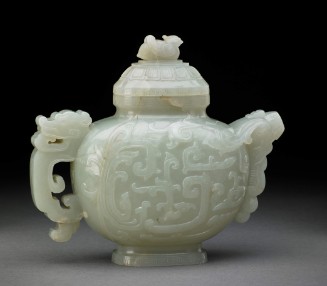
Of oval section, carved overall in low relief with bands of archaistic kuei dragons and keyfret, flanked by the thick handle and spout further carved as archaistic kuei, the domed cover decorated with pendant leaves surmounted by a quail-form knop, one body fissure
Chinese Artist
Qing dynasty (1644 -1911), 18th century
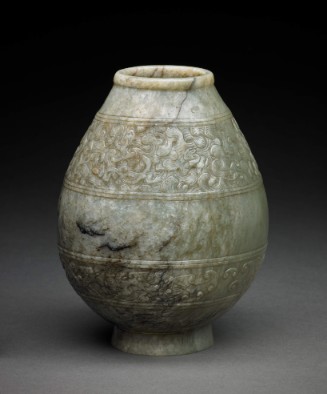
Of swelling ovoid form, decorated with dense frieze of numerous mythical animals interweaving amid interlocking scrollwork, above a further smaller band of hooked scrolls, volutes and masks, the greenish gray stone suffused with white and black rivering overall.
Chinese Artist
Qing dynasty (1644 -1911), 17th-18th century
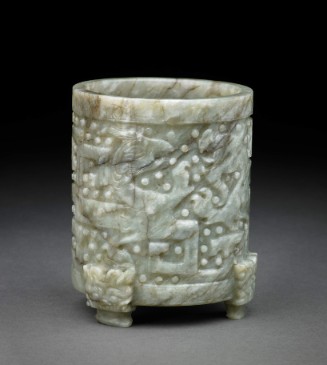
With upright cylindrical sides raised on three monster mask feet, carved on one side with a broad taotie mask flanked by an angular strapwork dragon and phoenix confronting on the reverse, between bands of archaistic motifs, the gray stone striated with deep brown and gray
Chinese Artist
18th-19th century or later
Carved with archaistic motifs
Chinese Artist
19th century
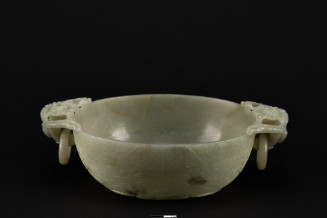
Well carved around the sides in low relief with a dense frieze of foliate blooms and furled leaves, issuing from a collar of petals encircling the base, forming a ring foot, the underside with a flowerhead, set with two flowerhead-form handles suspending loose rings, the interior center with a flowerhead, the greenish white stone striated with gray, minor chips.
Chinese Artist
Qing dynasty, 18th-19th century
Green vessel and lid carved with archaistic taotie marks, with two animal head handles.
Chinese Artist
Qing dynasty (1644 -1911), Jiaqing reign (1796 -1820)
With the hind legs and front left leg folded under the body, and the right front leg flexed as the creature prepares to rise, the tail colored around to rest on the left haunch, the belly and neck faintly ribbed to indicate folds, the head facing forward with well-defined horns above ears delineated with fine incising, the greenish-gray stone with pale mottling.
Chinese Artist
Qing dynasty (1644 -1911)
null