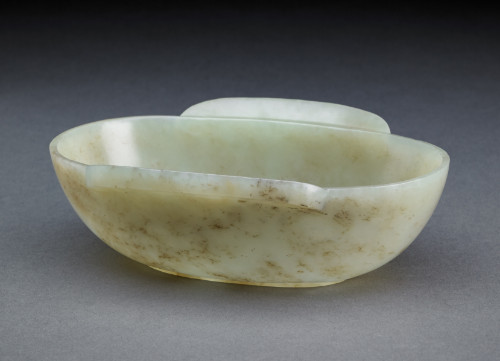
This ear cup reflects the Song period's profound interest in history in its characteristic design found in jades of the late Han period (206BC-AD220). The thinly worked oval cup has two flat handles projecting just below the rim at the longer sides, resting on an oval base with a raised foot ring. The highly translucent yellow jade possesses darker russet brown inclusions creating a desirable "skin" throughout the cup. The ear cup is of a fine, smooth polish. In our opinion, this ear cup is a fi…
Ear Cup
Courtesy of the Harn Museum of Art, Photography by Randy Batista

Ear Cup

Artist Chinese Artist
DateQing dynasty (1644-1911) or later
Place of originChina, Asia
MediumJade (nephrite)
Dimensions1 7/16 x 3 5/16 x 4 1/4 in. (3.7 x 8.4 x 10.8 cm)
ClassificationsFurnishings and Equipment
Credit LineBequest of Dr. David A. Cofrin
Object number2009.48.187
Collections
Visual DescriptionThis ear cup reflects the Song period's profound interest in history in its characteristic design found in jades of the late Han period (206BC-AD220). The thinly worked oval cup has two flat handles projecting just below the rim at the longer sides, resting on an oval base with a raised foot ring. The highly translucent yellow jade possesses darker russet brown inclusions creating a desirable "skin" throughout the cup. The ear cup is of a fine, smooth polish. In our opinion, this ear cup is a fine archaistic example of Song dynasty workmanship and design.
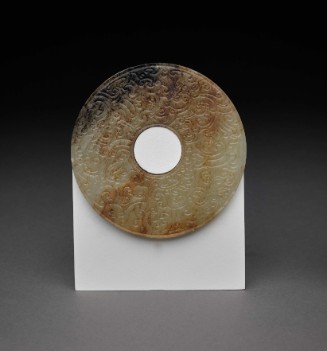
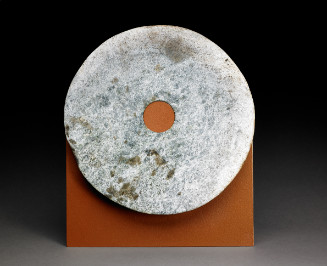
This large bi disc has been meticulously worked with a subtle concave rim rarely seen on bi discs of this size. Small circular bracelet-form jades from recent Liangzhu excavations show edges which are slightly concave in shape. This suggests an original bone-derived stylistic element. Although these wearable jades with concave edges are more frequently seen, this bi example of large size is most unusual. The surface of the bi disc is highly polished, and there has been much attention to both sha…
Chinese, Liangzhu culture
Neolithic period or later
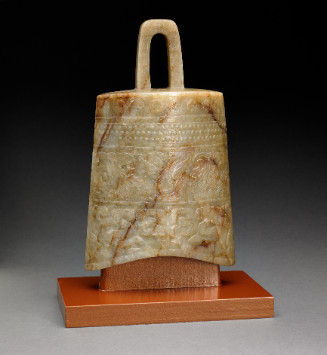
Bell is divided into sections which are reminiscent of the piece-mold technique of seaming the elements of the bronze bells together, seen on this jade bell as design elements. This archaistic bell is of greenish-gray jade with russet inclusions. In our opinion this archaistic bell expresses the refinement of design and technical workmanship of the late Song to early Ming period.
Chinese Artist
Song Dynasty (960-1279) or later
Disc with Cloud Pattern
Chinese Artist
Eastern Zhou dynasty (770-256 BCE)
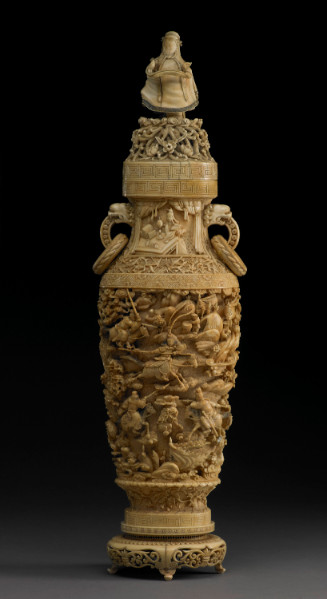
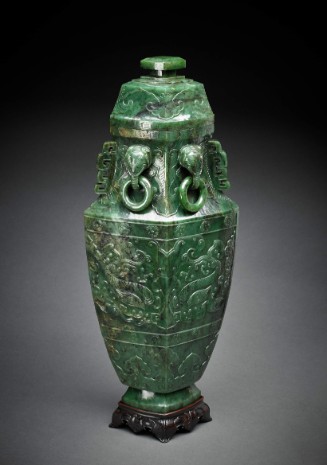
Vase with Scenes from the Novel Sanguo Zhi
Chinese Artist
Qing dynasty (1644-1911), late 18th century
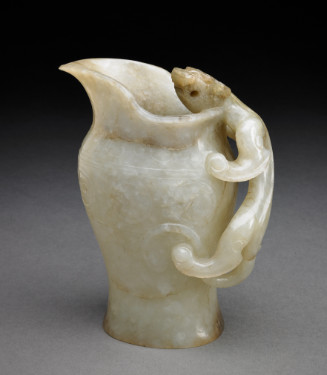
An oval vase-shaped ewer with curved spout elegantly carved from translucent jade. The mottled white material has greenish-gray tones and inclusions. The handle is carved aways from the cup in the sculptural from of a chih dragon with turned head clutching the rim. The dragon has a raised spine, spiraling articulations, and stylized wings on the thighs and shoulders.
Chinese Artist
possibly Ming Dynasty (1368-1644)
Carved with archaistic motifs
Chinese Artist
19th century
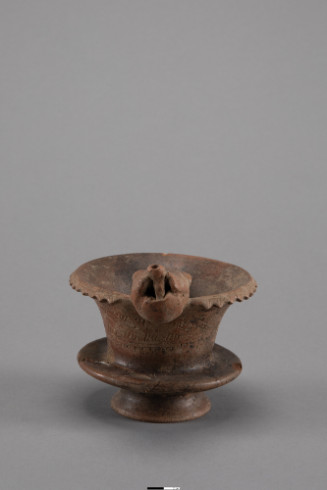
Cup with outward flaring base ring, wide saucer-like bottom gently curved on underside, flat on top - horizontal ring of 3/4" to wall of cup with gradual outward slope, wide flare of rim, small notched pattern in lower edge of rim, interior smooth with rounded bottom; brown ware with red slip, large modeled animal head attached to rim, hollow with rattle, small nub ear, incised face pattern, open mouth, bulbous nose with poked hole to make small cup, panel if inscribed weave pattern with line bo…
Costa Rican Artist
1-300
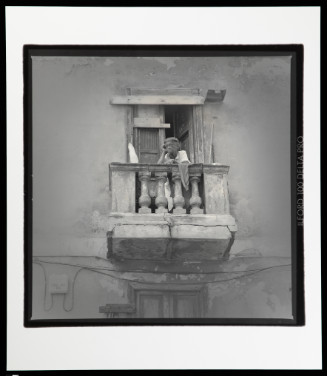
Woman on balustraded balcony cups a hand to her ear.
Alexey Titarenko
2006
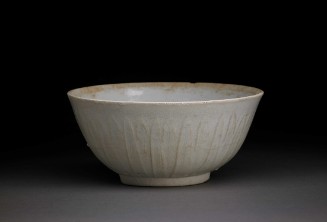
Small bowl in Chinese Song Dynasty style, thinly glazed with pale celadon extending from lip to just above foot ring; well-molded petal design on exterior; irregular, plain interior surface, well-finished foot.
Vietnamese
14th-15th century
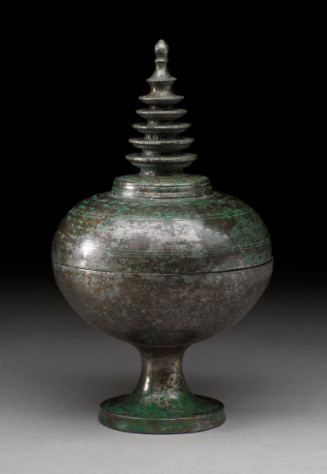
The domed cover has a raised central section surmounted by a five-storied stupa with a bud-shaped finial over two knobs; the cover is incised with bands of fine lines; the cup is on a waisted stem with a widely spread foot
Chinese Artist
Tang dynasty (618-907)
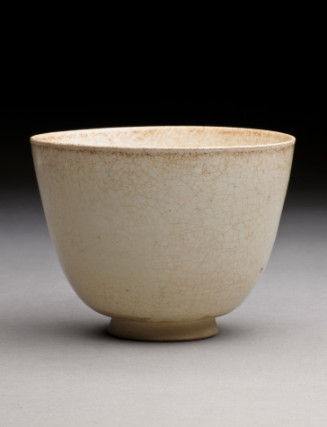
An off-white cup bowl on a short foot. The glaze is covered in a network of fine brown crackles. A thin, slightly rough band of speckled brown edges the top rim.
Chinese Artist
Sui or early Tang Dynasty, 6th-7th century
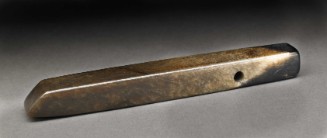
Adze
Chinese Artist
Neolithic Period or later
null