Adze
Adze
Courtesy of the Harn Museum of Art, Photography by Randy Batista

Adze

Artist Chinese Artist
DateNeolithic Period or later
Place of originChina, Asia
MediumJade
Dimensions4 5/16 x 5/8 x 5/16 in. (11 x 1.6 x 0.8 cm)
ClassificationsFurnishings and Equipment
Credit LineBequest of Dr. David A. Cofrin
Object number2009.48.135
Collections
Visual DescriptionThis archaic, rectangular scroll weight with a chamfered edge at one end was pierced laterally for suspension. In our opinion, this scroll weight is a fine example of Ming period scholarly jade art. (Bernstein appraisal description)

Slender with a single hole
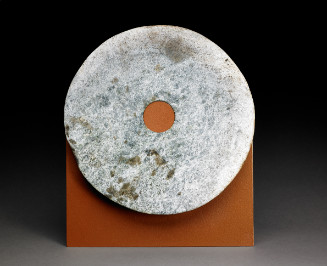
This large bi disc has been meticulously worked with a subtle concave rim rarely seen on bi discs of this size. Small circular bracelet-form jades from recent Liangzhu excavations show edges which are slightly concave in shape. This suggests an original bone-derived stylistic element. Although these wearable jades with concave edges are more frequently seen, this bi example of large size is most unusual. The surface of the bi disc is highly polished, and there has been much attention to both sha…
Chinese, Liangzhu culture
Neolithic period or later
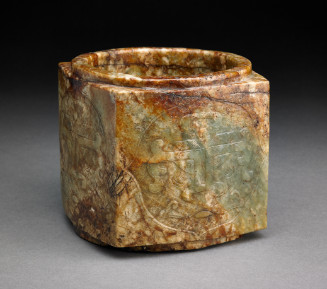
Cong with Taotie Designs
Chinese Artist
Ming dynasty (1368-1644) or later
Carved with archaistic motifs
Chinese Artist
19th century
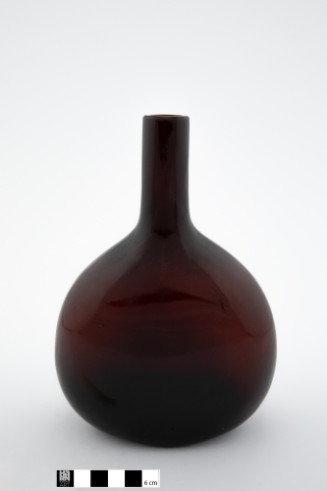
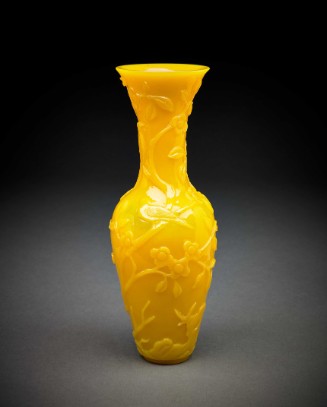
The translucent, deeply colored amber colored glass imitates the dark amber found in nature. The walls of the vase are thickly formed with swirling striations that are typical of the period. A slight crizzling is evident on the inner surface of the vase and may also be seen on the exterior surface.
The body of the vase is of a flattened circular form with a tubular neck and finished with a beveled lip. Unpolished grinding marks about the shoulders of the vase are evidence of the carving process…
Chinese Artist
Yongzheng Period (1723-1735)
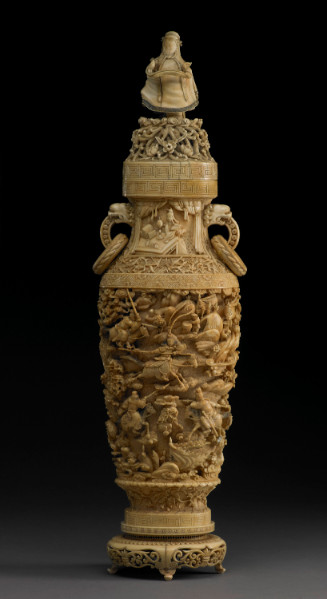
Vase with Scenes from the Novel Sanguo Zhi
Chinese Artist
Qing dynasty (1644-1911), late 18th century
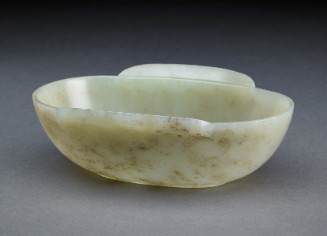
This ear cup reflects the Song period's profound interest in history in its characteristic design found in jades of the late Han period (206BC-AD220). The thinly worked oval cup has two flat handles projecting just below the rim at the longer sides, resting on an oval base with a raised foot ring. The highly translucent yellow jade possesses darker russet brown inclusions creating a desirable "skin" throughout the cup. The ear cup is of a fine, smooth polish. In our opinion, this ear cup is a fi…
Chinese Artist
Qing dynasty (1644-1911) or later
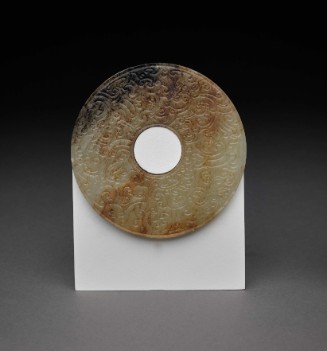
Disc with Cloud Pattern
Chinese Artist
Eastern Zhou dynasty (770-256 BCE)
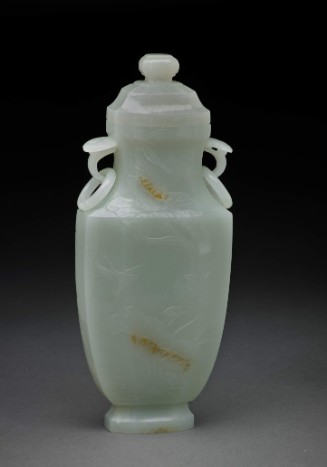
This striking octagonal vase is delicately worked from icy white jade with pale yellow surface skin markings. The artist has expertly incorporated the subtle yellow inclusions of the material with the edges of the broad graceful lotus leaves. The design extends the length of the vase to the concave neck. On either side, the covered vase is graced by handles in the shape of ruyi, or wish granting scepters. From each handle, circular rings are worked from the same jade boulder. In our opinion, the…
Chinese Artist
18th-19th century
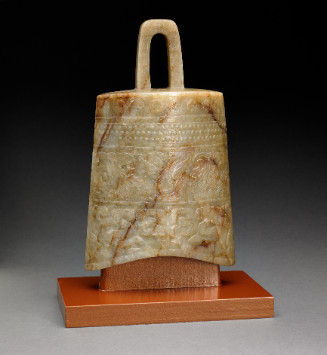
Bell is divided into sections which are reminiscent of the piece-mold technique of seaming the elements of the bronze bells together, seen on this jade bell as design elements. This archaistic bell is of greenish-gray jade with russet inclusions. In our opinion this archaistic bell expresses the refinement of design and technical workmanship of the late Song to early Ming period.
Chinese Artist
Song Dynasty (960-1279) or later
Carved with a pair of birds perched in prunus and chrysanthemum
Chinese Artist
Qing Dynasty (1644-1911), Qianlong period (1736-1795)
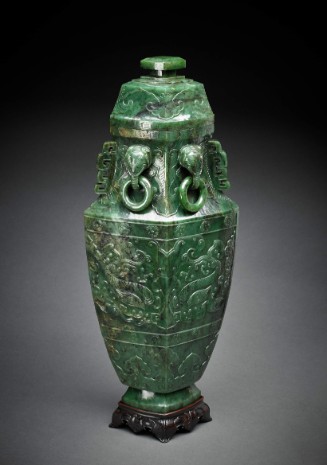
A Mughal-style vase and cover carved from celadon green nephrite with lighter inclusions. The vase is carved in an unusual flattened and fluted form that is elliptical in cross-section. Either side of the vase is carved with three leafy acanthus scrolls and hanging loose rings. The long flaring neck is carved on either side
Chinese Artist
19th century or later
null