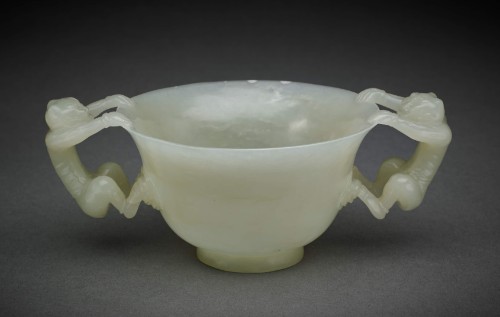
The handles formed by two demons braced against the sides as they pull themselves up towards the rim, each with knobby backbone and shallow horns, wearing a leopard skin loin cloth and bangles at the wrists and ankles
Cup
Courtesy of the Harn Museum of Art, Photography by Randy Batista

Cup

Artist Chinese Artist
DateQing dynasty (1644 - 1911), 18th-19th century
Place of originChina, Asia
MediumJade
Dimensions2 1/2 x 4 13/16 x 3 1/8 in. (6.4 x 12.2 x 7.9 cm)
ClassificationsFurnishings and Equipment
Credit LineBequest of Dr. David A. Cofrin
Object number2009.48.254
Collections
Visual DescriptionThe handles formed by two demons braced against the sides as they pull themselves up towards the rim, each with knobby backbone and shallow horns, wearing a leopard skin loin cloth and bangles at the wrists and ankles
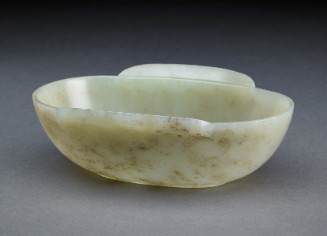
This ear cup reflects the Song period's profound interest in history in its characteristic design found in jades of the late Han period (206BC-AD220). The thinly worked oval cup has two flat handles projecting just below the rim at the longer sides, resting on an oval base with a raised foot ring. The highly translucent yellow jade possesses darker russet brown inclusions creating a desirable "skin" throughout the cup. The ear cup is of a fine, smooth polish. In our opinion, this ear cup is a fi…
Chinese Artist
Qing dynasty (1644-1911) or later
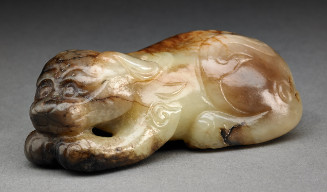
Shown in a recumbent position with head resting on its front paws and tail tucked under the body, with bulbous eyes, floppy ears, slightly knobby backbone and scrolls outlining the haunches, the stone of pale yellow, pale brown and dark brown color.
Chinese Artist
Yuan and Ming dynasty (1279-1644)
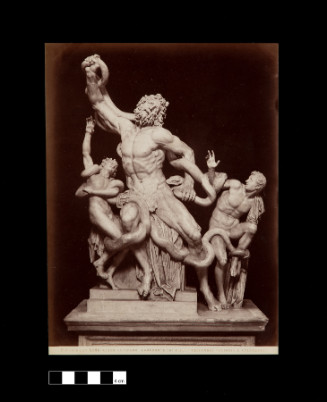
A sepia-toned photograph of the sculpture Laocoön and His Sons (Hellenistic Greece, marble, Vatican Museums). The central figure of Laocoön and his sons flanking him struggle to free themselves from serpents. Their writhing bodies create sinuous lines that convey movement.
Unknown
undated
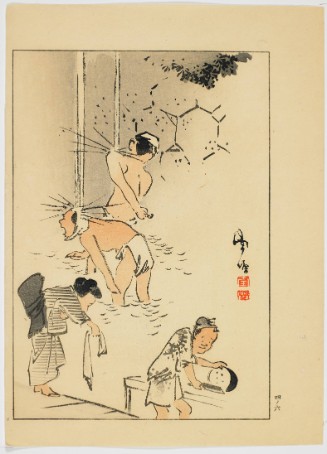
four figures
Kanamori Nanto
1893
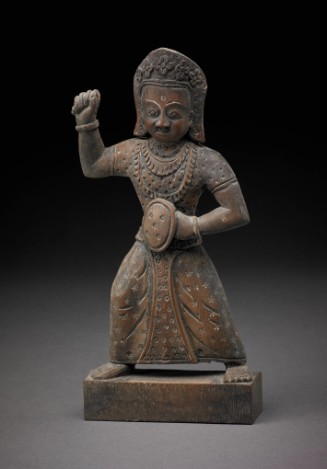
A standing figure carved from dark reddish-brown stone, featuring an elaborate headdress and large circular earrings, wearing a patterned garment that falls to the ankles. The figure raises its right hand and holds a circular object in its left hand.
Indian Artist
20th century
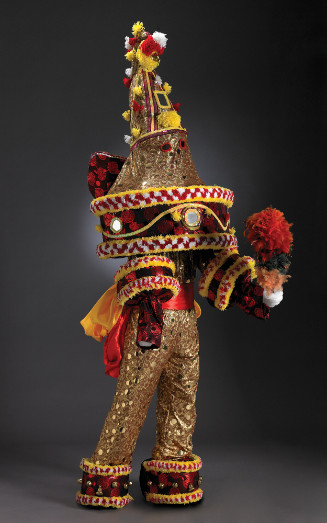
Masquerade costume consists of an Ebonko head (name of the conical curving feature found on head piece is called Etundu); a tailored cloth shirt and trousers (known as Ofon Idem Ebonko); cloth mane worn on chest and wrapped around shoulders (Ofon Nyanya); two hand tufts with small bells worn around wrist (Ita Ubok); two leg tufts with small bells worn around ankle adorned with small bells (Ita Ukot); a winged hat worn on the back of the head (Itam Ekot), a Mbobo cloth girdle with decorative fold…
Ekpenyong Bassey Nsa
2010
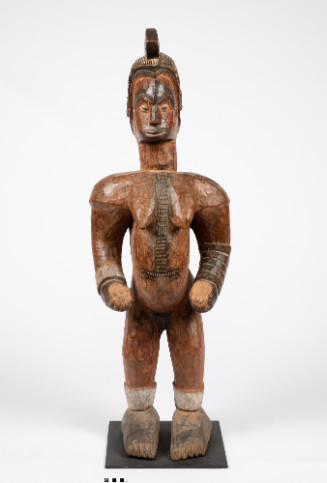
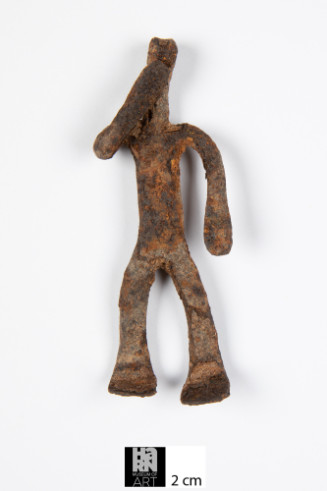
Schematic figure with right arm bent with hand close to mouth, left arm down. Head, feet and hands are flat and rounded; feet are bent at ankles.
Lobi Artist
c. 1950
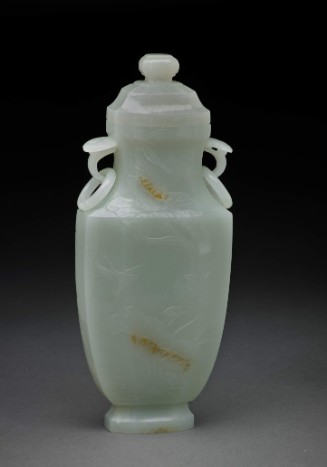
This striking octagonal vase is delicately worked from icy white jade with pale yellow surface skin markings. The artist has expertly incorporated the subtle yellow inclusions of the material with the edges of the broad graceful lotus leaves. The design extends the length of the vase to the concave neck. On either side, the covered vase is graced by handles in the shape of ruyi, or wish granting scepters. From each handle, circular rings are worked from the same jade boulder. In our opinion, the…
Chinese Artist
18th-19th century
null