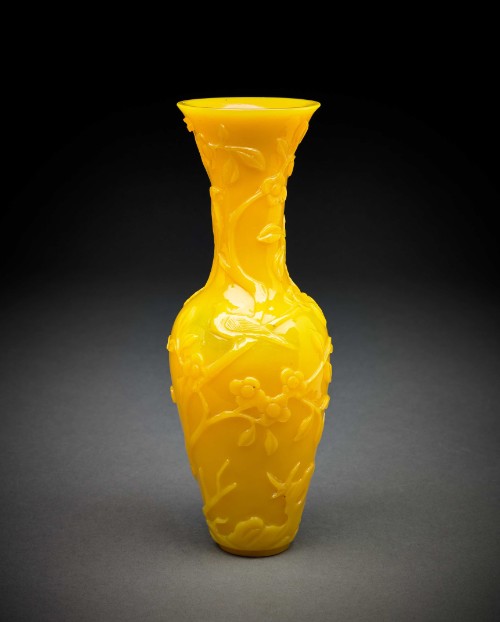
Carved with a pair of birds perched in prunus and chrysanthemum
Baluster Vase
Courtesy of the Harn Museum of Art, Photography by Randy Batista

Baluster Vase

Artist Chinese Artist
DateQing Dynasty (1644-1911), Qianlong period (1736-1795)
Place of originChina
MediumGlass
DimensionsHeight x Diameter: 7 3/8 x 2 5/8 in. (18.7 x 6.7 cm)
ClassificationsFurnishings and Equipment
Credit LineBequest of Dr. David A. Cofrin
Object number2009.48.173
Collections
Visual DescriptionCarved with a pair of birds perched in prunus and chrysanthemum

From Bernstein invoice:
An imperial yellow glass amphora shaped vase. The relief carving depicts a pair of birds perched among flowering prunus and chrysanthemum. The "egg yolk" yellow glass varies in translucency and thickness throughout the form, becoming very thin at the shoulders of the vase, and quite thick around the base. The narrow base widens to low swelling shoulders connecting with a long narrow tapering neck that flares at the mouth. The vase is finished with a short raised foot. The underside is finely incised with a blackened four-character mark of Qianlong (yuzhi). In our opinion, it is a fine example of the period.
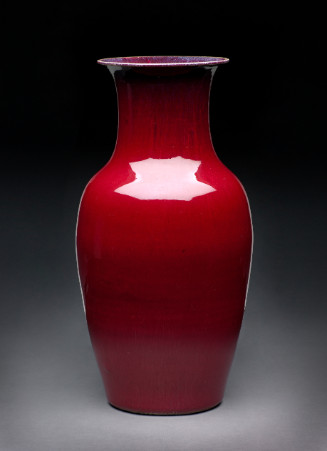
A sleek, baluster-shaped ceramic vase with a highly reflective, solid deep red glaze. It features a sharply flared rim, a gently sloping neck, and wide shoulders that taper smoothly to a flat base.
Chinese Artist
Qing dynasty (1644-1911)
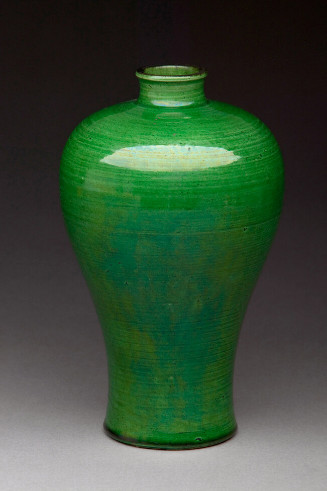
A tall, bright green ceramic vase with a short narrow neck, broad shoulders, and a tapering body that flares slightly at the base. The glossy green glaze has subtle horizontal lines and slight color variations throughout.
Chinese Artist
Qing dynasty (1644-1911), Kangxi period (1662-1722)
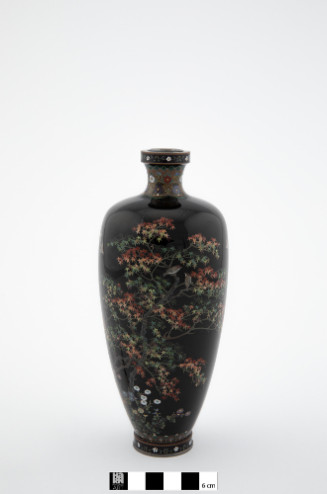
The slender vase with an elongated neck and set on a raised foot and decorated in polychrome enamels worked in silver wire with birds in maple trees above chrysanthemums against a black ground, the neck decorated with scrolling vines and flowers on a brown ground
Japanese Artist
Meiji Period (1868–1912)
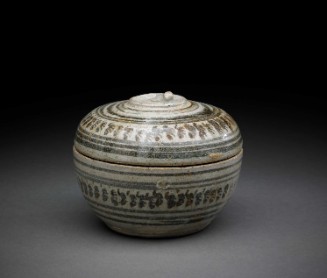
Central medallion on lid; lid shoulders rounded; flanged globular body; narrow ring foot with one incised line above foot and recessed base; black speckled greyish buff clay body; celadon gloss glass.
Thai Artist
Si Satchanalai (14th - 16th century)
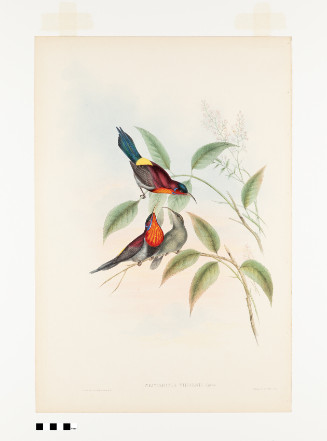
Three Nextarinia Vigorsii (Vigors' Sun-Bird) birds standing on a plant with green leaves and small pink flowers.  The two male birds have blue-green heads and tails, red shoulders, yellow backs, brown wings, orange throats, and gray-brown bellies; the female is gray-brown.
John Gould
1849-1881
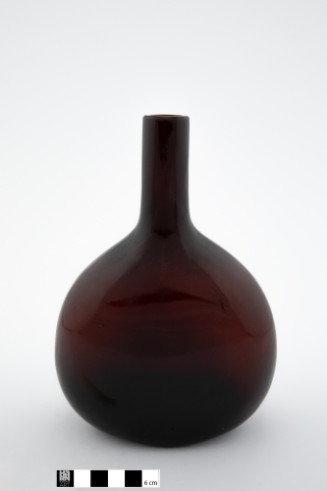
The translucent, deeply colored amber colored glass imitates the dark amber found in nature. The walls of the vase are thickly formed with swirling striations that are typical of the period. A slight crizzling is evident on the inner surface of the vase and may also be seen on the exterior surface.
The body of the vase is of a flattened circular form with a tubular neck and finished with a beveled lip. Unpolished grinding marks about the shoulders of the vase are evidence of the carving process…
Chinese Artist
Yongzheng Period (1723-1735)
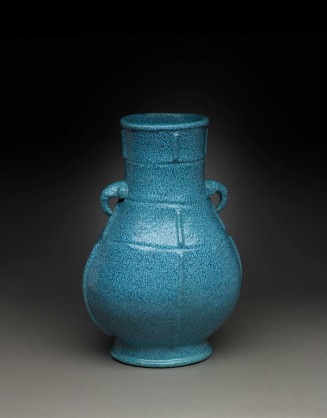
Of flattened pear shape, the vase is molded with evenly spaced sets of vertical ribbed flanges around the neck, mid and lower sections, with a pair of elephant-head loop handles on the shoulders, and applied overall with a mottled glaze of turquoise and lapis-blue tones
Chinese Artist
Qing dynasty (1644-1911), 18th-19th century
A bird perched on a branch; a background view with two other birds perched on a fence, one feeding the other
John Gould
1862-1873
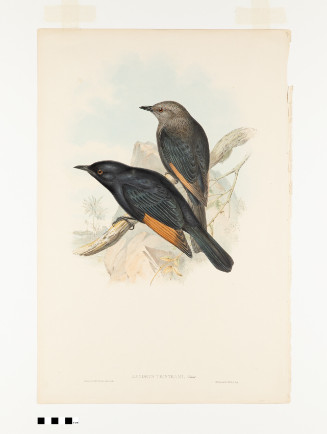
Two Amydrus Tristrami (Tristam's Amydrus) birds perched on a branch and set against a distant rocky landscape with palm trees.  The male has a purple-ish black body with black and orange wings, and the female has a brown and black speckled head with black and orange wings.
John Gould
1840-1869
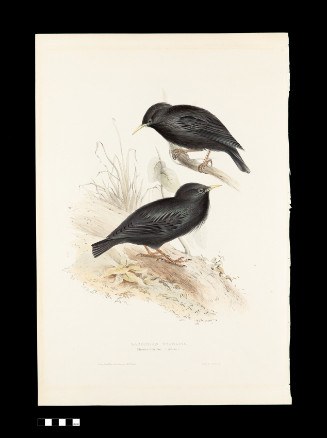
Two black birds in a landscape: one bird is on the ground while the other is perched on a branch
John Gould
1832-1837
World of Fossilization
Sato Junshiro
1961
null