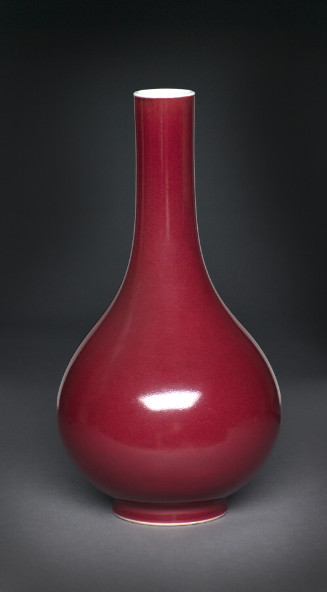
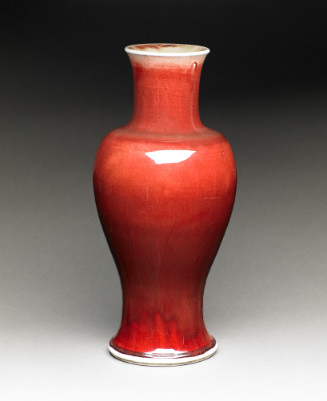
A sleek, baluster-shaped ceramic vase with a highly reflective, solid deep red glaze. It features a sharply flared rim, a gently sloping neck, and wide shoulders that taper smoothly to a flat base.
Baluster Vase
Courtesy of the Harn Museum of Art, Photography by Randy Batista

Baluster Vase

Artist Chinese Artist
DateQing dynasty (1644-1911)
Place of originChina, Asia
MediumPorcelain
Dimensions16 x 8 1/8 x 8 1/8 in. (40.6 x 20.6 x 20.6 cm)
ClassificationsFurnishings and Equipment
Credit LineGift of Dr. and Mrs. Robert Magoon, in honor of Sam and Bessie Proctor
Object number1995.14
Collections
Visual DescriptionA sleek, baluster-shaped ceramic vase with a highly reflective, solid deep red glaze. It features a sharply flared rim, a gently sloping neck, and wide shoulders that taper smoothly to a flat base.
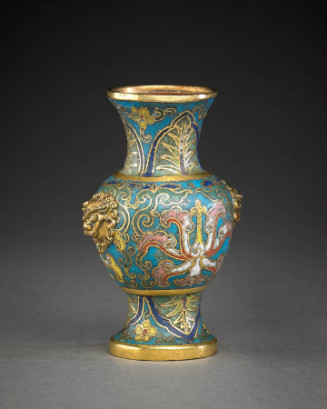
A fine miniature cloisonné enamel vase of baluster form, the rounded body set with two high relief gilt-bronze mask handles and decorated with lotus flowers and leaves, the tall flared foot decorated with flower heads and leaf lappets, the tall flared neck similarly decorated. All enameled in red, yellow, white, light and dark green, pink, and lapis blue on a turquoise blue ground.
Chinese Artist
18th Century
A smooth, glossy deep red vase with a wide, bulbous body that tapers upward into a long, narrow neck. The flat rim at the top opening and the bottom edge of the short foot are both white.
Chinese Artist
Qing dynasty (1644-1911), Qianlong reign (1736-1795)
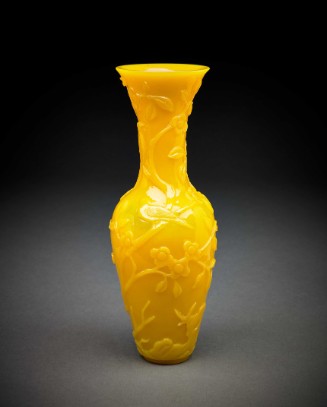
Carved with a pair of birds perched in prunus and chrysanthemum
Chinese Artist
Qing Dynasty (1644-1911), Qianlong period (1736-1795)
Pale blue-green ceramic vase with a crackled glaze. It features a flared rim, a long neck, and a bulbous body carved with vertical petal-like fluting, resting on a slightly flared foot.
Chinese Artist
Yuan dynasty (1279-1368)
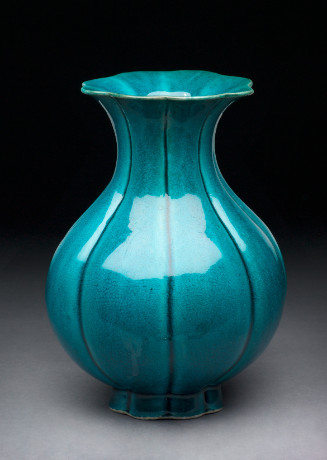
The well-rounded sides terminate in a flared mouth and are supported on a slightly spreading, shaped foot. The vase is covered with a lustrous deep turquoise, finely crackled glaze which pools in the crevices.
Chinese Artist
18th century
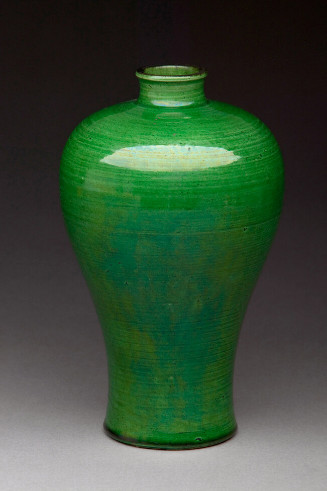
A tall, bright green ceramic vase with a short narrow neck, broad shoulders, and a tapering body that flares slightly at the base. The glossy green glaze has subtle horizontal lines and slight color variations throughout.
Chinese Artist
Qing dynasty (1644-1911), Kangxi period (1662-1722)
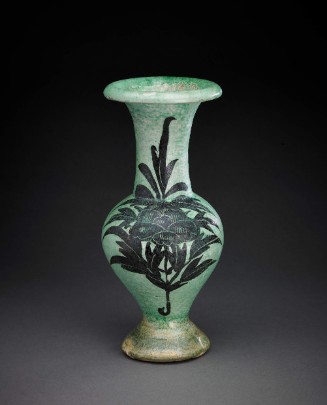
Vase with tapering body and tall neck, two large leafy peony sprays painted in black over a white slip, incised details, thin pale green glaze, pools to a darker green on the flared foot.
Chinese Artist
Jin Dynasty (1115-1234), 12th century
vase with deep cranberry glaze thinning at the lip of the flared neck to a pale greenish white
Chinese Artist
18th century
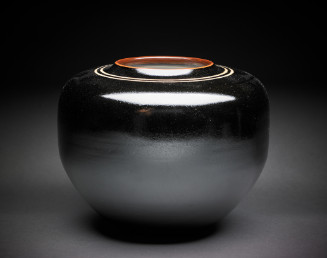
Vase in a flattened globe with circular, linear ornamentation at the shoulder and mouth. Of porcelain with a deep iron-oxide black glaze, the lines on the shoulder carved and inlaid with white glaze that glows gold on the edges.
Miyanohara Ken
Showa Period (1926 – 1989), c. 1968
A small, pale green ceramic flask with a flattened, round body. Two looped handles connect the neck to the shoulders. The surface features a molded pattern of concentric circles with radiating lines.
Chinese Artist
Qing Dynasty (1644-1911)
A small, pale blue-green glazed ceramic flask with a flattened oval body. It features two looped handles connecting the neck to the shoulders. The surface has faint, raised floral relief decorations.
Chinese Artist
Qing Dynasty (1644-1911)
null