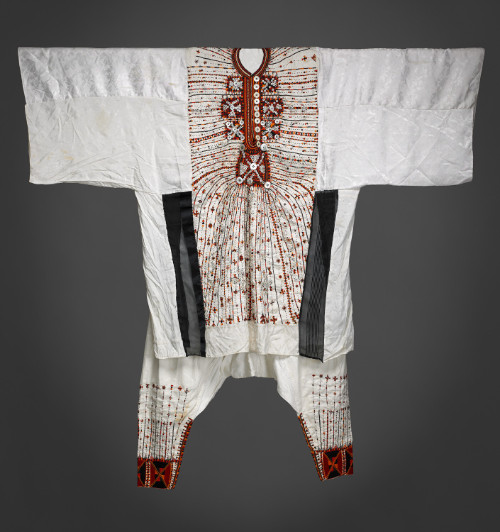
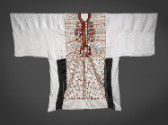
Two-piece ensemble Tunic made of synthetic damask cloth w/ silk embroidered geometric patterns in black, yellow, red, green; with mother of pearl buttons large and small sewn throughout in geometric patterns; see-through synthetic black panels on side of top "asherah nahuak; white cotton muslin trousers "srauleen" w/ silk embroidery on lower legs in red, orange, green, yellow and black thread"
Woman's Wedding Ensemble
Courtesy of the Harn Museum of Art, Photography by Randy Batista

Woman's Wedding Ensemble

Maker Amazigh Artist , Siwa, Egypt
Datelate 20th century
Place of originEgypt, Africa
MediumSynthetic cloth, silk, cotton, buttons
DimensionsTop: 48 1/16 in. x 6 ft. 10 1/2 in. (122 x 209.6 cm)
Trousers: 36 x 41 in. (91.4 x 104.1 cm)
ClassificationsClothing and accessories
Credit LineMuseum Purchase with funds from The Caroline Julier and James G. Richardson Acquisition Fund
Object number2009.32.15
Collections
Visual DescriptionTwo-piece ensemble Tunic made of synthetic damask cloth w/ silk embroidered geometric patterns in black, yellow, red, green; with mother of pearl buttons large and small sewn throughout in geometric patterns; see-through synthetic black panels on side of top "asherah nahuak; white cotton muslin trousers "srauleen" w/ silk embroidery on lower legs in red, orange, green, yellow and black thread"
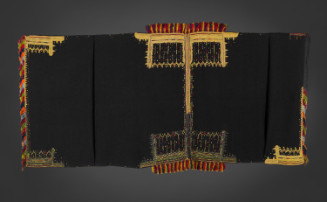
Two panels (handsewn together with red silk) in fine spun wool dyed black with heavy embroidery at the four corners in gold thread, yellow, green, red, blue silk. Embroidered patterning consists of geometric motifs resembling an architectural setting (gables and columns) or a jeweled crown with pendants; along the borders, linking the heavy inlay at the corners are small silk crosses in the above-mentioned colors. Fringes at either end are made of twisted silk threads in red, orange, mauve, gree…
Amazigh Artist
20th century
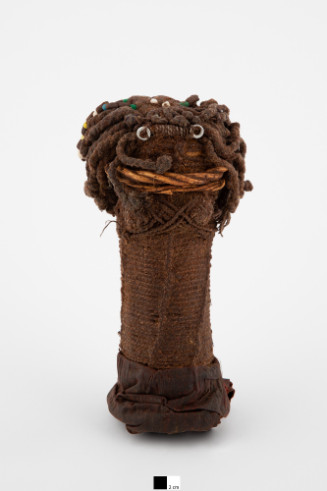
Cylindrical form wrapped with fiber, and hair and long braided strands on top. Glass or plastic bead strands on top and neck (yellow and blue beads) and wood or other brown beads (?) encircling form. Entire form is covered with red ochre
Ambo Artist, Mwila group
20th century
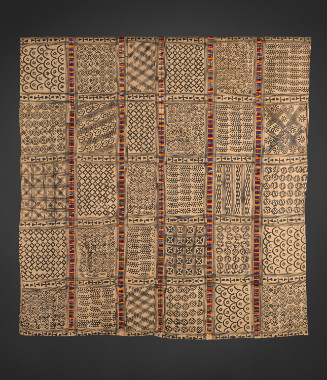
Sandy/light beige commercial cotton background with six panels with a band of embroidered threads in burgundy, black, yellow, blue, grey and green between each panel and this holds the panels together; w/black stamped Adinkra patterns done in squares which are outlined in five black lines framing these squares including: spider (ananse), unity (obi nka obie), fern (aya), spiritual cleanliness (musuyidie), circular house (fihankra), and rams' horns and other patterns.
Akan Artist
late 20th century
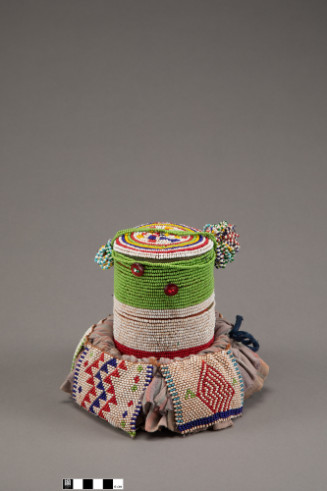
Cylindrical core wrapped with strands of beads in registers of red, white and green; top is covered with white, red, blue, yellow and green beads, clumps of beaded strands on either side of top with same colors. Panels of beads encircle base, and rest on a thick ruffled white cloth skirt. Two brown buttons attached to one side, slightly askew.
Tsonga Artist
20th century
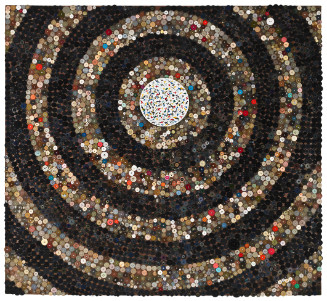
A mixed-media piece with tightly packed buttons in concentric rings of alternating black and mixed-color buttons radiate outward from a central white disk speckled with tiny colorful marks.
Elias Sime
2002
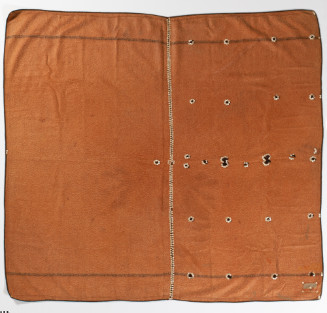
The Fengu blankets are similiar to those of the Xhosa. This one has the fur trim which the Fengu prefer as well as the older mother-of-pearl buttons. There is also the fine black wool embroidery work and the delicate use of the glass bead-work. The blanket would have been worn partially folded over by about one third the width. The origin is Mazizini.
Zulu Artist
1850-1950
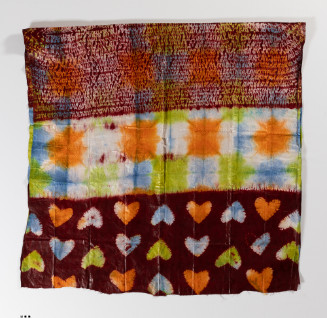
Resist dyed damask cloth with burgundy, lime green, orange white, blue patterns: hearts, circles and solid areas (larger textile); headtie, solid lime green.
Malian Artist
20th century
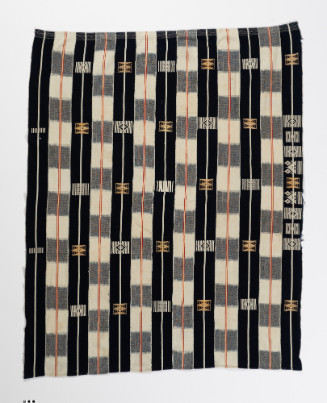
White, blue dominant striped pattern; strip woven cloth hand sewn at selvedges; indigo dyed yarns, and synthetic dyes; red, yellow; machine stitching. Scrolling design on one border with muslin cloth backing.
Senufo Artist
20th century
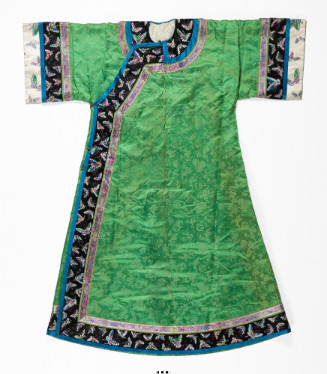
Body of robe is green damask densely patterned with Three Friends of Winter motif; white satin cuffs and both the black binding and a woven pink binding are embroidered with butterflies.  There is a narrow blue silk binding at hem and between white cuffs and bindings on sleeves; there is a gold ribbon on either side of pink binding panel.  The buttons are a textured gilded brass, and the lining is an off-white silk.
Chinese Artist
Qing dynasty (1644-1911), late 19th century
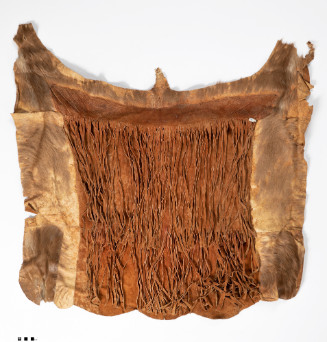
Beaded panels attached to a band of ostrich eggshell beads, with strands of ostrich eggshell beads forming a fringe between beaded strips of black and white beads, Beadwork is attached to a hide apron.
Yei Artist
20th century
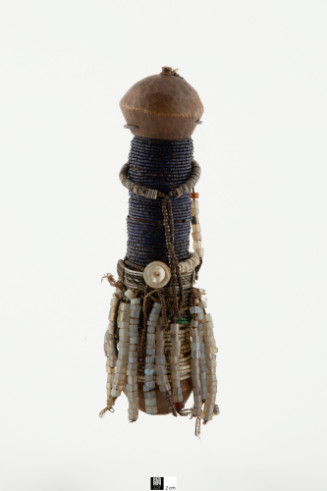
Wood cylinder with knob on each end, wrapped with dark blue beads, upper half, and strands of white glass and other beads on lower half, including vertical strands of ostrich shell beads and clear and light green glass beads. Large mother of pearl button in the center; right arm made of strand of alternating light and dark glass beads. Left arm is missing, as are some other beads.
Ambo Artist
late 19th century
null