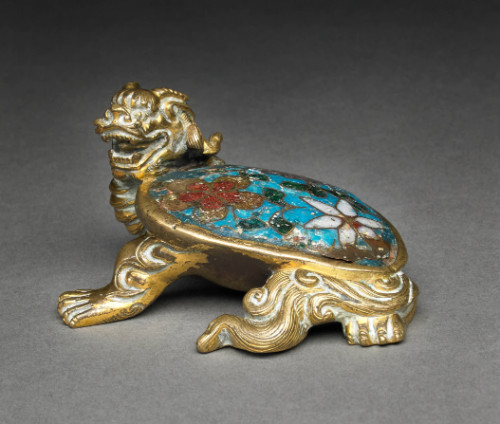
Heavily and finely cast as a three-legged bixi, a mythological dragon-tortoise with dragon-like head with forked antlers and bushy tail, the carapace inlaid with a cloisonné enamel fragment of 16th century date decorated with thee flower heads and green leafy tendrils reserved on a turquoise-blue ground
Weight
Courtesy of the Harn Museum of Art, Photography by Randy Batista

Weight

Artist Chinese Artist
Date17th - 18th Century
Place of originChina, Asia
MediumBronze and enamel
Dimensions1 1/2 x 2 5/8 x 2 5/8 in. (3.8 x 6.7 x 6.7 cm)
ClassificationsSculpture
Credit LineBequest of Dr. David A. Cofrin
Object number2009.48.51
Collections
Visual DescriptionHeavily and finely cast as a three-legged bixi, a mythological dragon-tortoise with dragon-like head with forked antlers and bushy tail, the carapace inlaid with a cloisonné enamel fragment of 16th century date decorated with thee flower heads and green leafy tendrils reserved on a turquoise-blue ground
Bibliography
Kaikodo Journal XXII
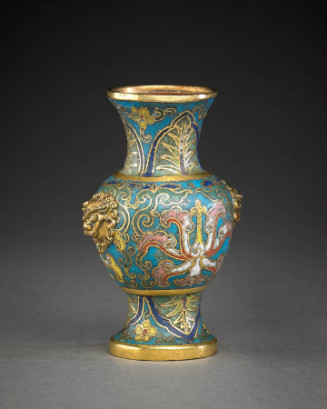
A fine miniature cloisonné enamel vase of baluster form, the rounded body set with two high relief gilt-bronze mask handles and decorated with lotus flowers and leaves, the tall flared foot decorated with flower heads and leaf lappets, the tall flared neck similarly decorated. All enameled in red, yellow, white, light and dark green, pink, and lapis blue on a turquoise blue ground.
Chinese Artist
18th Century
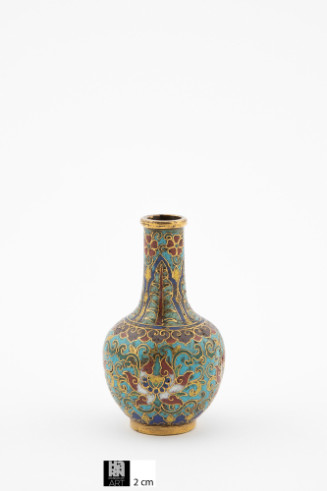
A fine cloisonné enamel vase of globular bottle form with a cylindrical neck and low gilt foot rim, decorated with ruyi-head lappets at the foot and around the shoulder; the body decorated with formalized lotus flowers, leaves and stems; the neck decorated with flowers above tall leaf-form lappets; all enameled in red, yellow, white, lapis blue, light and dark green, and aubergine on a turquoise ground.
Chinese Artist
18th Century
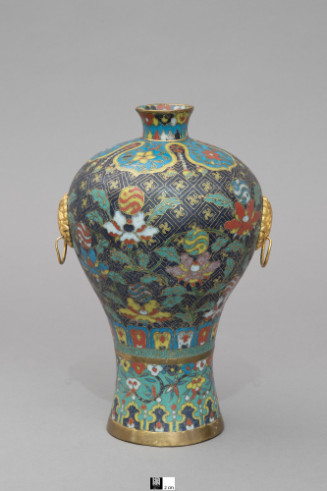
Cloisonné enamel on metal with gilt bronze lion handles.
Chinese Artist
Ming dynasty (1368-1644)
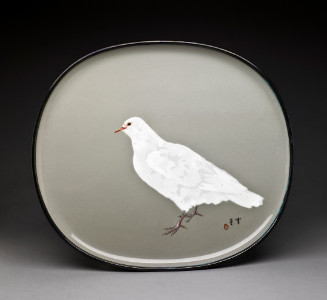
An oval cloisonne enamel tray with a white dove depicted in 'musen' (the wireless technique) and the wired technique on pale ground. His beak, eye and legs with finely detailed wire technique. The tray rim of 'shakudo.' The underside of the tray with characteristic stylized blossoms and silver wire signature.
Namikawa Sosuke
c. 1895-1905
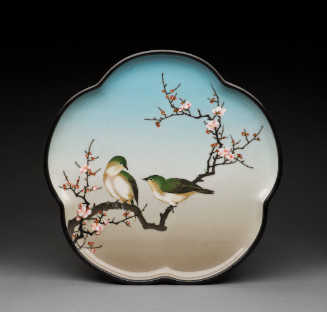
Meiji period (19th century). Modeled in the outline of a plum blossom and designed in silver and gold wire–outlined cloisonne and wireless enamel with two birds perched on a branch of flowering pink plum, the lower portion of the background shaded gray and the sky area shaded blue, the underside decorated with chocolate-brown cherry florets outlined in gold wire on a dark brown ground, rim in gold and copper shakudo metal.
Namikawa Sosuke
c. 1900-1910
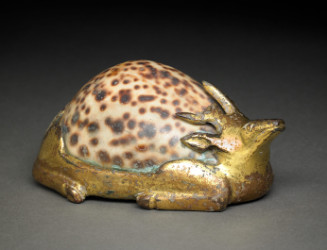
A sea shell forming the body of the gilt-bronze animal lying semi-recumbent with legs tucked neatly under the body and with head raised up, with antlers and ears flared back to hold the shell in place
Chinese Artist
Western Han Dynasty (206 B.C. - 9 A.D.)
A deer’s head with four birds perched on its antlers; the branches of a tree extend downward from the deer’s neck; the upper half of the composition includes a network of branches set against a green background.
Osmeivy Ortega ("Oz")
undated
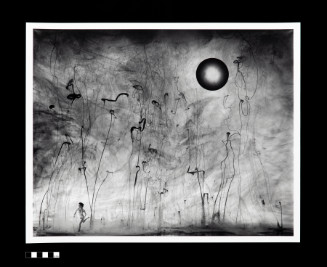
Black and white composite photograph. A small human figure runs along the bottom left. Thin, dark, ink-like tendrils rise upwards through a cloudy, swirling background. A large dark circle floats in the upper right corner.
Jerry Uelsmann
1994
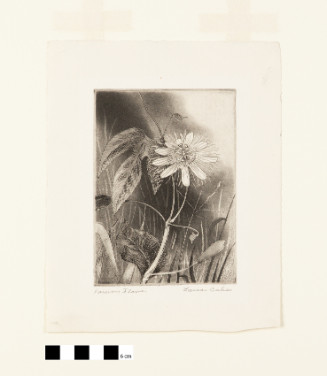
Black and white print of a blooming passion flower on a leafy vine. The flower features radiating petals and an intricate center, surrounded by textured leaves, coiled tendrils, and a closed bud, set against a dark, softly shaded background.
Lamar Baker
c. 1935 - 1940
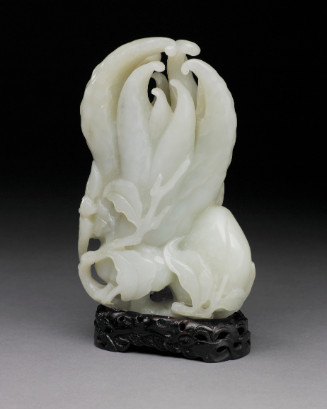
The emphasis on the smooth sensuous surface, fluidity of lines and the attention to detail are all typical elements of the eighteenth century carving tradition.  Fashioned of a pure white jade, the citron is entwined with leaves and accompanied by a bat and a peach. The long delicately carved tendrils bend gracefully at the tips, resembling Buddha's hand in the classic position. The citron symbolizes wishes for longevity as well as wealth, since it illustrates the gesture of grasping money. The …
Chinese Artist
18th-19th century
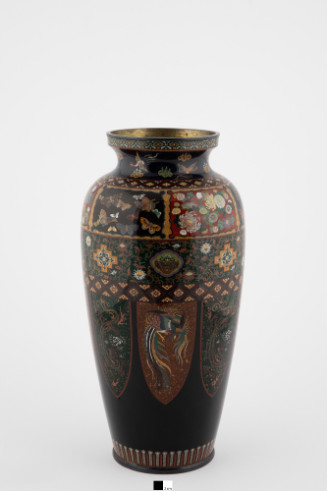
Baluster form vase with several bands of decoration including flowers, birds, dragons and phoenixes.
Japanese Artist
late 19th Century
null