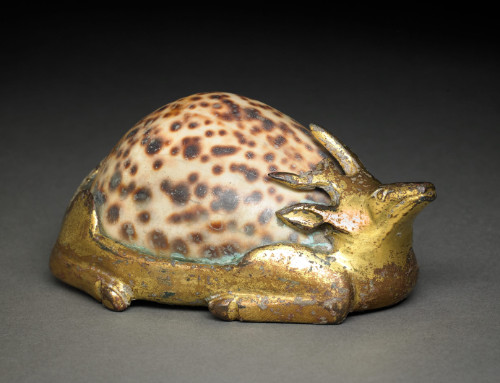
A sea shell forming the body of the gilt-bronze animal lying semi-recumbent with legs tucked neatly under the body and with head raised up, with antlers and ears flared back to hold the shell in place
Deer-Shaped Mounted Shell
Courtesy of the Harn Museum of Art, Photography by Randy Batista

Deer-Shaped Mounted Shell

Artist Chinese Artist
DateWestern Han Dynasty (206 B.C. - 9 A.D.)
Place of originChina, Asia
MediumGilt bronze
Dimensions2 1/16 x 4 5/8 x 3 in. (5.2 x 11.7 x 7.6 cm)
ClassificationsSculpture
Credit LineBequest of Dr. David A. Cofrin
Object number2009.48.310
Collections
Visual DescriptionA sea shell forming the body of the gilt-bronze animal lying semi-recumbent with legs tucked neatly under the body and with head raised up, with antlers and ears flared back to hold the shell in place
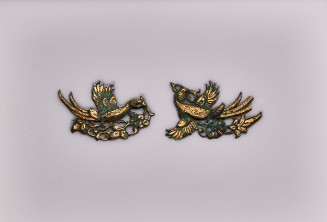
Long-tailed bird in flight; holding leafy branch from it's beak which trails underneath it's body; the design is punched from the ungilt reverse side.
Chinese Artist
Tang Dynasty (618-907), 8th century
Long-tailed bird in flight; holding leafy branch from it's beak which trails underneath it's body; the design is punched from the ungilt reverse side.
Chinese Artist
Tang Dynasty (618-907), 8th century
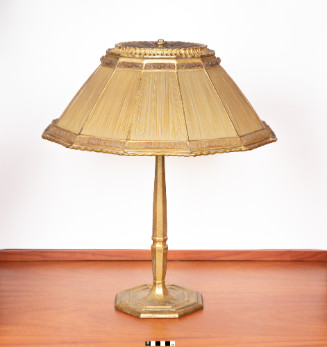
Table lamp with gilt bronze doré base; shade with panes of gold Favrile-fabrique art glass in the “linenfold” design (resembles silk in folds or pleats) in a gilt (doré) bronze frame
Louis Comfort Tiffany
c. 1920
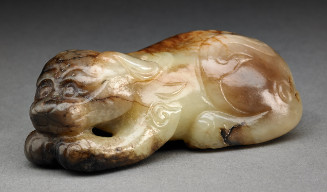
Shown in a recumbent position with head resting on its front paws and tail tucked under the body, with bulbous eyes, floppy ears, slightly knobby backbone and scrolls outlining the haunches, the stone of pale yellow, pale brown and dark brown color.
Chinese Artist
Yuan and Ming dynasty (1279-1644)
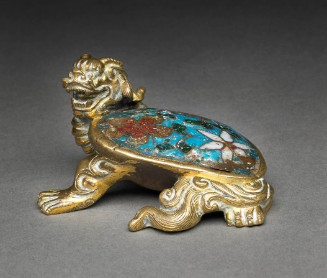
Heavily and finely cast as a three-legged bixi, a mythological dragon-tortoise with dragon-like head with forked antlers and bushy tail, the carapace inlaid with a cloisonné enamel fragment of 16th century date decorated with thee flower heads and green leafy tendrils reserved on a turquoise-blue ground
Chinese Artist
17th - 18th Century
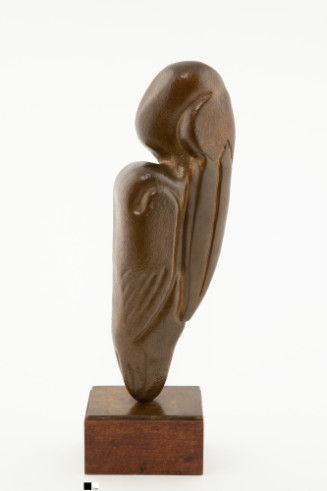
Figure is in the form of a pelican with head tucked into its breast.
John Flannagan
1941
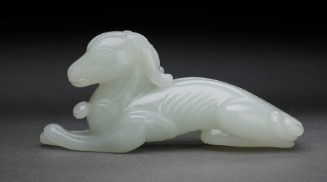
The graceful greyhound shown in a recumbent position with forepaws crossed and back legs tucked beneath the body, with long ears and coiled tail, one end of the long, bell-hung ribbon tied around the arched neck trailing beneath the belly, the slender body carved with pronounced ribs and backbone, the stone well polished and of even white tone.
Chinese Artist
Qing dynasty (1644-1911), 18th-19th century
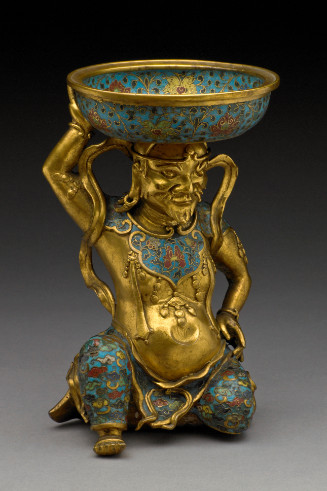
A bearded man holding a basin his head.
Chinese Artist
Qing dynasty (1644–1911)
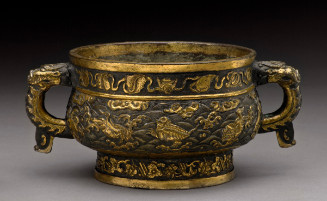
bombe-form censer with central band of waves and mythical sea creatures
Hu Wenming
Ming Dynasty (1368-1644), 16th-17th century
Solid bronze; cast in the shape of a bear and a tiger locked in combat; the bear is caught with open eyes and mouth; the tiger bites the bear's back with a ferocious demeanor; engraved details.
Chinese Artist
Han dynasty (206 BCE-220 CE)
null