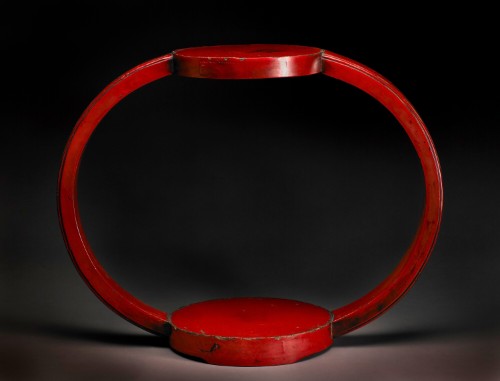
Stand for displaying an incense burner, in a circular form of two discs connected by flying supports, of bentwood and negoro red and black lacquer.
Incense burner stand
Courtesy of the Harn Museum of Art, Photography by Randy Batista

Incense burner stand

Maker Japanese Artist
DateLate Muromachi - Momoyama period, 16th century
Place of originJapan
MediumBentwood and negoro red and black lacquer
Dimensions19 x 24 1/2 x 10 3/4 in. (48.3 x 62.2 x 27.3 cm)
ClassificationsFurnishings and Equipment
Credit LineGift of Kagedo Japanese Art
Object number2010.1.16
Collections
Visual DescriptionStand for displaying an incense burner, in a circular form of two discs connected by flying supports, of bentwood and negoro red and black lacquer.
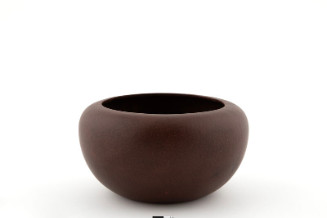
The speckled, purplish-brown body well potted in the form of an alms bowl with steep sides rising to a gently rounded rim with a wide mouth
Chinese Artist
Qing dynasty (1644-1911)
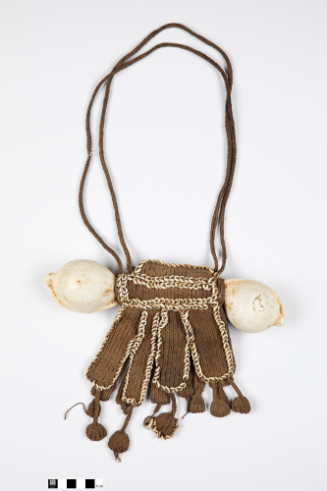
Plaited fiber in hanging rectangles edged with cowrie shells. Front has 4 hanging panels with attached dangling disc. Repeat in back. Large shells are mounted on either side of plaited fiber. Connected by stick that supports fiber. Double loops.
New Guinea, Coastal region, Astrolabe Bay
20th century
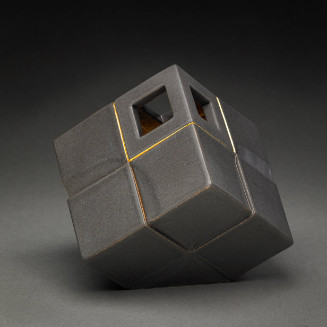
Angled cube kōro (incense burner) with matte, dark brown glaze, gold-glazed edges and square cut-outs
Kiyomizu (Masahiro) Rokubey VIII
c. 2004
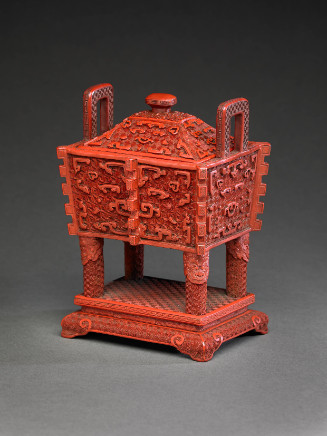
Red rectangular brazier with lid on integral stand
Chinese Artist
Qing dynasty (1644-1911), 18th century
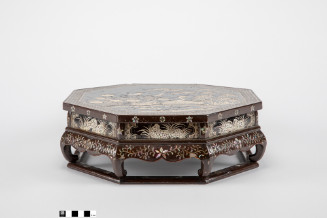
Octagonal stand with black lacquer inlaid with mother-of-pearl depicting two water birds by a pond
Chinese Artist
Ming dynasty (1368-1644)
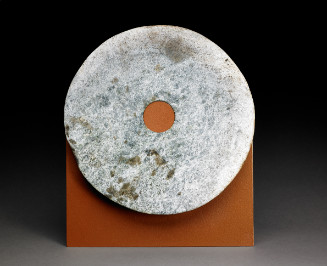
This large bi disc has been meticulously worked with a subtle concave rim rarely seen on bi discs of this size. Small circular bracelet-form jades from recent Liangzhu excavations show edges which are slightly concave in shape. This suggests an original bone-derived stylistic element. Although these wearable jades with concave edges are more frequently seen, this bi example of large size is most unusual. The surface of the bi disc is highly polished, and there has been much attention to both sha…
Chinese, Liangzhu culture
Neolithic period or later
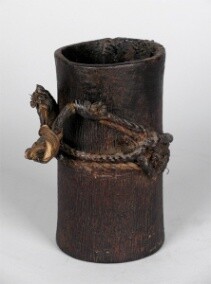
Urushi-oke or lacquer artisan's pail, of carved and assembled cypress wood with splashes and drips of the artisan's lacquer, and carrying rope.
Japanese Artist
early Meiji era, c. 1870
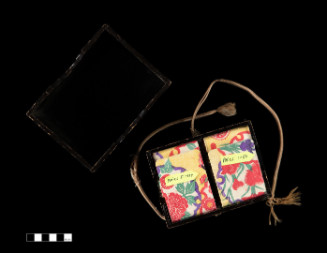
One Hundred Poets Game Card Set
Japanese Artist
c. 1840
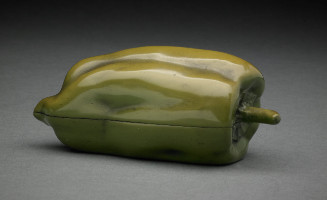
A lidded lacquer box with lid in the shape of a pepper.
Kōgetsu Taishō
early Shōwa era, c. 1920 – 1930
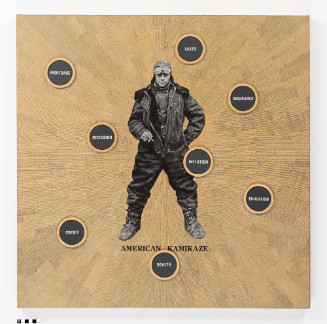
A vintage pilot stands against a radiating background. Eight circles labeled "mortgage", "taxes", "recession", "insurance", "inflation", "education", "credit", and "health" surround him. Below reads "AMERICAN KAMIKAZE".
Rubén Torres Llorca
2004
null