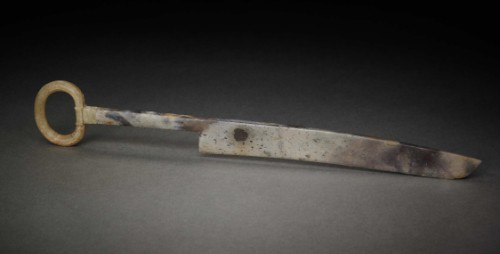
Carved as a long slender blade of slightly curved outline tapering in thickness towards the tip and the cutting edge from an upper, and thicker, flat edge which is a continuation of the narrow, beveled handle, fitted at its end with a short similar section set at the base of a slight saddle with raised edges from which issues a faceted oval ring, the blade now altered from burial to an opaque pale and dark mottled gray with a few translucent buff patches remaining, the ring section somewhat opaq…
Serpentine Knife
Courtesy of the Harn Museum of Art, Photography by Randy Batista

Serpentine Knife

Artist Chinese Artist
DateWarring States Period (c. 475-221 BCE)
Place of originChina, Asia
MediumJade
Dimensions1 1/8 x 7 5/8 x 1/4 in. (2.9 x 19.4 x 0.6 cm)
ClassificationsFurnishings and Equipment
Credit LineBequest of Dr. David A. Cofrin
Object number2009.48.308
Collections
Visual DescriptionCarved as a long slender blade of slightly curved outline tapering in thickness towards the tip and the cutting edge from an upper, and thicker, flat edge which is a continuation of the narrow, beveled handle, fitted at its end with a short similar section set at the base of a slight saddle with raised edges from which issues a faceted oval ring, the blade now altered from burial to an opaque pale and dark mottled gray with a few translucent buff patches remaining, the ring section somewhat opaque and of buff color
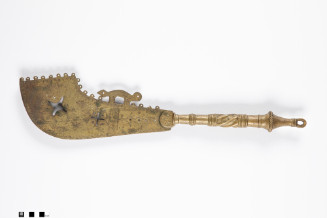
Forged curved blade with blunt end, and cast brass handle; cut out depiction of a chameleon on the inner curve, and cross cut-out in center of blade, with words engraved above: MK Balogu; Kent I of AL on one side and 23. 9 47 XX   MK Balogu AL on the opposite side. Engraved images of fish, serpents and possibly a frog, with borders of small circles. Edge of blade has rings, possible for attaching crotal bells (now missing).
Fon Artist
20th century
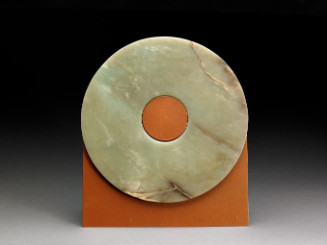
This semi-translucent stone of soft olive-green color with opaque buff mottling and some dark brown coloring in areas that show signs of alteration from burial, the inner and outer edges well finished and the stone with a high, soft polish, some chips
Chinese Artist
Zhou Dynasty (c.1050-256 BCE) or earlier
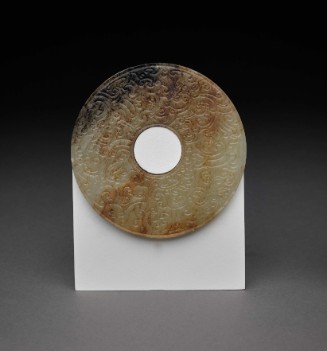
Disc with Cloud Pattern
Chinese Artist
Eastern Zhou dynasty (770-256 BCE)
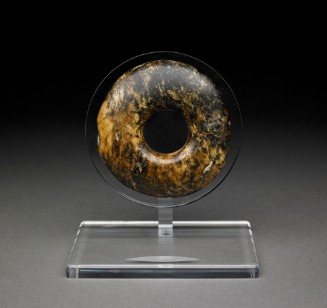
Disc
Chinese Artist
Neolithic Period or later
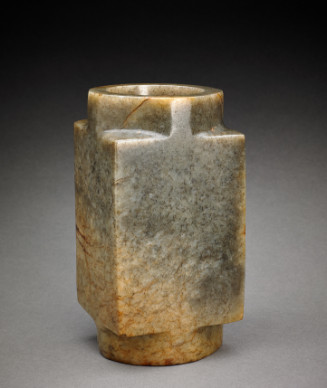
The semi-translucent stone of rich, dark olive-green color with brown mottling and veining, with areas of yellowish-buff color emanating from some of the veins and some opaque alteration from burial, carved as a rectangular block enclosing a cylindrical tube extending beyond the triangular shoulders at either end to form a collar, with a smooth satiny polish, some encrustation
Chinese Artist
Western Zhou dynasty (c. 1050-771 BCE)
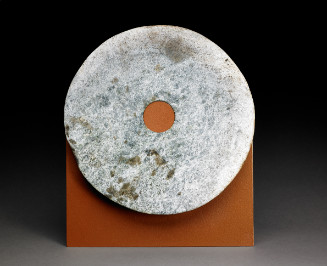
This large bi disc has been meticulously worked with a subtle concave rim rarely seen on bi discs of this size. Small circular bracelet-form jades from recent Liangzhu excavations show edges which are slightly concave in shape. This suggests an original bone-derived stylistic element. Although these wearable jades with concave edges are more frequently seen, this bi example of large size is most unusual. The surface of the bi disc is highly polished, and there has been much attention to both sha…
Chinese, Liangzhu culture
Neolithic period or later
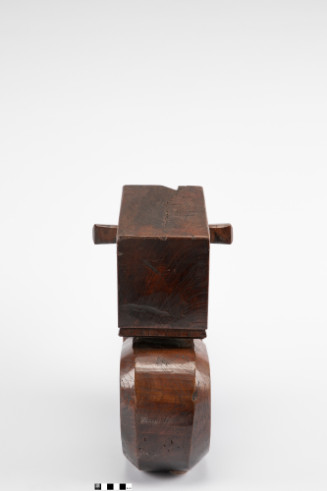
Jizai or hearth hanger hook in a Daikoku style with a high elongated cap proportionately equal to the rounded bottom hook, the curling edges of which are faceted. Carved of zelkova wood with a lacquer finish and warm patina.
Japanese Artist
Edo Period (1615-1868), 18th-early 19th century
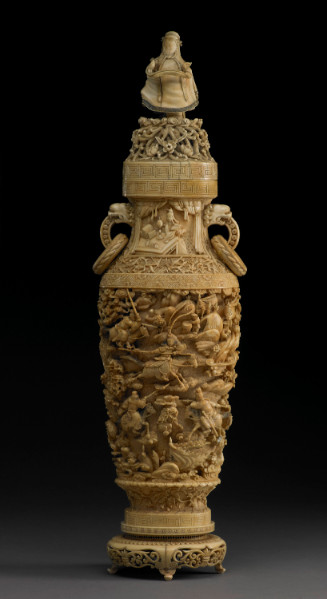
Vase with Scenes from the Novel Sanguo Zhi
Chinese Artist
Qing dynasty (1644-1911), late 18th century
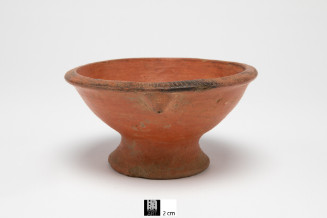
Late Polychrome Period, orange on buff.
Small rounded bowl with 1" tall base ring, flaring outward, rounded concave underneath - wall slopes outward, slightly rounded, with outward flare of rim, angled downward - one small nubbin on side beneath rim.
Rim divided into 6 even sections by 3 groups of incised parallel lines, separated by blank sections. Brown ware with red slip.
Costa Rican Artist
1200-1525
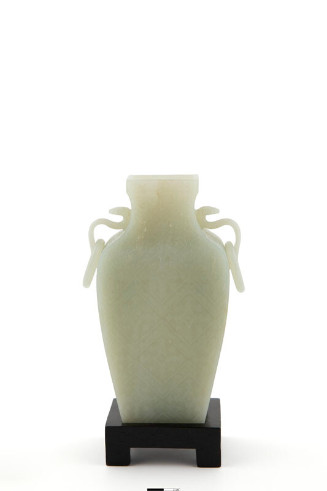
A jade vase of rectangular section, the sides gently tapering towards the slightly recessed base, the waisted neck with straight mouth rim, and worked in relief with two ruyi-sceptre handles from which loose rings are suspended. They body decorated overall in sunken relief with a geometric design of chevrons, clouds and squares. The stone a pale celadon stone. The base with an incised six-character reign mark Qianlong yu yong (for imperial use).
Chinese Artist
18th-19th century
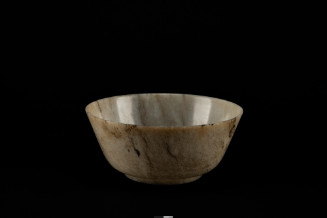
Well carved bowl with slightly flaring sides rising from a shallow foot ring, the stone of pale greyish-white tone with opaque white flecks and pale brown mottling and veining throughout, softly and evenly polished.
Chinese Artist
17th-18th century
null