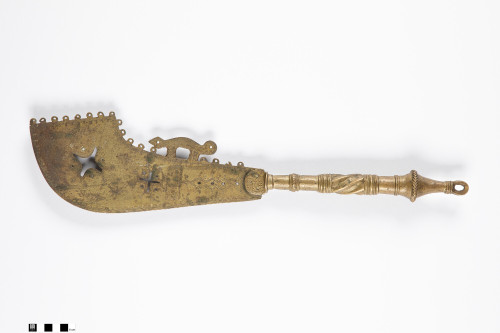
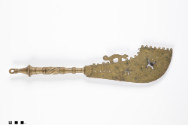
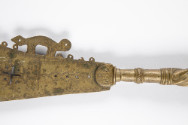
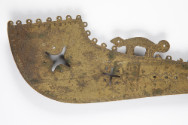
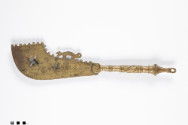
Forged curved blade with blunt end, and cast brass handle; cut out depiction of a chameleon on the inner curve, and cross cut-out in center of blade, with words engraved above: MK Balogu; Kent I of AL on one side and 23. 9 47 XX   MK Balogu AL on the opposite side. Engraved images of fish, serpents and possibly a frog, with borders of small circles. Edge of blade has rings, possible for attaching crotal bells (now missing).
Ceremonial knife
Courtesy of the Harn Museum of Art, Photography by Foad Seyed Mohammadi

Ceremonial knife

Artist Fon Artist
Date20th century
Place of originBenin, Africa
MediumBrass and metal (possibly iron)
Dimensions11 × 5 in. (27.9 × 12.7 cm)
ClassificationsFurnishings and Equipment
Credit LineGift of Drs. John and Nicole Dintenfass, in honor of Susan Cooksey
Object number2020.31
Collections
Visual Descriptionorged curved blade with blunt end, and cast brass handle; cut out depiction of a chameleon on the inner curve, and cross cut-out in center of blade, with words engraved above: MK Balogu; Kent I of AL on one side and 23. 9 47 XX MK Balogu AL on the opposite side. Engraved images of fish, serpents and possibly a frog, with borders of small circles. Edge of blade has rings, possible for attaching crotal bells (now missing).
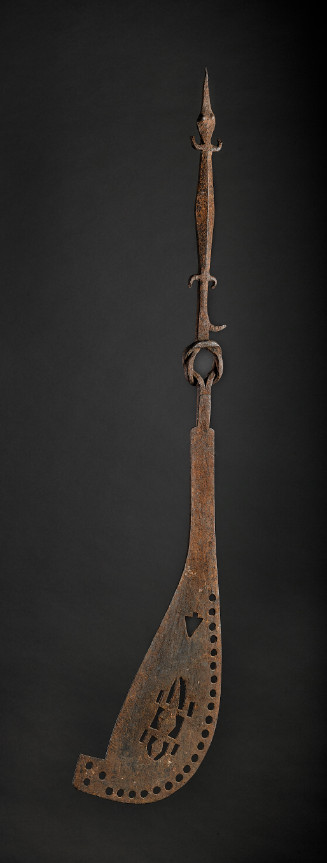
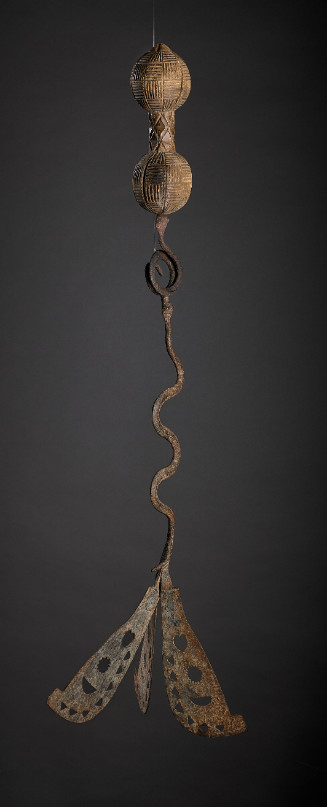
Sword with double-lobed handle of incised wood with traces of gold leaf, bronze serpent forming the shaft, terminating in three cut-out curved blades.
Akan Artist
19th-20th century
Sword with crocodile motif handle and cut out crocodile on blade.
Akan Artist
19th -20th century
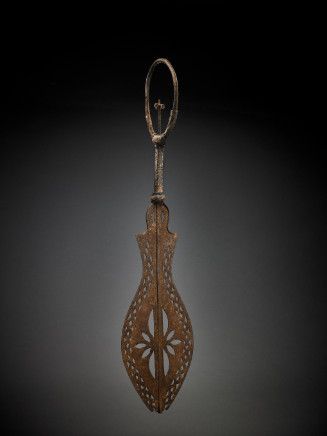
Flat bronze blade with cut out motif in center and around edges, ivory handle and loop on tope with cluster of twisted iron rods in center.
Edo Artist
19th Century
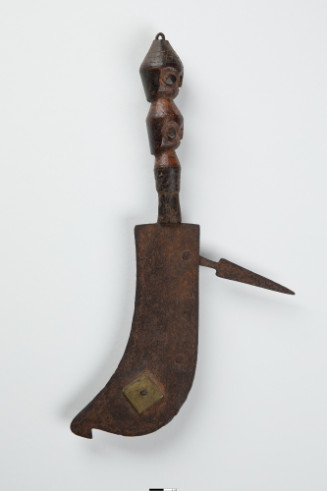
Knife with curved blade, with small stabbing blade attached, figurated handle with two heads.
Sierra Leonean Artist
20th century
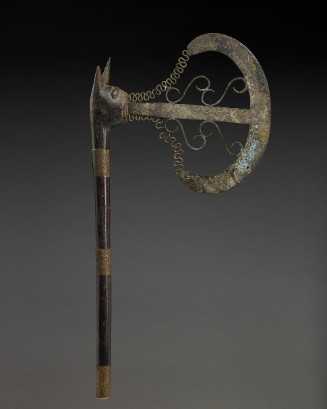
Axe with wood handle surmounted by bronze feline head and crescent shaped blade flanked by scrolls and joined to handle by fine undulating strands
Fon Artist
19th Century
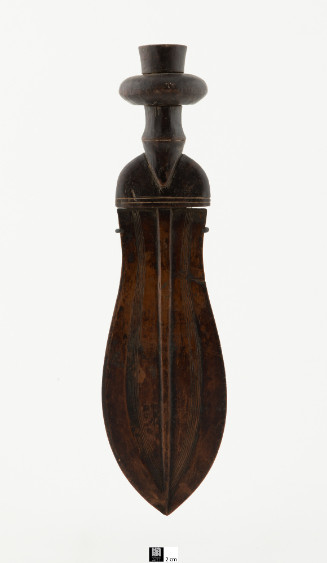
Broad knife with grooves on blade.
Kuba Artist
20th century
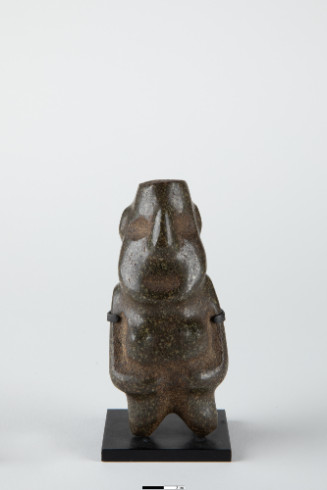
Standing female figure in the form of an axe head, feet form chisel end, separated by cut groove, hands on abdomen, arms indicated at side, breasts apparent, head tapers towards top, nose is large protruding blade, eyes and mouth are shallow grooves, top of head is pecked flat.  Bottom of feet and top of head have peck marks as if used for striking.
Mezcala Artist
100 B.C. - 200
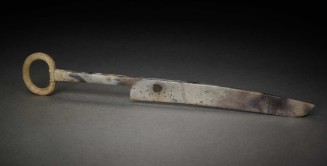
Carved as a long slender blade of slightly curved outline tapering in thickness towards the tip and the cutting edge from an upper, and thicker, flat edge which is a continuation of the narrow, beveled handle, fitted at its end with a short similar section set at the base of a slight saddle with raised edges from which issues a faceted oval ring, the blade now altered from burial to an opaque pale and dark mottled gray with a few translucent buff patches remaining, the ring section somewhat opaq…
Chinese Artist
Warring States Period (c. 475-221 BCE)
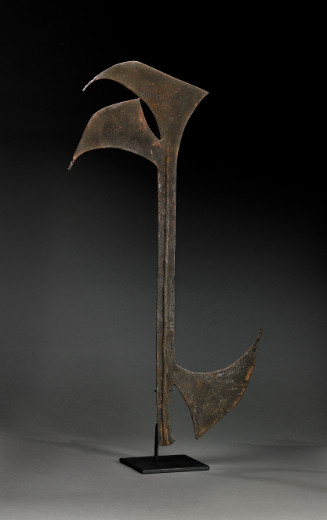
Forged metal with two triangular blades on left, one with one blade on right. Each is curved and tapers to a fine point that is twisted on the extremities.
Ndengese Artist
20th century
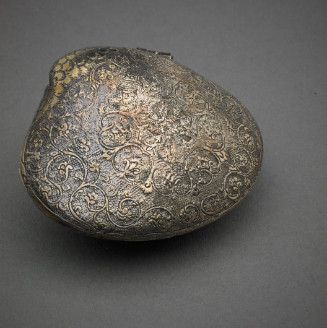
Realistically formed inside and out as a clam shell, each side engraved with a large central flower head encircled by a border of eight foliate lobes surrounded by leafy foliate scroll, all reserved on a ring-punch ground, the hinged area engraved with feathers bearing traces of gilding
Chinese Artist
Tang dynasty (618-907)
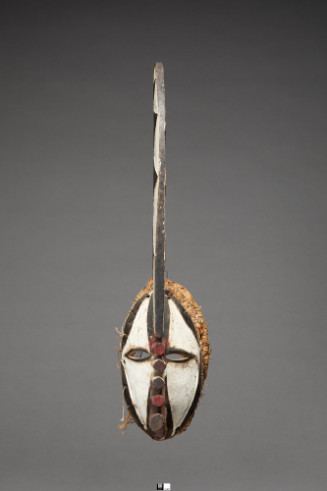
Mask with white and black paint; Face has white diamond shape, three tubes (red, white and black) projecting over the larger tubular mouth, A large blade attached to the forehead with black triangles on white ground. Raffia basketry on back.
Afikpo Artist
1970-1971
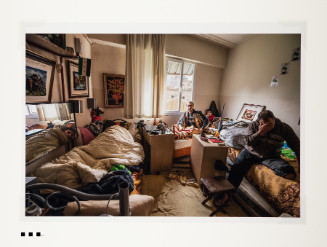
Dar Al Salam Rehabilitation Clinic, Reyhanli, Turkey, December, 2012
Gloriann Liu
Photo date: 2012; Print date: 2016
null