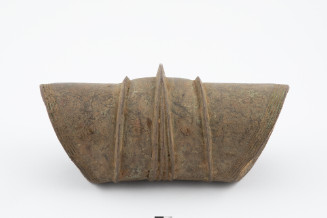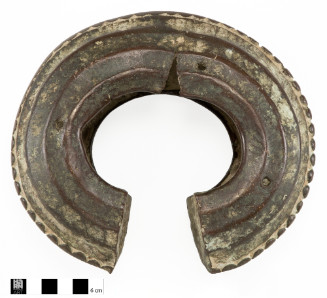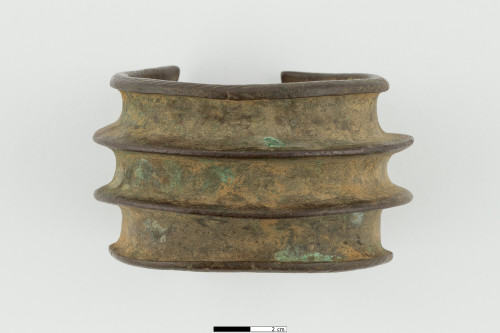
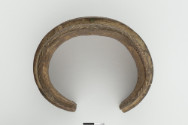
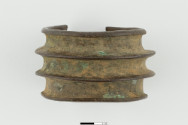
Solid metal anklet, cast from a puddle mold. Three tiers or bands with two prominent central rings. Some erosion and oxidation.
Anklet
Courtesy of the Harn Museum of Art, Photography by Foad Seyed Mohammadi

Anklet

Maker Nkundu Artist
Dateearly-mid 20th century
Place of originMbandaka, Equateur, Democratic Republic of Congo, Africa
MediumCopper alloy
Dimensions2 1/8 x 4 x 3 1/2 in. (5.4 x 10.2 x 8.9 cm)
ClassificationsClothing and accessories
Credit LineGift of Sally and Rand Spiwak
Object number2003.28.1
Collections
Visual DescriptionSolid metal anklet, cast from a puddle mold. Three tiers or bands with two prominent central rings. Some erosion and oxidation.
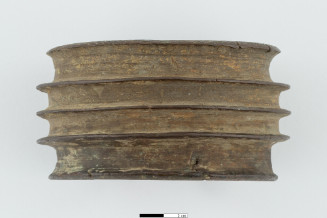
Solid metal bracelet, cast from a puddle mold. Four tiers or bands with three prominent central rings.
Nkundu Artist
early-mid 20th century
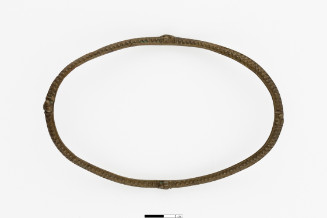
Tubular form with ridges and herringbone pattern on edges of central axis of exterior.
Ekonda Artist
19th-20th century
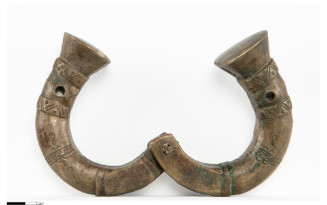
Ring bracelet with flared ends, hinged in center, with inscribed geometric motifs.
Tuareg Artist
20th century
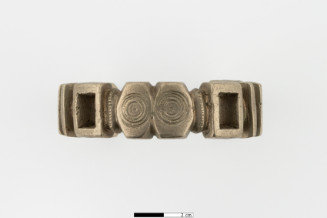
Cast metal bracelet with openwork squares pattern and inscribed spirals on center and end.
Igbo Artist
20th century
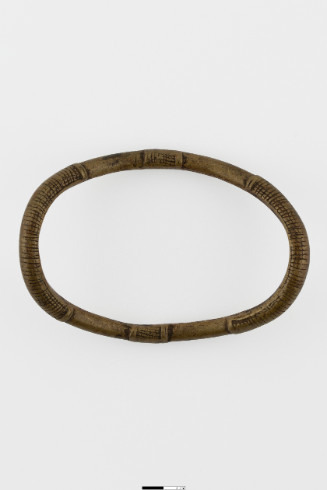
Ovoid brass anklet; with incised lines; cast brass.
Senufo Artist
20th century
brass cast ring with open area in back; carinated form with beadin along center ridge, white accretions and patination
Dan Artist
early 20th century
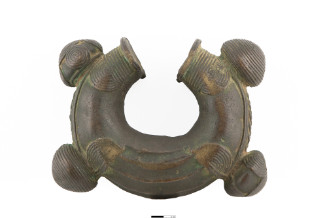
Ovoid brass anklet; python head motif on four points; all over pattern of scales of serpent.
Senufo Artist
20th century
Pair of anklets (hujuul)
Somali Artist
undated
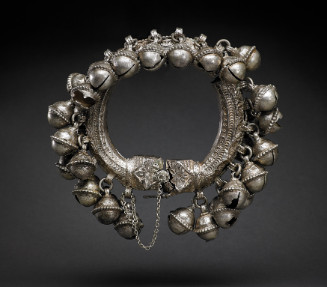
Anklet with two sections, pin on chain fastener; two rows of bangle bells around circumference.
Somali Artist
19th-20th century
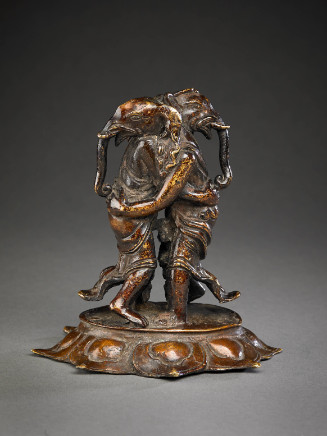
Two elephant headed figures embracing
Nepalese
19th century
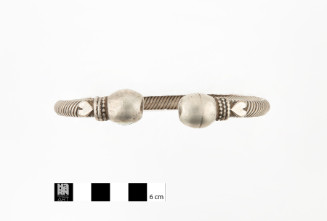
A heavy brass lost wax (cire perdue) cast open ring with fluted surface and globular knobs with spiral motifs. Visible file marks on some areas, and some pocking, with clayey encrustation.
Kru Artist
19th century or earlier
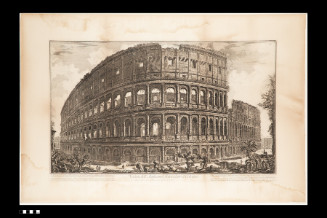
A sepia-toned etching of the Colosseum. The massive, curving amphitheater features multiple tiers of arched openings and ruined stone. Small figures and trees are scattered at the base, with faint text printed along the bottom margin of the paper.
Giovanni Battista Piranesi
undated
null