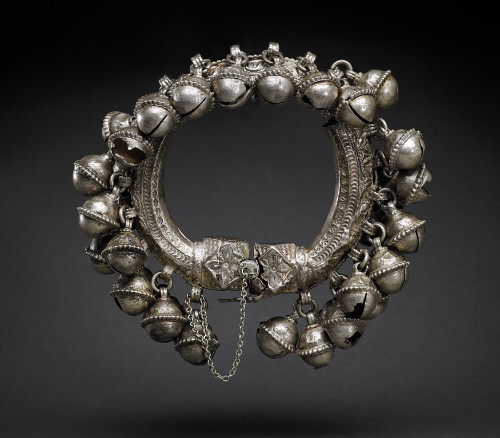
Anklet with two sections, pin on chain fastener; two rows of bangle bells around circumference.
Anklet
Courtesy of the Harn Museum of Art, Photography by Randy Batista

Anklet

Maker Somali Artist
Date19th-20th century
Place of originSomalia, Africa
MediumSilver
Dimensions7 1/4 × 6 1/2 × 1 3/4 in. (18.4 × 16.5 × 4.4 cm)
ClassificationsClothing and accessories
Credit LineGift of Katheryne Loughran and John Loughran, President of Foundation for Cross Cultural Understanding
Object number2005.28.37
Collections
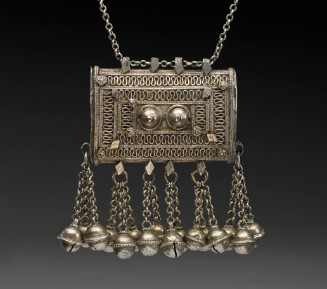
Visual DescriptionAnklet with two sections, pin on chain fastener; two rows of bangle bells around circumference; "Repousse bells with applique work and diamond shaped ends, floral applique clasp with chain and bar closure."
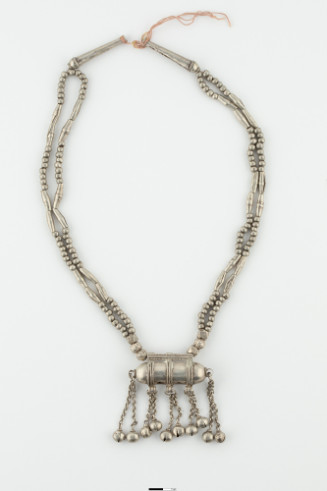
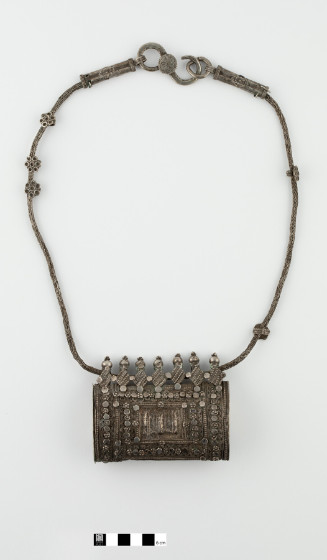
Rectangular porte Koran in silver filigree and diamond shaped applique work, with dangles/bells (shannuf) suspended on silver chain.
Somali Artist
18th - 19th century
Rectangular Porte Koran in silver filigree and diamond shaped applique work, with dangles/bells (shannuf) suspended on silver chain.
Somali Artist
18th century
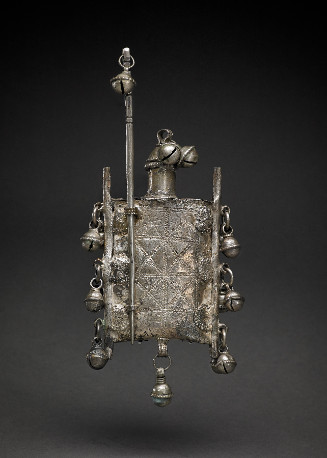
Rectangular vessel with rounded stopper, "saddle bag" design with bangle bells attached.  Inscribed surface of overlapping diamonds.  Stick mounted through loop on side, has bangle bell on handle end.
Somali Artist
19th-20th century
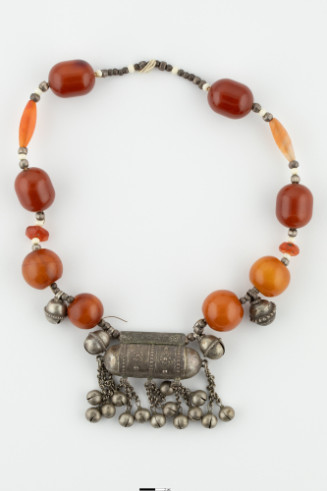
Koranic Amulet (xirsi)
Somali Artist
18th Century
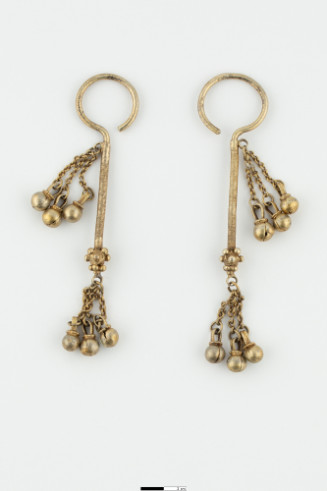
Looped earrings have chains and bells attached.
Somali Artist
undated
Rectangular porte Koran with appliqué, filigree and repoussé work on chain belt with appliqué medallions and large "S" shaped clasp.
Somali Artist
18th Century
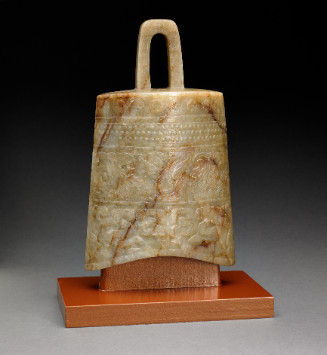
Bell is divided into sections which are reminiscent of the piece-mold technique of seaming the elements of the bronze bells together, seen on this jade bell as design elements. This archaistic bell is of greenish-gray jade with russet inclusions. In our opinion this archaistic bell expresses the refinement of design and technical workmanship of the late Song to early Ming period.
Chinese Artist
Song Dynasty (960-1279) or later
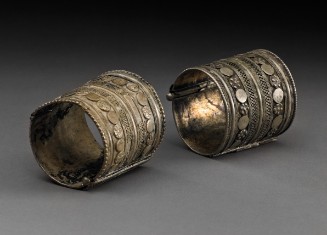
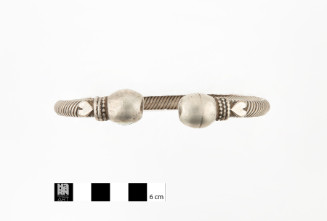
Pair of Silver Cuffs
Somali Artist
early 19th century
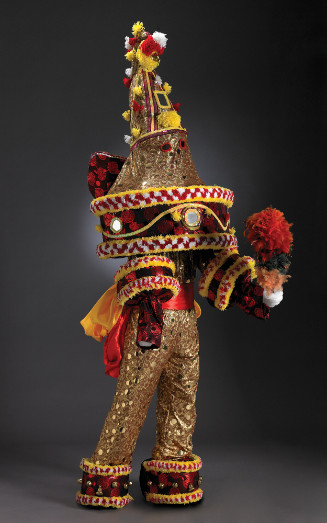
Masquerade costume consists of an Ebonko head (name of the conical curving feature found on head piece is called Etundu); a tailored cloth shirt and trousers (known as Ofon Idem Ebonko); cloth mane worn on chest and wrapped around shoulders (Ofon Nyanya); two hand tufts with small bells worn around wrist (Ita Ubok); two leg tufts with small bells worn around ankle adorned with small bells (Ita Ukot); a winged hat worn on the back of the head (Itam Ekot), a Mbobo cloth girdle with decorative fold…
Ekpenyong Bassey Nsa
2010
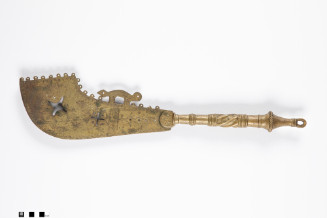
Forged curved blade with blunt end, and cast brass handle; cut out depiction of a chameleon on the inner curve, and cross cut-out in center of blade, with words engraved above: MK Balogu; Kent I of AL on one side and 23. 9 47 XX   MK Balogu AL on the opposite side. Engraved images of fish, serpents and possibly a frog, with borders of small circles. Edge of blade has rings, possible for attaching crotal bells (now missing).
Fon Artist
20th century
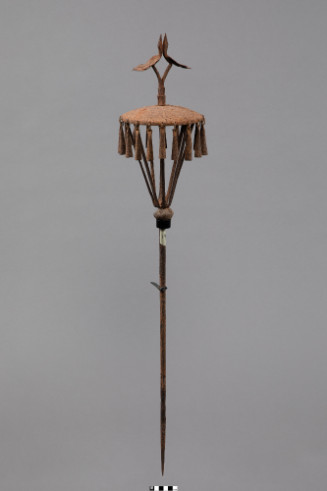
Iron staff surmounted by disk; two abstract heraldically configured birds; conical bells suspended from lower edge of disk.
Fon Artist
19th-20th century
Pair of anklets (hujuul)
Somali Artist
undated
null