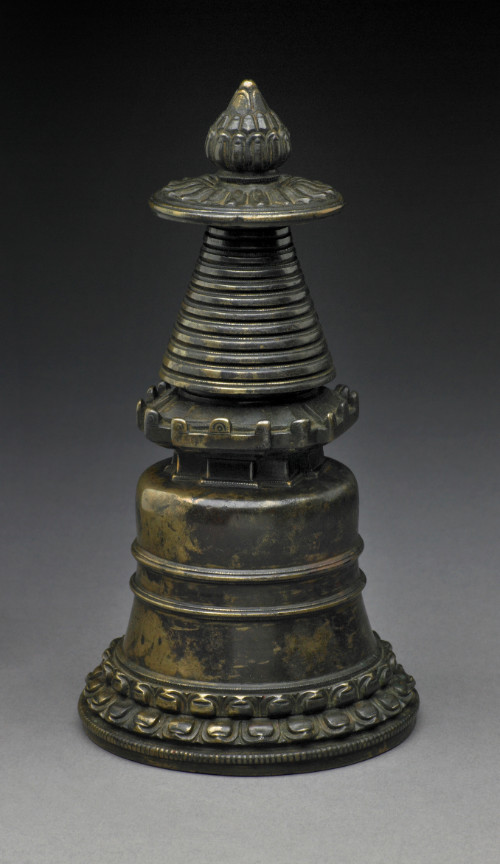
Kadamspa style, lotus base, cylindrical center, supporting square turret, tapering parasols, lotus disk and bud-shaped shaped finial
Chorten Reliquary
Courtesy of the Harn Museum of Art, Photography by Randy Batista

Chorten Reliquary

Maker Tibetan
Date13th century
Place of originTibet, Asia
MediumBronze
Dimensions7 1/8 x 3 11/16 in. (18.1 x 9.4 cm)
ClassificationsFurnishings and Equipment
Credit LineMuseum purchase, gift of Janet M. Elliot
Object number2000.5
Collections
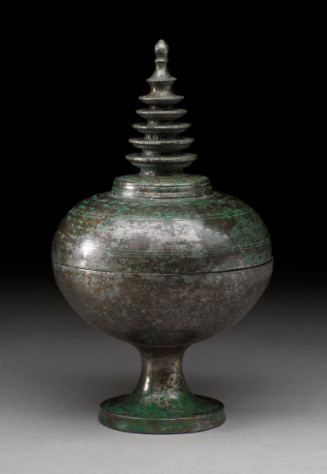
Visual DescriptionKadamspa style, lotus base, cylindrical center, supporting square turret, tapering parasols, lotus disk and bud-shaped shaped finial
The domed cover has a raised central section surmounted by a five-storied stupa with a bud-shaped finial over two knobs; the cover is incised with bands of fine lines; the cup is on a waisted stem with a widely spread foot
Chinese Artist
Tang dynasty (618-907)
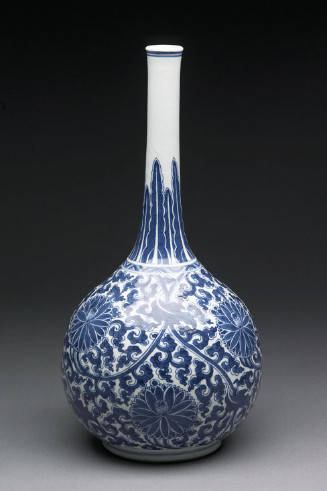
Bottle-shaped vase with bulbous body and long tapering neck. Surface decoration of blue glaze on white ground has lotus scroll with blossoms and foliate motif on neck base.
Chinese Artist
Qing dynasty (1644-1911), 18th-19th century
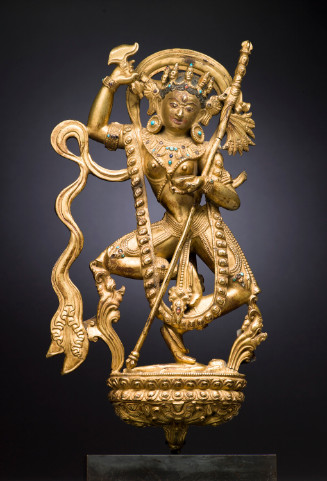
A female deity of Tibetan Buddhism standing in a dancing posture, holding a curved knife in her right hand and a staff decorated with skulls in her left hand.
Tibetan
13th Century
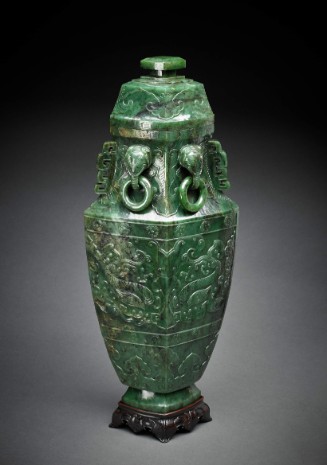
Carved with archaistic motifs
Chinese Artist
19th century
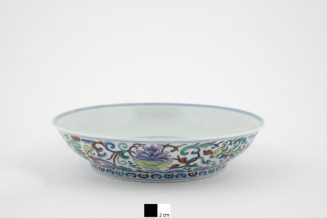
Interior of dish decorated with design of three phoenixes surrounding a stylized lotus blossom; the exterior also decorated with a band of phoenixes; six-character mark on base.

With shallow rounded sides rising to a slightly everted rim, brightly enameled with a central medallion of three archaistic phoenixes encircling a stylized lotus blossom borne on curling stems repeated in a frieze on the exterior, a border of C-shaped motifs enclosing a dot encircling the foot.
Chinese Artist
Qing dynasty (1644-1911), Daoguang reign (1821-1850)
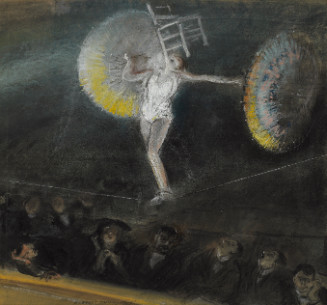
Pastel drawing of a female circus performer walking across a tightrope while holding two open parasols and balancing a chair on her chin. An audience looks on at the bottom of the frame.
Everett Shinn
1904
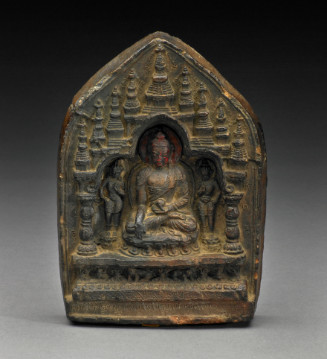
An arched dark relief of a seated, cross-legged figure flanked by two smaller standing figures. Traces of red pigment mark the central face. Multiple carved tiered towers fill the upper arch over a decorated, patterned base.
Tibetan
c. 15th century
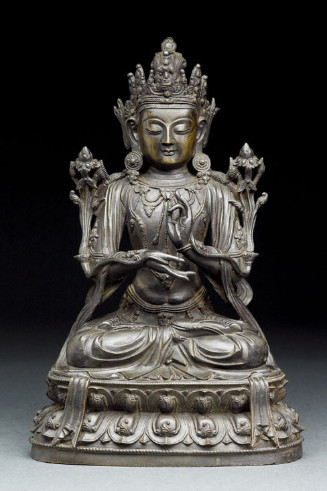
Figure of Avalokiteshvara seated in padmasana on lotus plinth. Right hand in varadamudra and left hand in vitarkamudra. Lotus stems held in each hand. Body adorned with beads and 5-pointed crown has image of seated Amitaba Buddha in center.
Chinese Artist
Ming Dynasty (1368-1644), 15th-16th century
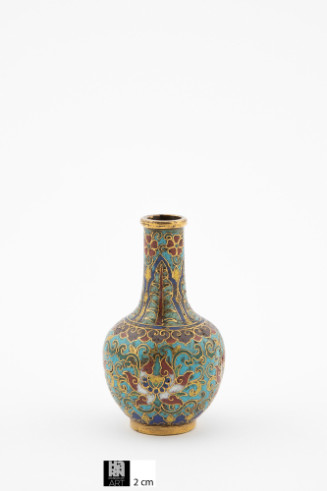
A fine cloisonné enamel vase of globular bottle form with a cylindrical neck and low gilt foot rim, decorated with ruyi-head lappets at the foot and around the shoulder; the body decorated with formalized lotus flowers, leaves and stems; the neck decorated with flowers above tall leaf-form lappets; all enameled in red, yellow, white, lapis blue, light and dark green, and aubergine on a turquoise ground.
Chinese Artist
18th Century
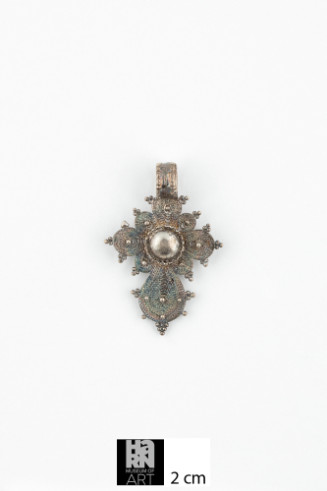
Silver pendant cross composed of disks and teardrop shaped lower vertical arm, the outer edge of each arm has trefoil spherical finials; on either side of the short arms are protruding half circles with a trefoil shape on its rim; the center of the cross has a large hemispherical boss with an incised line around it, the granulated surface of the cross is darkened; has a ring for suspension with beading
Ethiopian Artist
undated
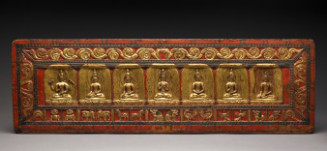
Seven Buddhist deities are depicted in seated positions; auspicious symbols within scrolling border; they sit on thrones supported by animal vehicles; gilt gold and pigment on carved wood.
Tibetan
12th century
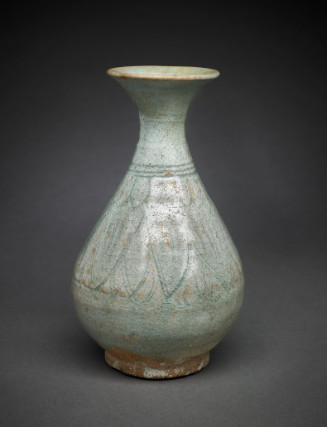
Pear-shaped bottle with low belly, long sloping shoulder and neck, flared mouth; light blue-green celadon glaze over incised downward pointing lotus petal design, with three incised lines at shoulder; glazed to immediately about foot. Shallow ring, exposed reddish-tan clay.
Thai Artist
15th-16th century
null