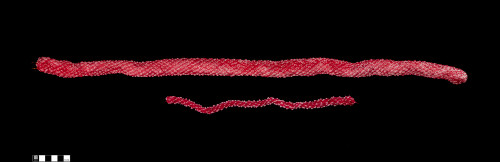
Coral colored obi ties.
Two obigime
Courtesy of the Harn Museum of Art, Photography by Foad Seyed Mohammadi

Two obigime

Artist Japanese Artist
DateShowa period (1926-1989)
Place of originJapan
MediumTextured fabric
Dimensionstie a: 1 1/4 × 28 in. (3.2 × 71.1 cm)
tie b: 1/2 × 13 in. (1.3 × 33 cm)
ClassificationsClothing and accessories
Credit LineGift of Shinichi Doi
Object number2016.56.14
Collections
Visual DescriptionCoral colored obi ties.
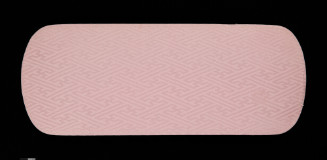
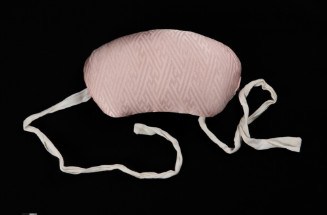
Pale pink thick obi padding with geometric design and ties.
Japanese Artist
Showa period (1926-1989)
Long tie-dyed obijime with coral, blue and white.
Japanese Artist
Showa period (1926-1989)
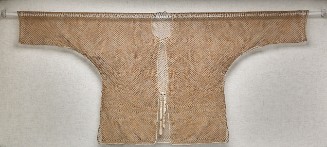
Network of bamboo tubes, the edges finished with silk with ties and a button-like clasp on the front
Chinese Artist
19th century
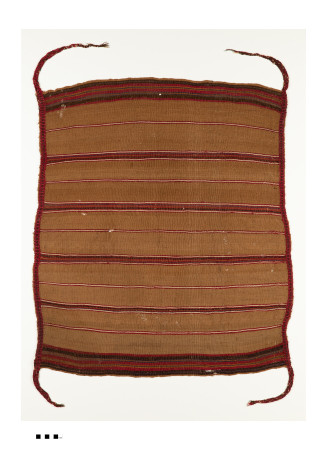
Woven in a double-cloth pattern with a plain field of brown with widely spaced thin stripes of white, red and black with a narrow border of red, top and bottom, and a border edging of red and black at the sides, ties at each corner.
Chancay Artist
1200-1450
Mask with scarifications; surmounted by a large tray with bowl; complex ties; pigments.
Yoruba Artist
mid 20th century
Apron
Tsonga Artist
late 20th century
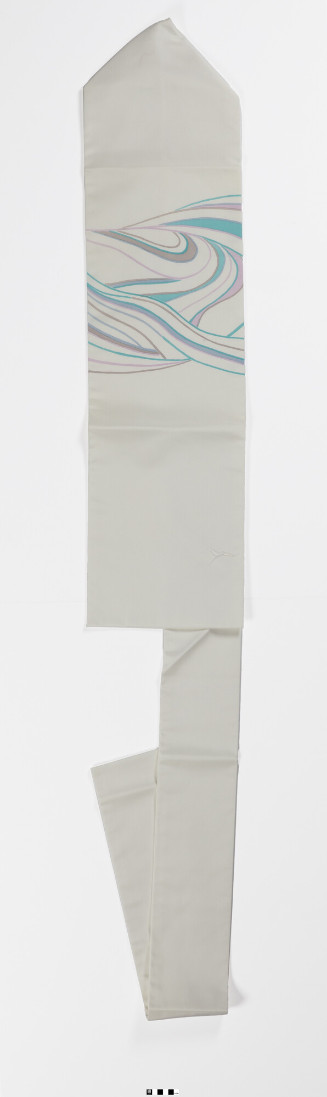
Cream colored obi with painted design.
Japanese Artist
Showa period (1926-1989)
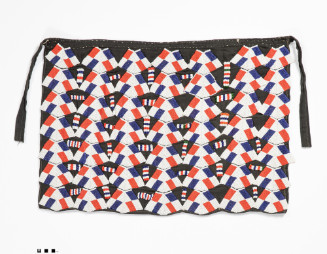
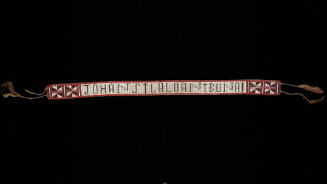
Rectangular strip; woven glass beads; white ground, red edges; "JOHANS LALOAN BUNAI" in black; blue and black pinwheel panels at ends; cord ties with tassels; tan canvas backing
Papua New Guinea
undated
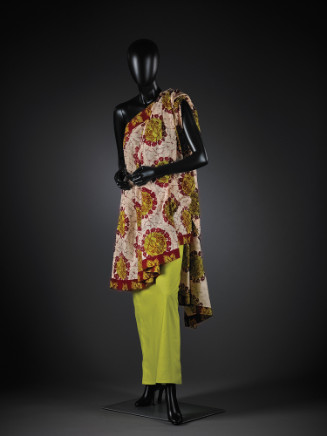
Wax print cloth (commercial cloth) with burgundy and lime green floral motifs, burgundy border around neckline and hem; to be worn with one shoulder exposed; knee length

The Akwadzan is sewn from wax print fabric, likely produced by Ghana Textiles Production, a Ghanaian company that Chez Julie officially collaborated with during the late 1960s and early 1970s.  The background of the wax print is a light shade of coral/salmon, with a repeated medallion pattern of a bird on a branch, surrounded…
Juliana Kweifio-Okai
late 1960s
Formal wedding obi (maru obi) with patterned silk brocade on both sides- very heavy
Japanese Artist
Taisho era (1912-1926)
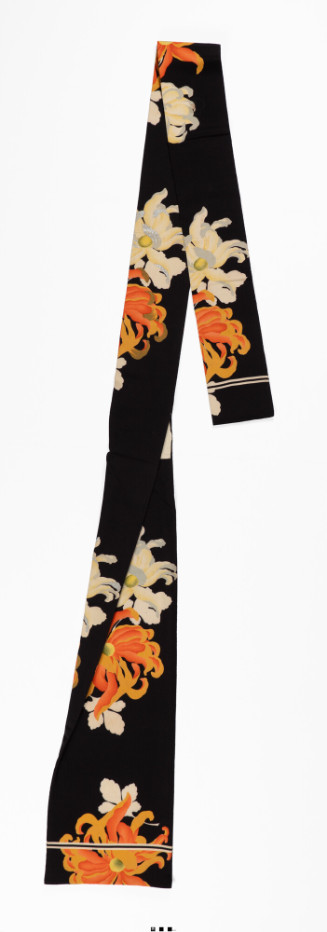
Black obi with floral design.
Japanese Artist
Showa period (1926-1989)
Pale pink obi padding.
Japanese Artist
Showa period (1926-1989)
null