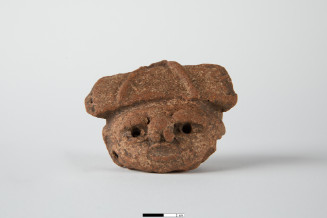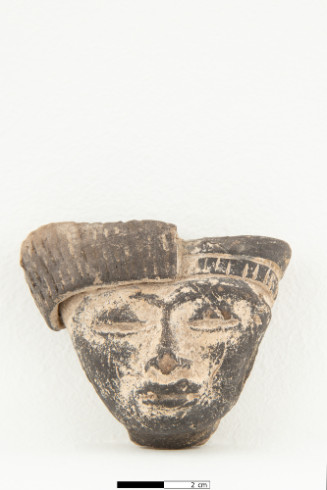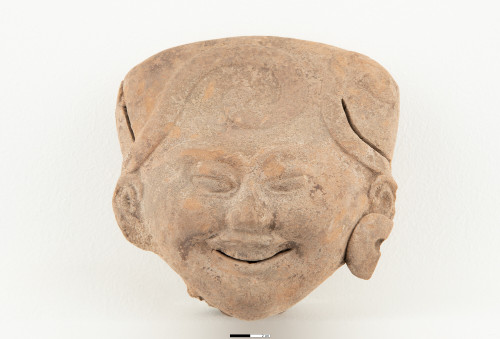
Smiling head of child scroll headdress on flattened skull, fragment—removed from body
Head of Child
Courtesy of the Harn Museum of the Harn Museum of Art, Photography by Foad Seyed Mohammadi

Head of Child

Artist Mexican Artist
Date600-900
Place of originVeracruz, Mexico, North and Central America
MediumCeramic
Dimensions6 × 5 1/2 × 3 1/4 in. (15.2 × 14 × 8.3 cm)
ClassificationsSculpture
Credit LineGift of John F. and Lynn T. Scott
Object number2018.52.5
Collections
Visual DescriptionSmiling head of child scroll headdress on flattened skull, fragment—removed from body
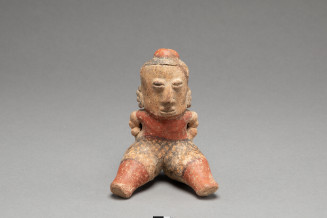
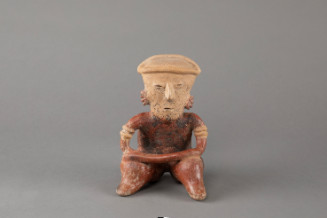
Large hollow seated male figure with large head, ribbon type headdress, coffee bean eyes, small protruding nose, slit mouth, elongated face, multi-earrings with red slip, short neck, long boneless arms folded across and resting on thick bent legs with blunt feet, body with red slip and black dendritics marks on chest, white slip armbands, buff-colored face and headdress.
Mexican Artist
100 BCE-200 CE
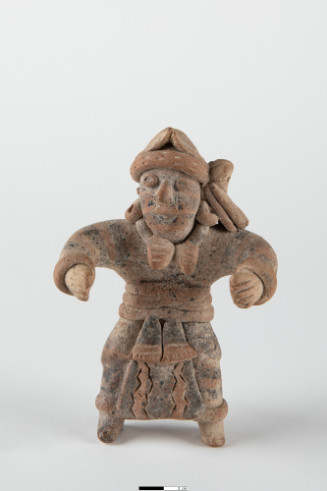
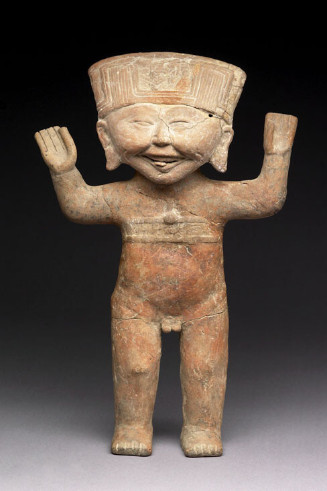
Standing male figure with arms held out as in an embrace wearing long skirt with wrapped sash that hangs in front ending in tassels, has small triangular "tail", shell like object protruding from middle of upper back, conical headdress with small peak in front, animal skull hanging from sash on right side of head.   Face painted in horizontal black stripes arms and legs painted in black stripes skirt and sash painted with black to correspond to pattern inscribed of zig zag bands
Mexican Artist
100-200
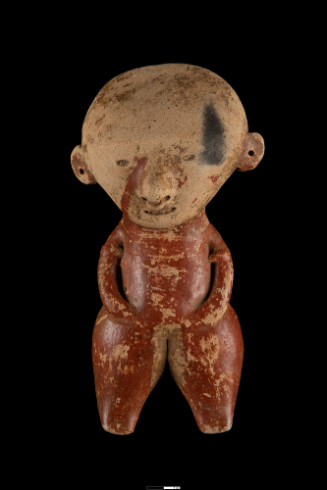
Standing female figure, frontal, small arms attached to body, hands at sides of abdomen.  Thick, stubby legs; flattened, heart-shaped head, tapering back from forehead; protruding nose with ring; slit eyes and mouth.
Mexican Artist
500 - 200 B.C.
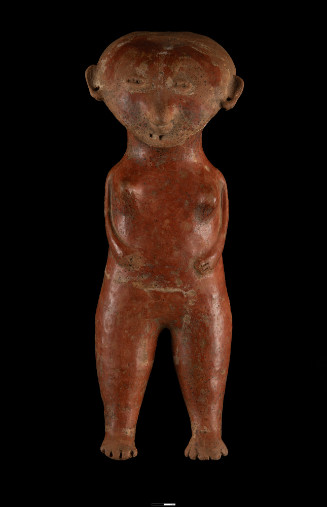
Standing female figure, frontal, small arms attached to body with hands placed on sides of abdomen, thick legs, tapering to foot with indicated toes.  Head in flattened and heart shaped protruding nose with rings, coffee bean eyes, two poke marks for mouth ears pierced, figuring in red slip, white pigment indicates groin flap, traces of white along hairline and around eyes, white indicating ankle bracelets.
Mexican Artist
100 BCE-200 CE
Object is trapezoidal, as it represents a head  with well defined features and  flaring headdress; black clay body with white residue; loss on right side; the head was originally part of a complete form, now detached below the chin
Mexican Artist
350-650
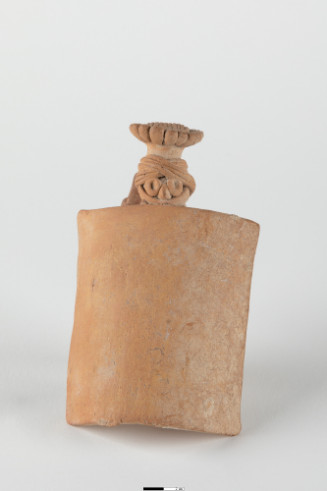
Ortices phase, standing male figure holding large, arched shield that covers all of body, upraised hand holds club, head is wrapped in bands of material-design, crossing over forehead, extending across chin, headdress extends upwards, flares out in circle with multiple lobes, check pattern (sunflower?) in middle.
Mexican Artist
300 - 100 B.C.
Seated Female Effigy Figure
Mexican Artist
100 BC-100 AD
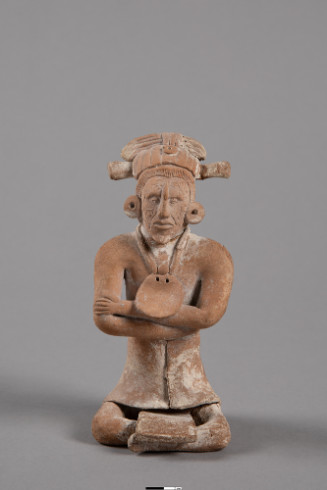
Small solid figurine of seated male with crossed legs and arms, hands on opposing elbows. Wears skirt with long loin cloth, tubular necklace with large shell pectoral, body hand formed, head mold-made, finely detailed with raised mat design on face, large ear spools, high elaborate headdress, has goatee; reddish-brown clay with fragments of white slip.
Maya Artist
550-830
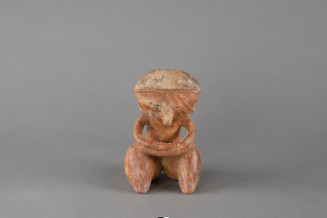
Seated hollow figure with red and white slip, large head with hole in top of crown, bowl-type headdress, broad face with coffee bean eyes, small protruding nose with nose-ring, small slit mouth, low small ears, black and orange striations, black dendritic marks, long thin boneless crossed arms resting on knees of heavy bent legs, blunt feet.
Mexican Artist
100 BCE-200 CE
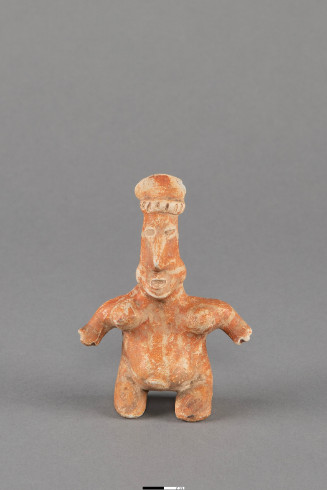
A reddish-brown clay figurine. It has short legs, short, outstretched arms, and round breasts. The elongated head features a long nose, white-ringed eyes, an open mouth, and is topped with a flat, ridged headdress.
West Mexican Artist
undated
null