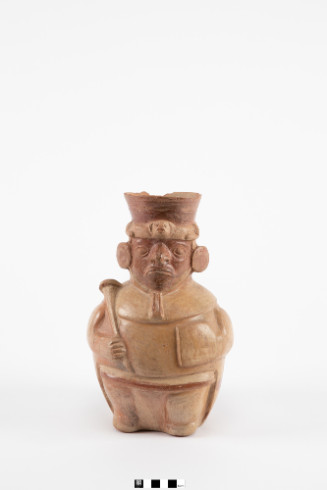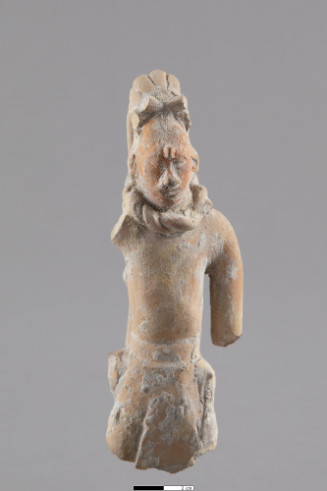
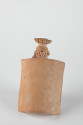
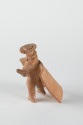
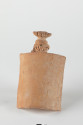
Ortices phase, standing male figure holding large, arched shield that covers all of body, upraised hand holds club, head is wrapped in bands of material-design, crossing over forehead, extending across chin, headdress extends upwards, flares out in circle with multiple lobes, check pattern (sunflower?) in middle.
Standing warrior with shield
Courtesy of the Harn Museum of Art, Photography by Foad Seyed Mohammadi

Standing warrior with shield

Artist Mexican Artist
Date300 - 100 B.C.
Place of originColima, Mexico, North and Central America
MediumCeramic
Dimensions5 3/4 x 4 x 5 in. (14.6 x 10.2 x 12.7 cm)
ClassificationsSculpture
Credit LineGift of Mrs. A.H. Spivack, in memory of Dr. A.H. Spivack
Object numberC-75-67
Collections
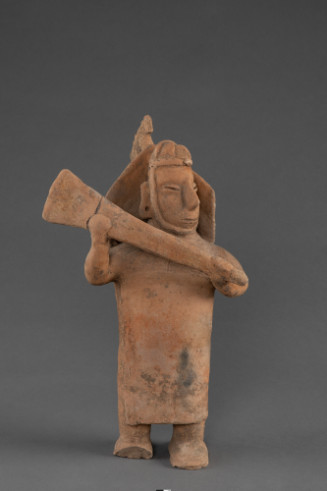
Visual DescriptionOrtices phase, standing male figure holding large, arched shield that covers all of body, upraised hand holds club, head is wrapped in bands of material-design, crossing over forehead, extending across chin, headdress extends upwards, flares out in circle with multiple lobes, check pattern (sunflower?) in middle.
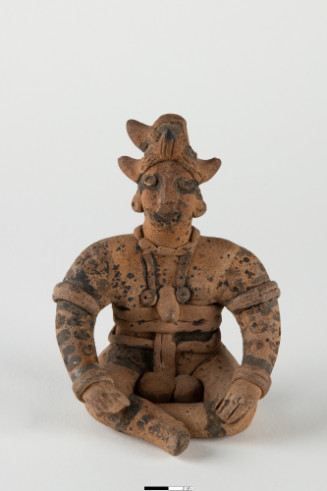
Standing male figure, arms raised, elbows bent, holding a large blade in both hands, wearing long cylindrical armor that extends up behind the head as flaps, with partial rounded crest extending from back towards head, headgear with chin strap; four diamond shapes in white located on upper shoulder region of back armor.
Mexican Artist
200 BCE -200 CE
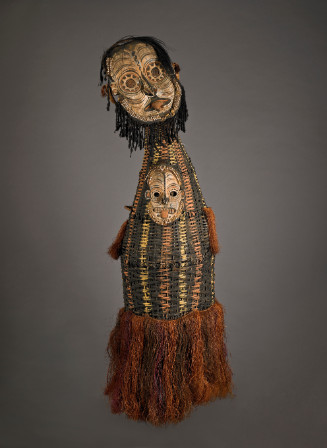
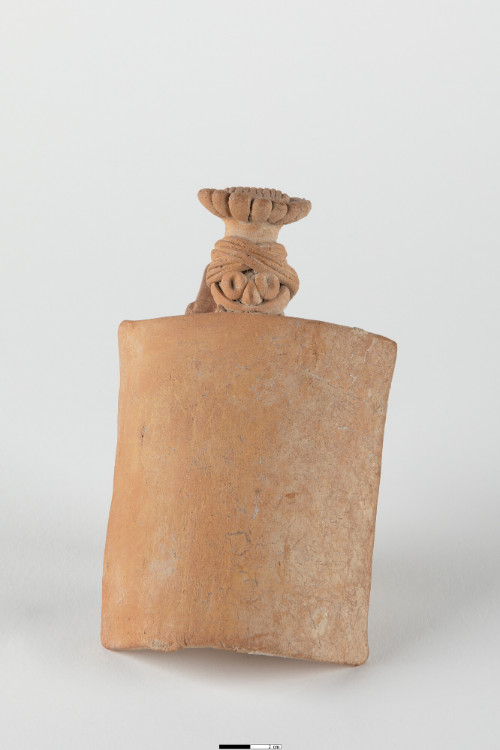
Woven basketry cone shaped from topped with traditional Sepik human head made of clay and painted designs.  Large shell eyes, typical nose and protruding tongue.  Hair beard.  Face encircled in shells, embedded with clay.  On basketry torso is the "dual" ancestor's face mocking the larger predominate face.  Raffia fringe extends from bottom.  Handle on side and back.  Wood plug earring.  Raffia fringe covers armholes inside.  Striped design in red, black and yellow.
Iatmul
20th century
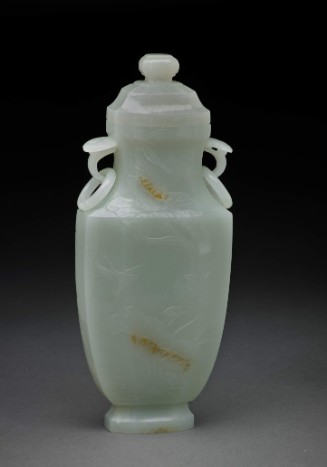
This striking octagonal vase is delicately worked from icy white jade with pale yellow surface skin markings. The artist has expertly incorporated the subtle yellow inclusions of the material with the edges of the broad graceful lotus leaves. The design extends the length of the vase to the concave neck. On either side, the covered vase is graced by handles in the shape of ruyi, or wish granting scepters. From each handle, circular rings are worked from the same jade boulder. In our opinion, the…
Chinese Artist
18th-19th century
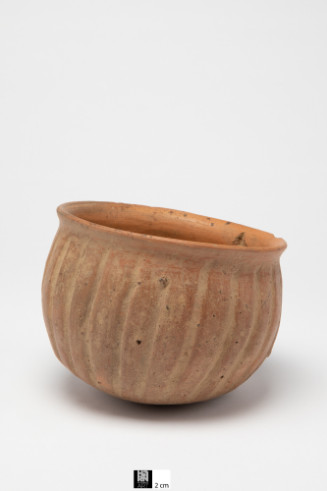
Small bowl with slightly rounded bottom, rounded walls sloping outwards, bottom half, inwards top. Small outward flare of rim. Wall is divided into numerous vertical lobes by indented vertical bands running from base to rim. Interior is smooth and round. Ceramic with orange slip
Quiché Maya Artist
1200-1500
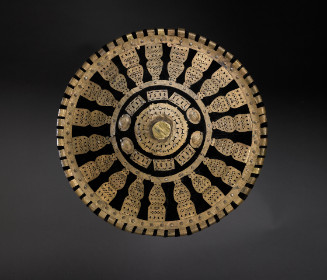
Shield of dome shaped leather with dark fabric (velvet) cover, rolled brass cut outs attached with brass studs in concentric patterns, with a central raised pedestal ending in a flat disk.
Ethiopian Artist
19th-20th century
Beautiful hand modelled figure of a man with forehead deformation, necklace and skirt, and long flowing hair that extends down back past trunk; black metal pedestal base; cinnabar, white and blue paint traces.
Maya Artist
550-830
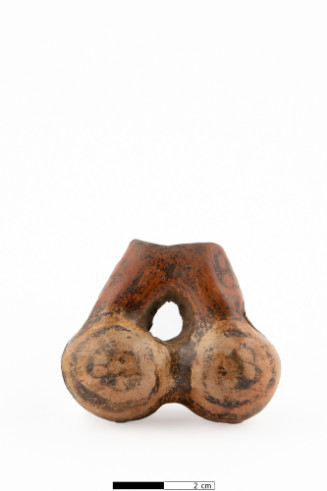
A ceramic whistle featuring two bulbous, tan lower lobes and reddish-brown arms that angle upward to meet at a single top opening, leaving a central hole. Dark brown painted circular designs decorate the lower lobes.
Panamanian
undated
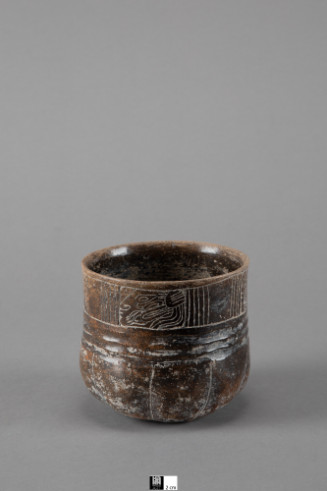
Tall bowl with flat bottom, rounded lower wall formed into nine lobes, rising into straight, vertical wall; upper frieze of four inscribed face glyphs separated by vertical lines, three wide inscribed bands below, vertical inscribed lines between each lobe.
Maya Artist
600-700
null