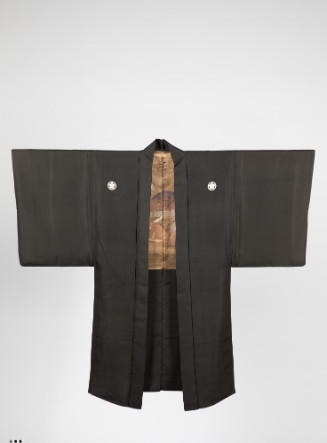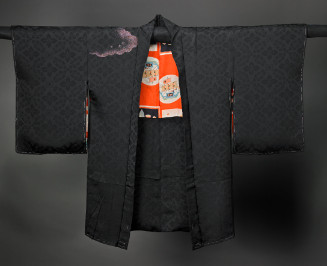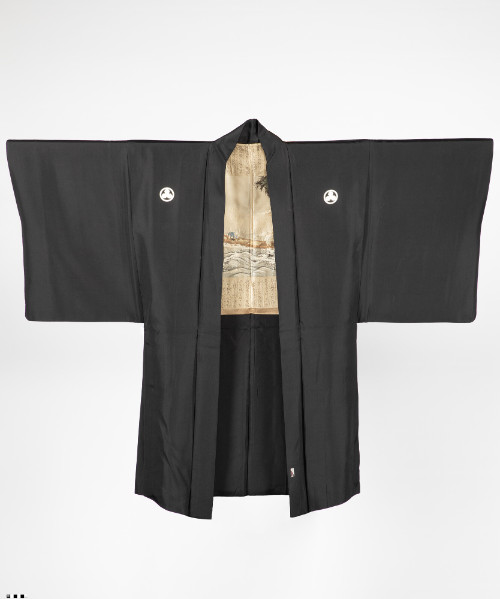
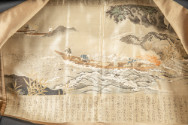
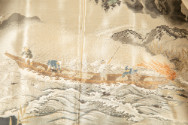
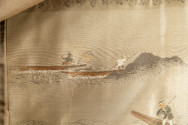
This is a men's black formal haori with unique pattern lining. The textile is habutae silk. The linking has woven patter- "ukai" (ancient fishing method catching Japanese trout by using tamed cormorants) and characters motif.
Men's haori
Courtesy of the Harn Museum of Art, Photography by Foad Seyed Mohammadi

Men's haori

Artist Japanese Artist
Dateundated
Place of originJapan, Asia
MediumDyed silk
Dimensions38 1/2 x 50 1/2 in. (97.8 x 128.3 cm)
ClassificationsClothing and accessories
Credit LineGift of Martin and Caryl McKellar
Object number2022.12.7
Collections
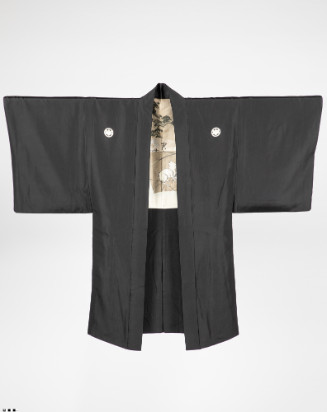
Visual DescriptionThis is a men's black formal haori with unique pattern lining. The textile is habutae silk. The linking has woven patter- "ukai" (ancient fishing method catching Japanese trout by using tamed cormorants) and characters motif.
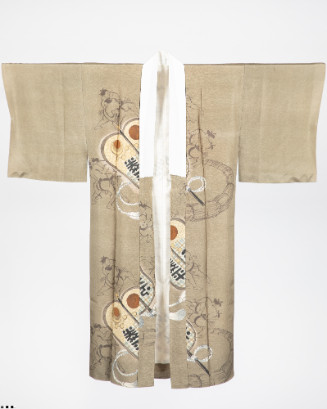
This is a men's black formal haori with unique pattern lining. Textile is habutae silk. The lining has woven pattern of rabbit, pine tree, kougou and characters.
Japanese Artist
undated
This is a men's black haori from pre-WWII. It has a man with mountain scenery motifs, which are woven finely. This mountain has various town scenery on it. Textile is habutae silk.
Japanese Artist
undated
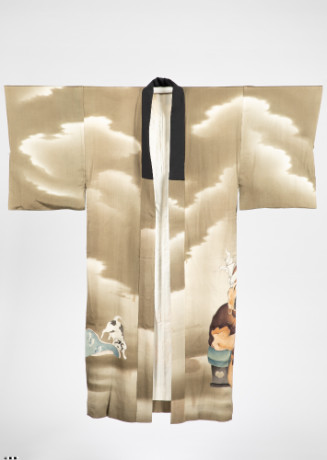
This is a men's juban (undergarment) with a design of a piece by Kawanabe Kyosai, which is dyed. Daruma has ear cleaning by a beautiful lady. Their faces are finely expressed. Textile is kinsha silk with small grains.
Japanese Artist
undated
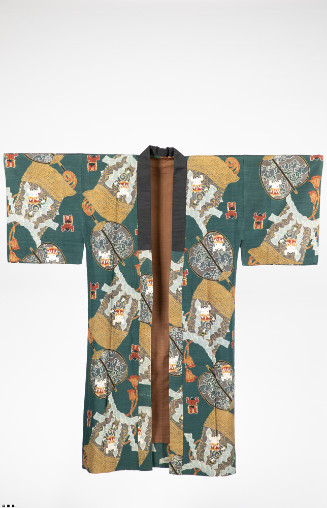
This vintage men's juban (undergarment) is made of thick green tsumugi silk. It has a wonderful sumo motif which is dyed boldly. "Mawashi", "gunpai" (referee's fan), sumo wrestler and dragon motifs can be seen.
Japanese Artist
undated
Men's juban
Japanese Artist
undated
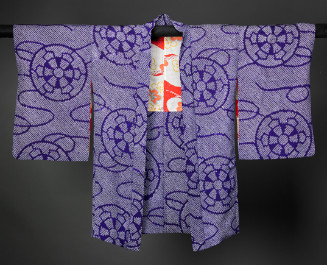
Purple silk with dot pattern overall that develop roundels with floral design within. Lining is red-orange, cream and turquoise in floral design.
Japanese Artist
Taisho Period (1912-1926)
Patterned black silk with woven design on clouds, ropes, symbols, done with gold, silver, and red threads. Lining is Art Deco in feel with patterned ships, cards and animals.
Japanese Artist
Taisho Period (1912-1926)
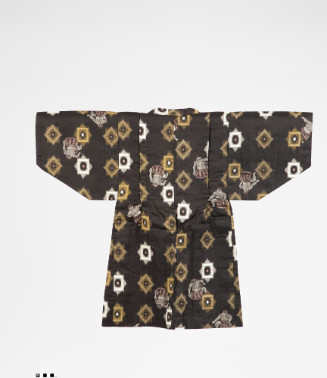
This is a boy's haori. It has a sumo wrestler and geometric pattern which is dyed. It is called "nikoniko-gasuri."
Japanese Artist
undated
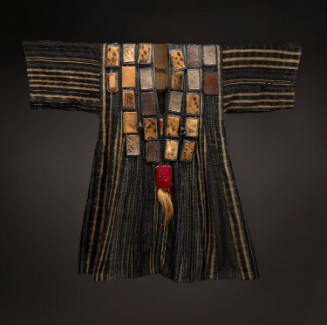
Two panels (handsewn together with red silk) in fine spun wool dyed black with heavy embroidery at the four corners in gold thread, yellow, green, red, blue silk. Embroidered patterning consists of geometric motifs resembling an architectural setting (gables and columns) or a jeweled crown with pendants; along the borders, linking the heavy inlay at the corners are small silk crosses in the above-mentioned colors. Fringes at either end are made of twisted silk threads in red, orange, mauve, gree…
Amazigh Artist
20th century
Haori with interior decorated with baseball players and cityscape
Japanese Artist
1930-1940s
null