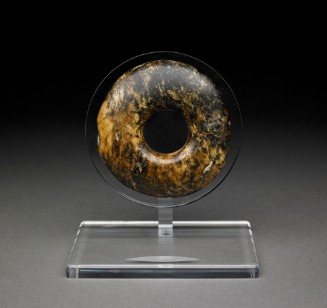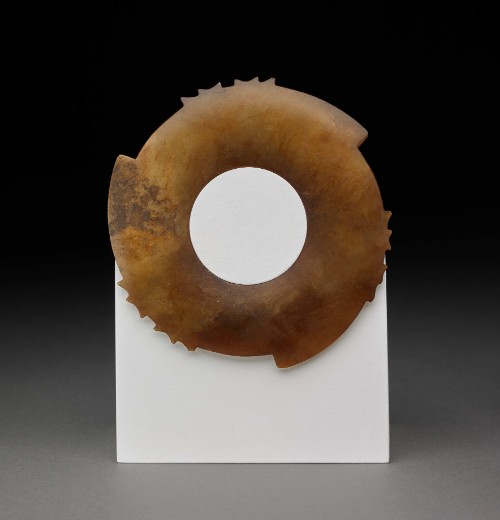
Of circular bi-shape and convex section, the edges with three equidistant notches and serrations, one surface etched with two lines at right angles, the jade of mottled brown color with a small area of calcification
Notched Disc
Courtesy of the Harn Museum of Art, Photography by Randy Batista

Notched Disc

Maker Chinese, Longshan Culture
DateNeolithic period, c. 2300-1700 BCE or later
Place of originChina, Asia
MediumBrown nephrite
DimensionsThickness x Diameter: 1/4 x 5 1/4 in. (0.6 x 13.3 cm)
ClassificationsSculpture
Credit LineBequest of Dr. David A. Cofrin
Object number2009.48.272
Collections
Visual DescriptionOf circular bi-shape and convex section, the edges with three equidistant notches and serrations, one surface etched with two lines at right angles, the jade of mottled brown color with a small area of calcification
This large bi disc has been meticulously worked with a subtle concave rim rarely seen on bi discs of this size. Small circular bracelet-form jades from recent Liangzhu excavations show edges which are slightly concave in shape. This suggests an original bone-derived stylistic element. Although these wearable jades with concave edges are more frequently seen, this bi example of large size is most unusual. The surface of the bi disc is highly polished, and there has been much attention to both sha…
Chinese, Liangzhu culture
Neolithic period or later
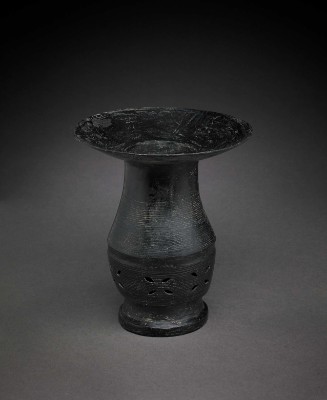
Thinly-potted black goblet with flaring rim and incised designs on the exterior.
Chinese, Longshan Culture
Neolithic Period, c. 2500-2000 BCE
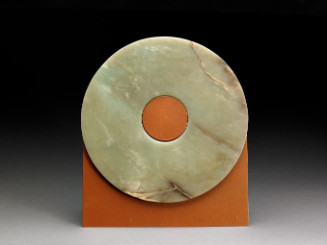
This semi-translucent stone of soft olive-green color with opaque buff mottling and some dark brown coloring in areas that show signs of alteration from burial, the inner and outer edges well finished and the stone with a high, soft polish, some chips
Chinese Artist
Zhou Dynasty (c.1050-256 BCE) or earlier
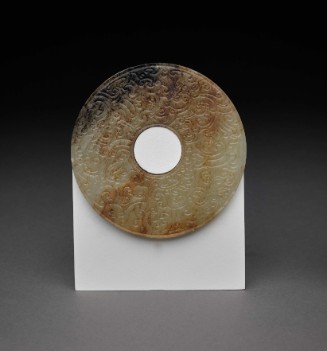
Disc with Cloud Pattern
Chinese Artist
Eastern Zhou dynasty (770-256 BCE)
Disc
Chinese Artist
Neolithic Period or later
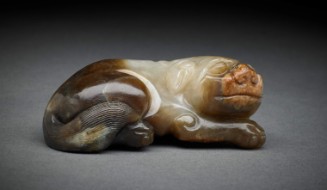
cleverly carved using the natural inclusions of the stone, its head turned to one side, its combed mane trailing over its ribbed back, opposite the tail flicked to one side, the underside detailed with padded paws, the stone of mottled brown, beige and white tones
Chinese Artist
Ming dynasty (1368-1644)
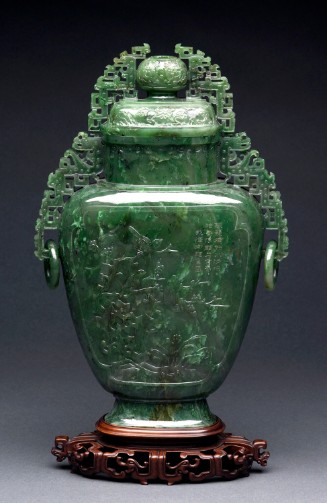
Green jade covered vase featuring etched designs and intricate, ornate handles that extend from the lid down the sides, resting on a dark brown stand.
Chinese Artist
Attributed to the Qing Dynasty (1644-1911), Qianlong reign (1736-1795)
A black and white print of intersecting geometric planes. A large upper surface covered in repeating dashed lines angles downwards to a bright highlight, contrasting sharply with a large solid dark area and adjacent textured grid patterns.
Alan Cohen
1989
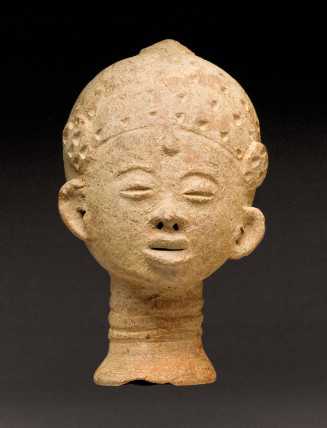
Terracotta head with triangular notches around coiffure/headdress. Stylized almond shaped eyes which resemble cowrie shells, has defined nose and full lips. Ears are not symmetrically aligned, neck has carved rings.
Akan Artist
17th-19th century
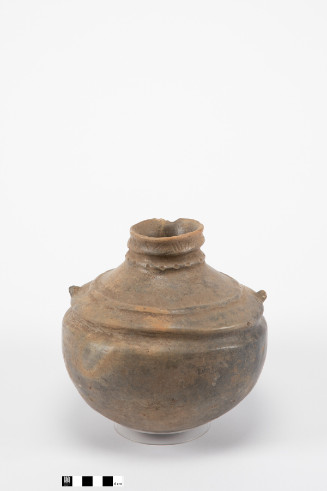
Globular jar with hemispherical bottom curving up into wall at 2/3 height is a wide indented groove with wall continuing at an inward slope to long neck. 2 raised rings with notches at base of neck and center of upper wall, wide raised ridge below rim. Grey ware with black slip, 2 small nubbins opposite each other on wall just above wide indented groove groups of incised lines, in opposing diagonals on rim.
Costa Rican Artist
1200-1550
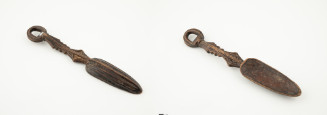
Spoon with carved handle, and bowl, striations on back of bowl, and notches on handle; bowl resembles a plant pod; loop on end of handle.
West African Artist
20th century
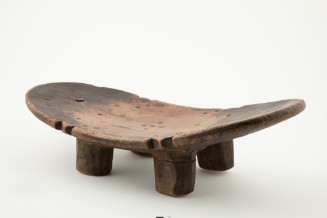
Oval stool; slightly curved seat with four small notches on each side; short cylindrical legs
Mande Artist
20th century
null