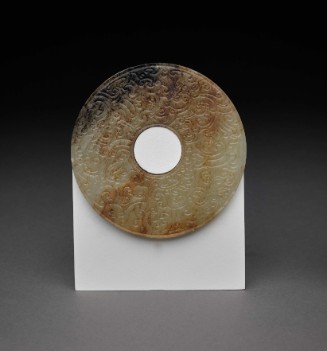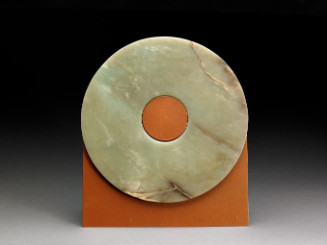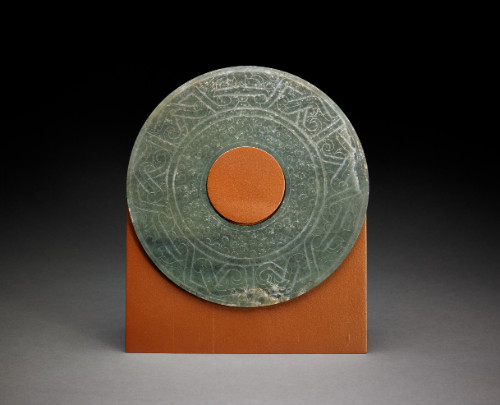
Carved from a light green jade with black inclusions, both sides of the disc are divided into two finely executed concentric decor zones. The inner band contains a grid of low relief curls within elevated hexagonal units, bordered by three "Bucraniums" that embellish the outer band. They stylized dragon forms are fluidly shaped from thick and thin incisions in a curvilinear pattern and separated by incised double brackets. Consistent with the practice of the time, cinnabar was applied to enhance…
Jade Disc (Bi) 玉璧
Courtesy of the Harn Museum of Art, Photography by Randy Batista

Jade Disc (Bi) 玉璧

Artist Chinese Artist
DateHan Dynasty (206 BCE-220 CE)
Place of originChina, Asia
MediumJade
DimensionsThickness x Diameter: 1/4 x 7 9/16 in. (0.6 x 19.2 cm)
ClassificationsSculpture
Credit LineBequest of Dr. David A. Cofrin
Object number2009.48.273
Collections
Visual DescriptionCarved from a light green jade with black inclusions, both sides of the disc are divided into two finely executed concentric decor zones. The inner band contains a grid of low relief curls within elevated hexagonal units, bordered by three "Bucraniums" that embellish the outer band. They stylized dragon forms are fluidly shaped from thick and thin incisions in a curvilinear pattern and separated by incised double brackets. Consistent with the practice of the time, cinnabar was applied to enhance the surface decoration.
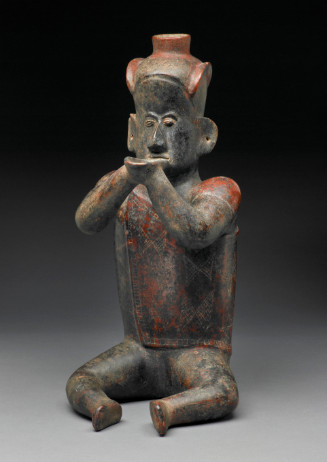
Seated girl with arm bands and necklace
Mexican Artist
100 BCE-200 CE
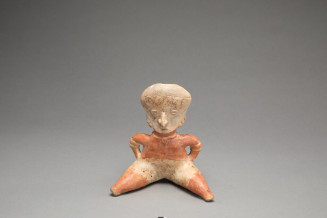
Hollow dark reddish pottery; red slipped on shoulders, cloak, and projecting parts of hat; incisions on cloak; spout on top of head
West Mexican Artist
100-300
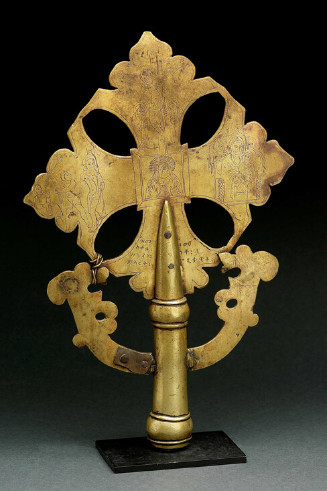
Cross with joined arms and two brackets attached to central support. Incised surface with images of the Virgin and Child, Crucifixion, and a written inscription on lower arm.
Ethiopian Artist
mid-late 18th century
Jade Prism (Cong) 玉琮
Chinese Artist
Zhou dynasty (1050–256 BCE) or later
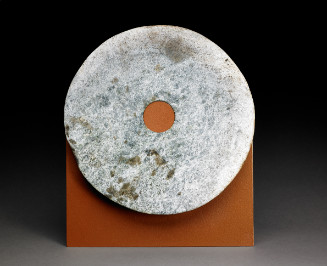
This large bi disc has been meticulously worked with a subtle concave rim rarely seen on bi discs of this size. Small circular bracelet-form jades from recent Liangzhu excavations show edges which are slightly concave in shape. This suggests an original bone-derived stylistic element. Although these wearable jades with concave edges are more frequently seen, this bi example of large size is most unusual. The surface of the bi disc is highly polished, and there has been much attention to both sha…
Chinese, Liangzhu culture
Neolithic period or later
Disc with Cloud Pattern
Chinese Artist
Eastern Zhou dynasty (770-256 BCE)
Disc
Chinese Artist
Neolithic Period or later
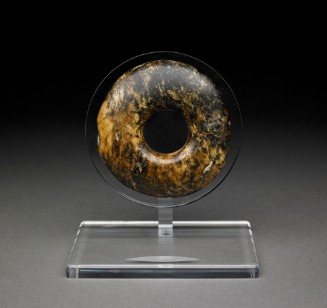
This semi-translucent stone of soft olive-green color with opaque buff mottling and some dark brown coloring in areas that show signs of alteration from burial, the inner and outer edges well finished and the stone with a high, soft polish, some chips
Chinese Artist
Zhou Dynasty (c.1050-256 BCE) or earlier
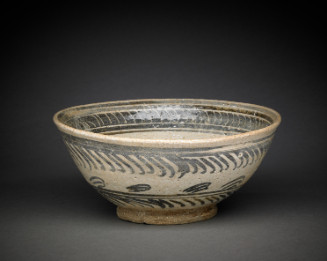
Bowl with varied decor. Interior: Chakra motif with "petals" and circular bands and repeat pattern below rim, together with five pontil marks. Exterior: abstracted design bands; exposed clay brown-toned and rough.
Thai Artist
14th-mid 16th century
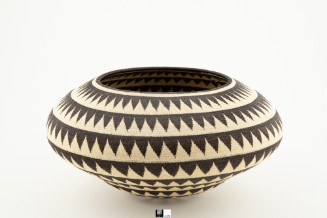
Large basket and disc
Elodia Cheucarama
c. 1990-2000
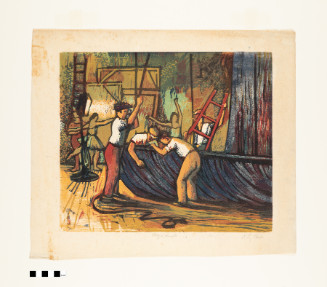
In the foreground, men work backstage to hoist a curtain while dancers (female and male) practice in the background. One man holds a red ladder.
Leonard Pytlak
c. 1936-1941
null