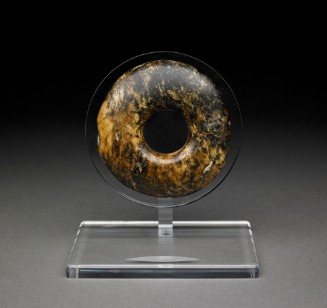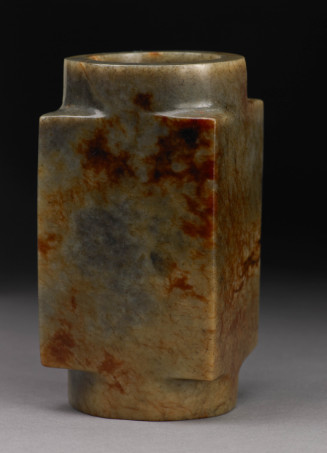
Jade Prism (Cong) 玉琮
Courtesy of the Harn Museum of Art, Photography by Randy Batista

Jade Prism (Cong) 玉琮

Artist Chinese Artist
DateZhou dynasty (1050–256 BCE) or later
Place of originChina, Asia
MediumJade, Nephrite
Dimensions4 1/4 x 2 1/8 x 2 1/8 in. (10.8 x 5.4 x 5.4 cm)
ClassificationsSculpture
Credit LineBequest of Dr. David A. Cofrin
Object number2009.48.143
Collections
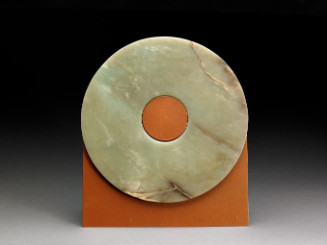
Visual DescriptionChips to edges and pithing
This semi-translucent stone of soft olive-green color with opaque buff mottling and some dark brown coloring in areas that show signs of alteration from burial, the inner and outer edges well finished and the stone with a high, soft polish, some chips
Chinese Artist
Zhou Dynasty (c.1050-256 BCE) or earlier
Disc
Chinese Artist
Neolithic Period or later
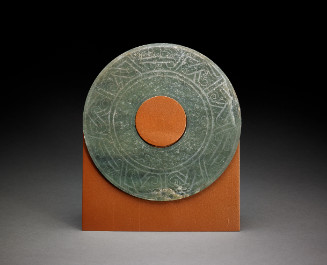
Carved from a light green jade with black inclusions, both sides of the disc are divided into two finely executed concentric decor zones. The inner band contains a grid of low relief curls within elevated hexagonal units, bordered by three "Bucraniums" that embellish the outer band. They stylized dragon forms are fluidly shaped from thick and thin incisions in a curvilinear pattern and separated by incised double brackets. Consistent with the practice of the time, cinnabar was applied to enhance…
Chinese Artist
Han Dynasty (206 BCE-220 CE)
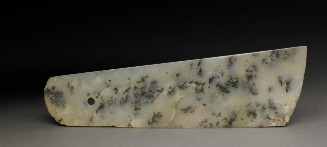
The tapered weapon carved with a sharp blade, with fitted groove opposite a circular hole on one end, the fitted groove opposite a circular hole on one end, the translucent milky green stone with dark brown flecks, chips
Chinese, Dawenkou Culture
Shang dynasty (c. 1600-1100 BCE)
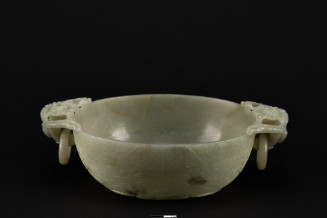
Well carved around the sides in low relief with a dense frieze of foliate blooms and furled leaves, issuing from a collar of petals encircling the base, forming a ring foot, the underside with a flowerhead, set with two flowerhead-form handles suspending loose rings, the interior center with a flowerhead, the greenish white stone striated with gray, minor chips.
Chinese Artist
Qing dynasty, 18th-19th century
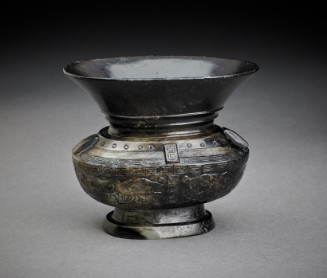
Of compressed zun form, the sides carved in shallow relief with two pairs of confronted dragons contained within keyfret borders, below four raised keyfret-incised flanges which divide the shoulder and interrupt a band of dots above, the widely flared neck encircled by two bowstring bands and carved on the interior with three grooved lines, intentionally altered to a blackish color with areas of the pale gray stone showing through, minor rim chips.
Chinese Artist
Song dynasty (960-1279)
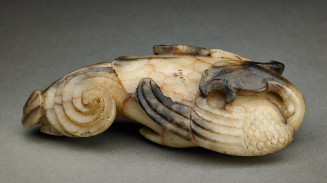
Shown with head arched back and resting on its body, some small chips to wings and tail feathers
Chinese Artist
Song and Ming dynasty (960-1644)
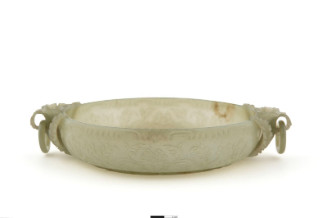
Bowl with shallow well-hollowed form, carved around the sides with feathery leaves and floral sprig springing from a collar of petals encircling the flat base, the underside with a flowerhead of overlapping radiating petals, the rim set with two upright floral sprig handles and loose rings, the thin translucent stone of yellowish green color, minute chips
Chinese Artist
18th-19th century
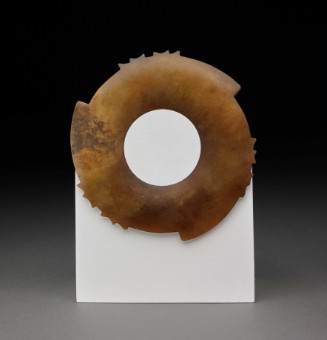
Of circular bi-shape and convex section, the edges with three equidistant notches and serrations, one surface etched with two lines at right angles, the jade of mottled brown color with a small area of calcification
Chinese, Longshan Culture
Neolithic period, c. 2300-1700 BCE or later
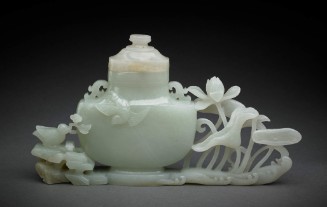
A white jade covered vase with lotus and bird motifs.
Chinese Artist
Qing Dynasty (1644-1911), 18th century
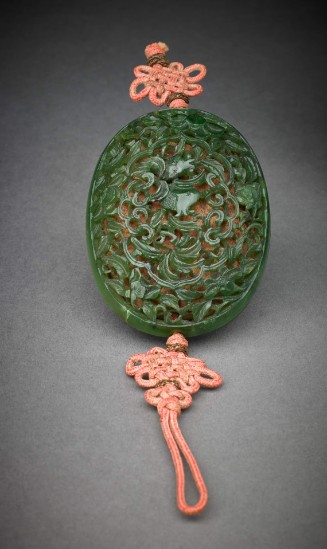
Dark green reticulated pomander with pink silk cord
Chinese Artist
Qing dynasty (1644-1911), 18th century
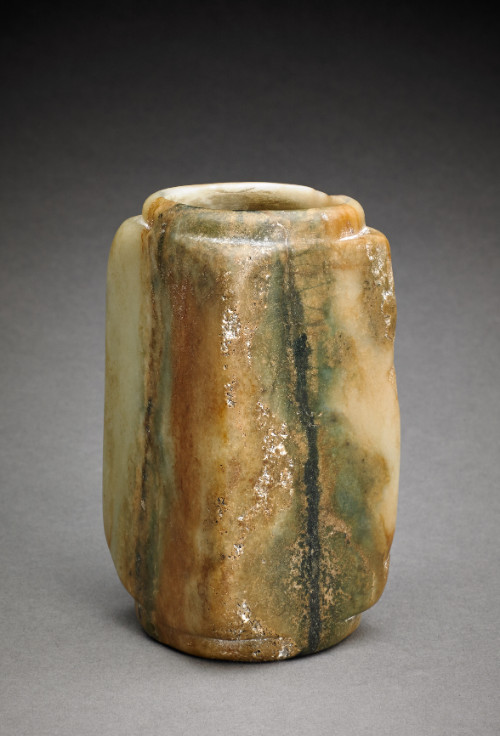
Carved from black-flecked, gray stone shading to buff with areas and veins of russet coloring in the form of a rectangular block surrounding a hollowed cylinder extending beyond the sharp triangular shoulders at either end to form a collar, the interior showing evidence of having been carved from both ends
Chinese Artist
Western Zhou dynasty (c. 1050-771 BCE)
null