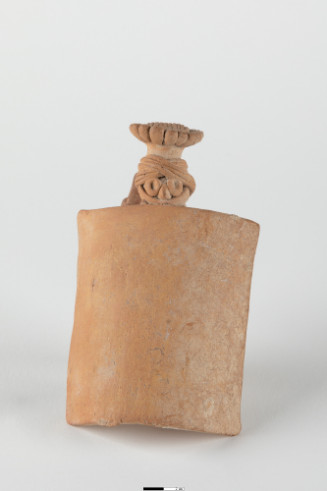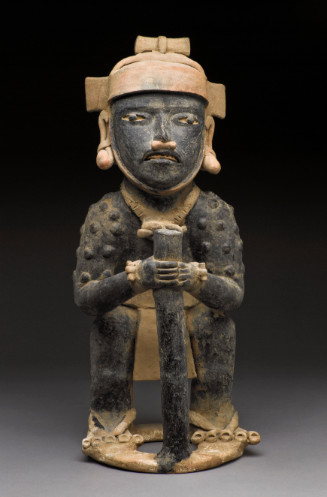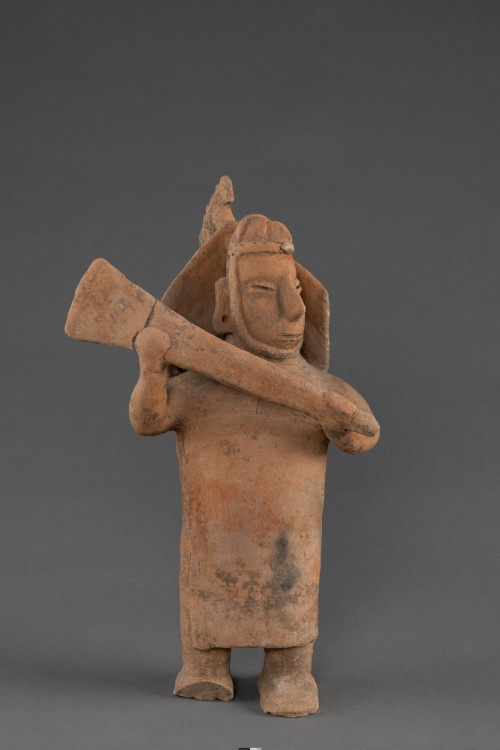
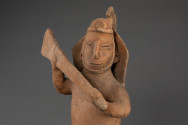
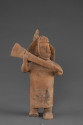
Standing male figure, arms raised, elbows bent, holding a large blade in both hands, wearing long cylindrical armor that extends up behind the head as flaps, with partial rounded crest extending from back towards head, headgear with chin strap; four diamond shapes in white located on upper shoulder region of back armor.
Standing Warrior
Courtesy of the Harn Museum of Art, Photography by Foad Seyed Mohammadi

Standing Warrior

Artist Mexican Artist
Date200 BCE -200 CE
Place of originColima, Colima, Mexico, North and Central America
MediumCeramic with traces of pigment
Dimensions18 3/4 x 11 1/4 x 8 in. (47.6 x 28.6 x 20.3 cm)
ClassificationsSculpture
Credit LineGift of Lawrence J. Cassard, M.D.
Object numberC-82-61
Collections
Visual DescriptionStanding male figure, arms raised, elbows bent, holding a large blade in both hands, wearing long cylindrical armor that extends up behind the head as flaps, with partial rounded crest extending from back towards head, headgear with chin strap; four diamond shapes in white located on upper shoulder region of back armor.
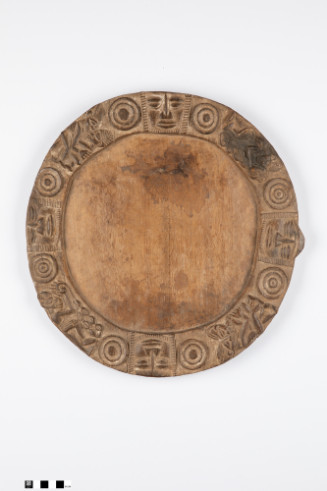
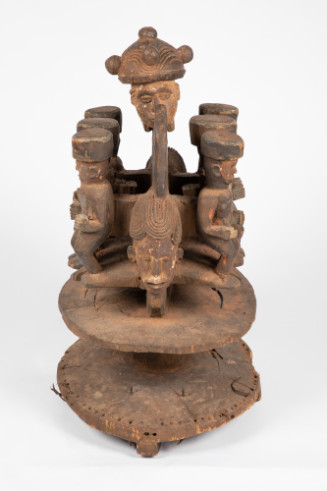
Double-tiered disk-shaped platforms that are surmounted by 6 (possibly young female) figures wearing pillbox style headgear, with bent knees and elbows, and hands with curled fingers; 3 of the identical figures are on either side of a large head with a helmet adorned with 4 spheres, and flanked below by mask-like faces with swirling hairdos. The head in the center, dominates the work and is inset between two vertical flanges. The bottom disk is perforated on the rim by 1/4 in holes all around. T…
Igbo Artist
19th century
Ortices phase, standing male figure holding large, arched shield that covers all of body, upraised hand holds club, head is wrapped in bands of material-design, crossing over forehead, extending across chin, headdress extends upwards, flares out in circle with multiple lobes, check pattern (sunflower?) in middle.
Mexican Artist
300 - 100 B.C.
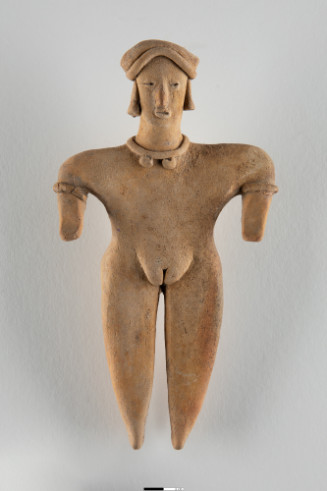
Standing female figure, frontal, legs tapering to small feet, wide shoulders, short arms hanging straight down.  Genitals apparent.  Necklace and arm bracelets.  Wrapped headdress with side flaps covering ears, rear flap extending to mid-back.  Slit eyes and mouth.
Mexican Artist
300 - 100 B.C.
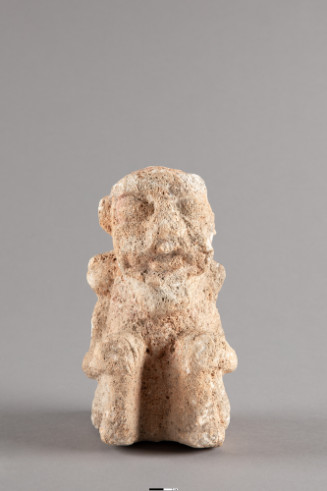
Seated male figure with legs flexed and pulled up torso, arms at side, hands on knees, wide bony shoulders, large head, jutting jaw, were-jaguar mouth with extended tongue, wide flat nose, bulbous rectangular eyes, low crown of head, back of figurine is very rough; traces of pigment on surface of figure.
Olmec Artist
1000-300 BCE
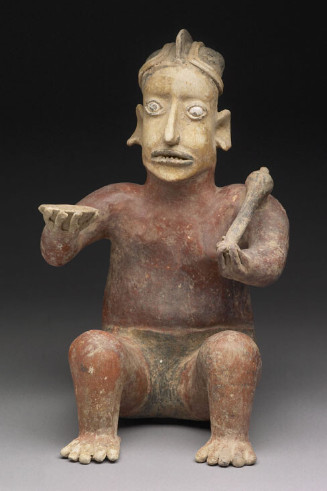
Seated male figure with knees bent and feet placed in front. Arms raised, holding dish on left and scepter on right. Elongated head, good modelling of features, wearing headgear with raised central crest. Body is thick, arms and legs are tubular. Black pigment indicating garment (shorts) around waist and hips. Linear black pigment design in angular spiral on scepter head. Black pigment on headgear. Body, arms, and legs in red pigment.
West Mexican Artist
1-200
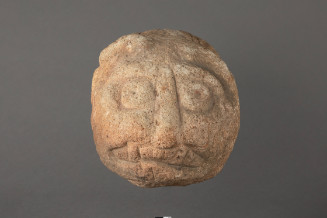
Carved stone head representing a jaguar; round face with extension of neck in back, features cut and grooved into smoothed surface.  Wide mouth, teeth showing with large incisors; nose indicated by two grooves, large donut-shaped eyes, stubby feline ears, low and rounded.  Traces of red pigment in grooved areas and pits of limestone.
Olmec Artist
800-1000
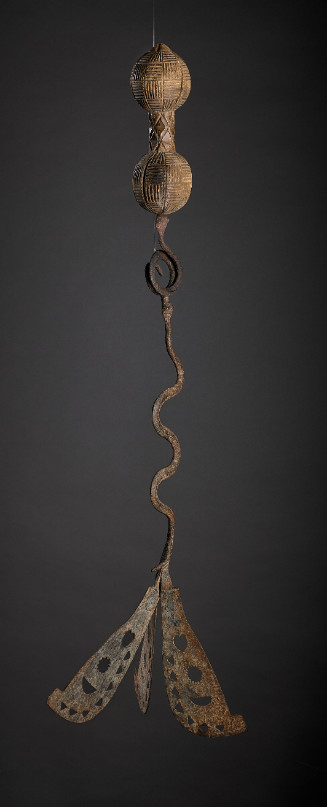
Sword with double-lobed handle of incised wood with traces of gold leaf, bronze serpent forming the shaft, terminating in three cut-out curved blades.
Akan Artist
19th-20th century
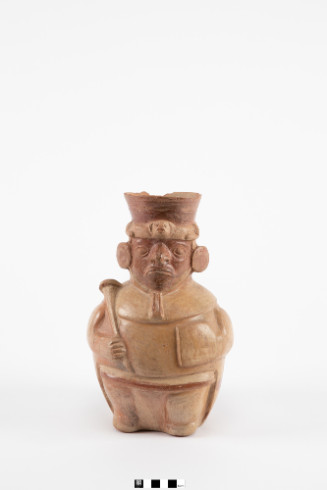
Holding a club to the front, wearing costume and helmet, painted black
Totonac Artist
150-450
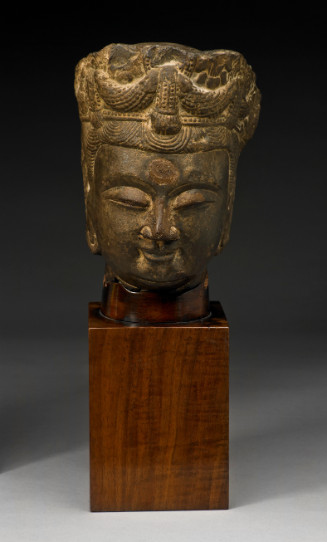
Head of a finely carved Bodhisattva with arched brows, elongated eyes, broad nose, and full lips. Wearing jeweled headdress held in place by a ribbon.
Chinese Artist
Northern Qi or Sui Dynasty, late 6th Century
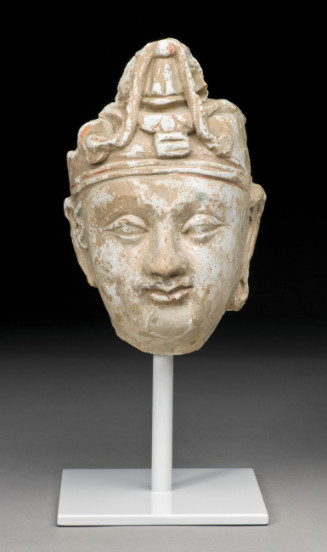
A head of the bodhisattva Maitreya with half-closed eyes and a small mouth. The painted wavy mustache shows the Classical features of Greco-Roman influence.
Afghani
4th-5th Century
null