Horn with incised linear pattern, clover-leaf design. Symbol of royal authority and wealth.
Cup
Courtesy of the Harn Museum of Art, Photography by Foad Seyed Mohammadi

Cup

Maker Babanki Artist
Date20th century
Place of originCameroon, Africa
MediumCarved horn
Dimensions7 3/4 x 2 1/2 x 6 1/2 in. (19.7 x 6.4 x 16.5 cm)
ClassificationsFurnishings and Equipment
Credit LineGift of Mr. and Mrs. Stephen A. Spear
Object numberS-73-133
Collections
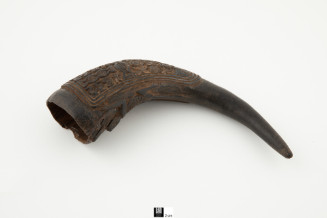
Visual DescriptionHorn with incised linear pattern, clover-leaf design. Symbol of royal authority and wealth.
Horn carved with geometricized motifs of spiders and frogs, with central image of naturalistic lizard (or crocodile).  Uneven edge on top of horn.
Babanki Artist
undated
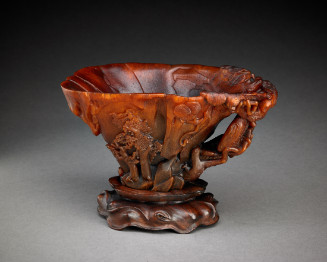
Rhinoceros horn cup with landscape designs on exterior that stands upon a small wooden base.
Chinese Artist
17th century
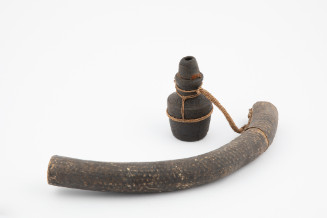
Animal horn or curved wooden tube wrapped in leather/hide possibly elephant or hippopotamus, sewn with raffia cord, dark brown incised ceramic bowl attached by cord.
Congolese Artist (Democratic Republic of Congo)
before 1953
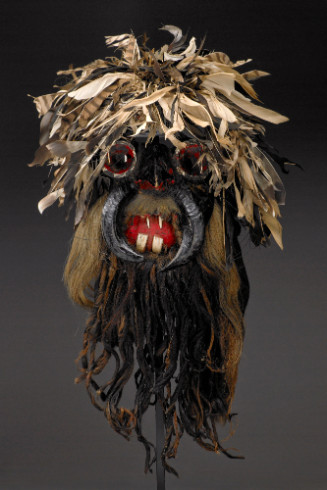
Mask with exaggerated features, attached teeth, horns, feathers, fur, and pigments.
Ivorian Artist
undated
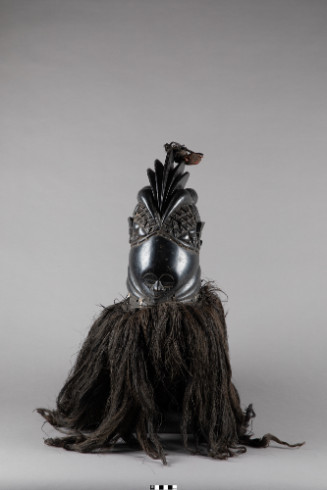
Helmet-style mask  depicting a woman’s head;  black exterior, adorned with antelope horn and cloth covered bundles attached to top, silver/ aluminum diadem; blackened raffia collar.
Sierra Leonean Artist
c. 1940
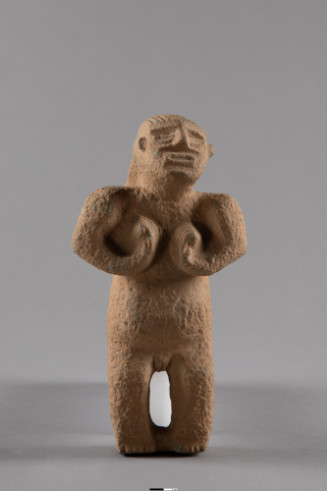
Standing figure with arms bent, elbows outward, hands cup breasts, rounded stomach, thick form with little negative space, flat bar of stone connects feet, incised linear design for long hair which ends in a straight row of knots at the shoulders.
Costa Rican Artist
1000-1522
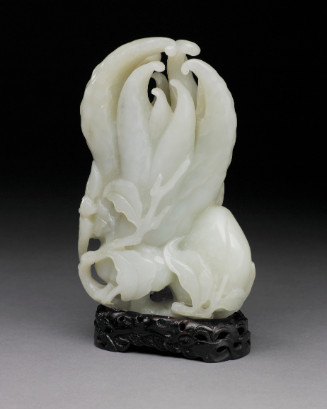
The emphasis on the smooth sensuous surface, fluidity of lines and the attention to detail are all typical elements of the eighteenth century carving tradition.  Fashioned of a pure white jade, the citron is entwined with leaves and accompanied by a bat and a peach. The long delicately carved tendrils bend gracefully at the tips, resembling Buddha's hand in the classic position. The citron symbolizes wishes for longevity as well as wealth, since it illustrates the gesture of grasping money. The …
Chinese Artist
18th-19th century
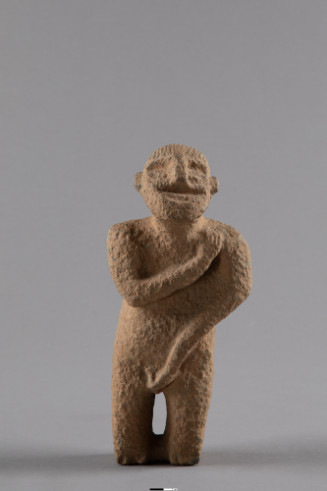
Standing figure with right hand on left shoulder and left hand on groin area; large head with incised linear decoration for hair; feet are connected by a flat bar of stone; overall very thick with little negative space.
Costa Rican Artist
1000-1522
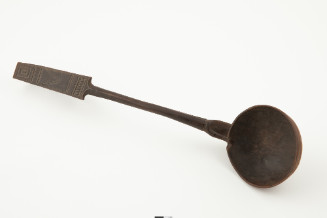
A large spoon carved from a single piece of wood. The handle forms a long arm ending with a hand extending onto the bowl. The top has fine decorative geometric patterns. Spoons like this were used for serving sour milk.
Zulu Artist
20th century
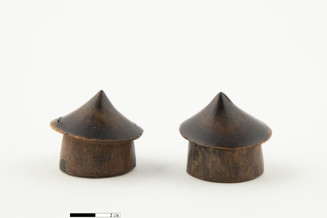
Two conical, dark brown plugs with hollow core.
Zulu Artist
late 19th-early 20th century
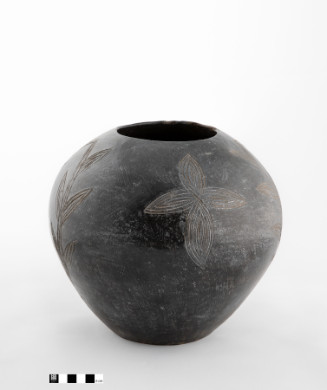
A round, dark grey ceramic pot with a simple circular opening. Its surface is decorated with lightly incised, linear patterns featuring a large four-petaled floral design on the right and a leafy branch on the left.
Zulu Artist
undated
null