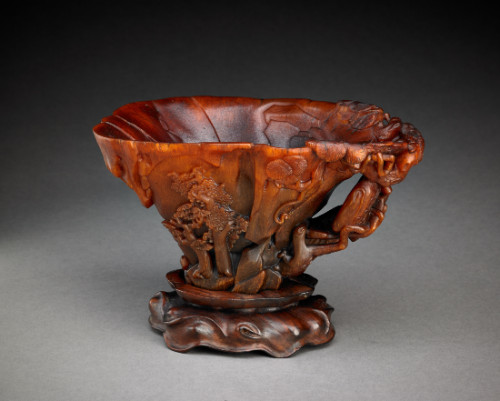
Rhinoceros horn cup with landscape designs on exterior that stands upon a small wooden base.
Libation Cup
Courtesy of the Harn Museum of Art, Photography by Randy Batista

Libation Cup

Artist Chinese Artist
Date17th century
Place of originChina
MediumHorn
Dimensionswithout stand: 6 x 3 1/4 in. (15.2 x 8.3 cm)
with stand: 6 x 3 3/4 in. (15.2 x 9.5 cm)
ClassificationsFurnishings and Equipment
Credit LineGift of Alan Whitehouse, In Memory of Hugh Whitehouse
Object number2010.62
Collections
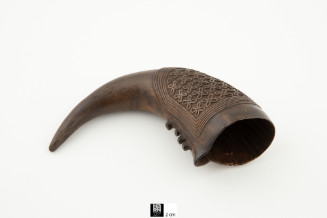
Visual DescriptionRhinoceros horn cup with landscape designs on exterior that stands upon a small wooden base.
Horn with incised linear pattern, clover-leaf design. Symbol of royal authority and wealth.
Babanki Artist
20th century
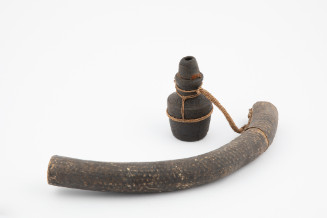
Animal horn or curved wooden tube wrapped in leather/hide possibly elephant or hippopotamus, sewn with raffia cord, dark brown incised ceramic bowl attached by cord.
Congolese Artist (Democratic Republic of Congo)
before 1953
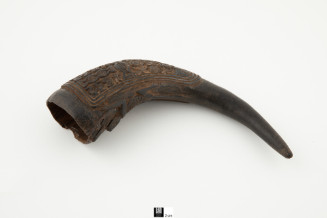
Horn carved with geometricized motifs of spiders and frogs, with central image of naturalistic lizard (or crocodile).  Uneven edge on top of horn.
Babanki Artist
undated
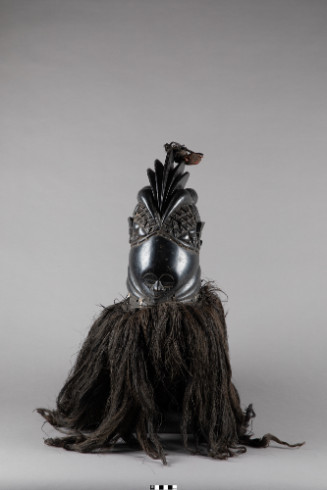
Helmet-style mask  depicting a woman’s head;  black exterior, adorned with antelope horn and cloth covered bundles attached to top, silver/ aluminum diadem; blackened raffia collar.
Sierra Leonean Artist
c. 1940
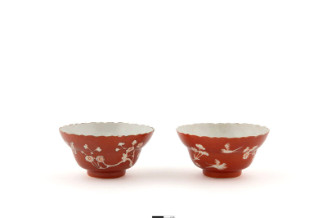
Pair of red-and-white small cups with plum blossom designs and spurious Tongzhi reign marks (1861-1875)
Chinese Artist
1912-1930s
A white porcelain cup with flared sides featuring blue decoration. The exterior shows painted abstract floral motifs with delicate leaves and dark accents. Two horizontal blue rings encircle the base.
Chinese Artist
Ming dynasty (1368-1644)
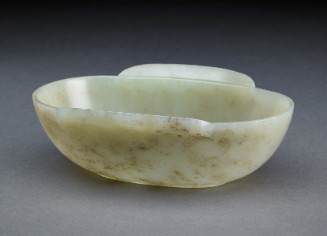
This ear cup reflects the Song period's profound interest in history in its characteristic design found in jades of the late Han period (206BC-AD220). The thinly worked oval cup has two flat handles projecting just below the rim at the longer sides, resting on an oval base with a raised foot ring. The highly translucent yellow jade possesses darker russet brown inclusions creating a desirable "skin" throughout the cup. The ear cup is of a fine, smooth polish. In our opinion, this ear cup is a fi…
Chinese Artist
Qing dynasty (1644-1911) or later
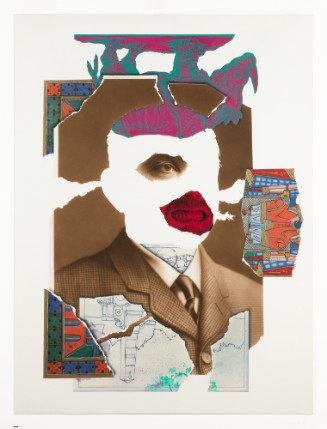
This diptych uses the image of a man as a central figure of a collage in both compositions. Other images include fragments of architectural blue prints and paintings of medieval figures. In addition the image of a rhinoceros appears in both pictures. The image is deceiving. Figures that appear to be adhered to the surface are actually part of the printed image.
Richard Heipp
c. 1990
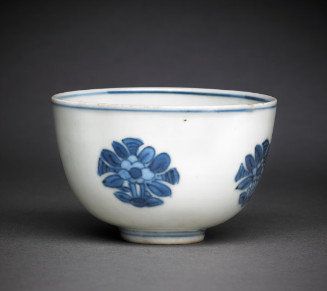
A white ceramic bowl with a slightly flared rim standing on a small foot. The exterior features painted blue floral designs of stylized blossoms with radiating petals. A thin blue line encircles the rim.
Chinese Artist
Ming dynasty (1368-1644)
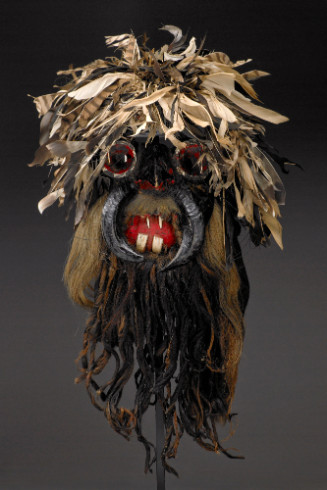
Mask with exaggerated features, attached teeth, horns, feathers, fur, and pigments.
Ivorian Artist
undated
Cup with thin rounded sides with flared rim carved on the exterior; five different flowering and fruiting plants growing in jardinières, supported on wide channeled foot, the stone of pale brownish white mottled with mid-brown
Chinese Artist
18th-19th century
null