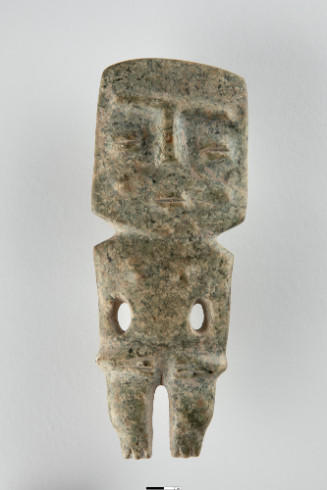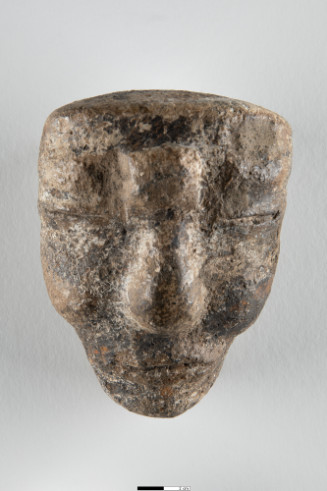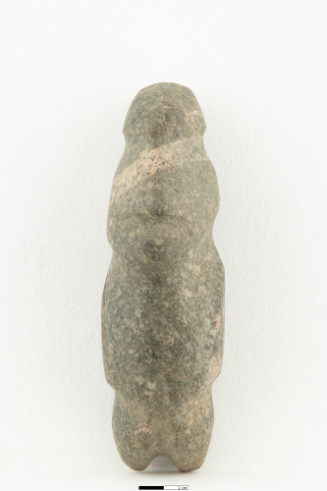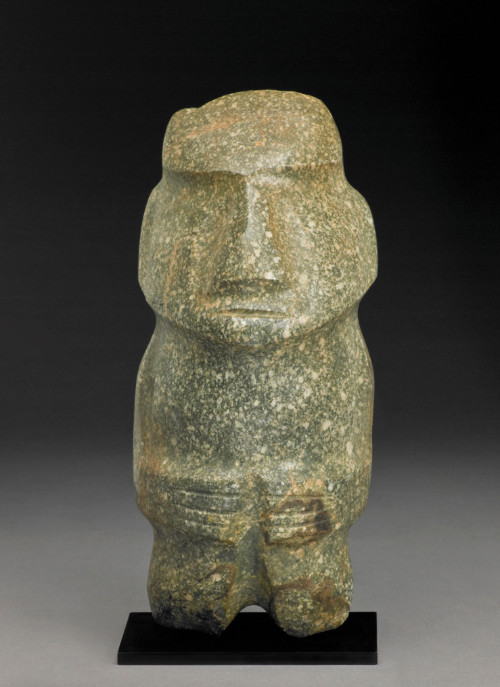
Standing anthropomorphic figure in the form of an axe head, feet form chisel end with grove carved between on front and back, arms indicated at side, hands across abdomen, figures shown by cut grooves, features shallow, wide flat nose, heavy brow, head tapers toward top
Large male axe-head figure
Courtesy of the Harn Museum of Art, Photography by Randy Batista

Large male axe-head figure

Maker Mezcala Artist
Date300 - 100 B.C.
Place of originGuerrero, Mexico, North and Central America
MediumCarved and polished greenstone
Dimensions10 1/2 x 4 1/2 x 3 1/2 in. (26.7 x 11.4 x 8.9 cm)
ClassificationsSculpture
Credit LineGift of Mrs. A. H. Spivack, in memory of Dr. A. H. Spivack
Object numberS-81-12
Collections
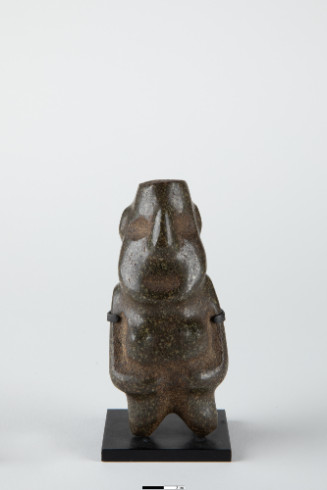
Visual DescriptionStanding anthropomorphic figure in the form of an axe head, feet form chisel end with grove carved between on front and back, arms indicated at side, hands across abdomen, figures shown by cut grooves, features shallow, wide flat nose, heavy brow, head tapers toward top
Standing female figure in the form of an axe head, feet form chisel end, separated by cut groove, hands on abdomen, arms indicated at side, breasts apparent, head tapers towards top, nose is large protruding blade, eyes and mouth are shallow grooves, top of head is pecked flat.  Bottom of feet and top of head have peck marks as if used for striking.
Mezcala Artist
100 B.C. - 200
Standing female figure in the form of an axe head.  Feet form chisel end, with cut groove between, hands on abdomen, arms at side with drilled holes to separate arms from body.  Square head, nose and brow form T shape, coffee-bean eyes and mouth, cheeks and breasts are slight swells from body plane.
Chontal Maya Artist
300 - 700
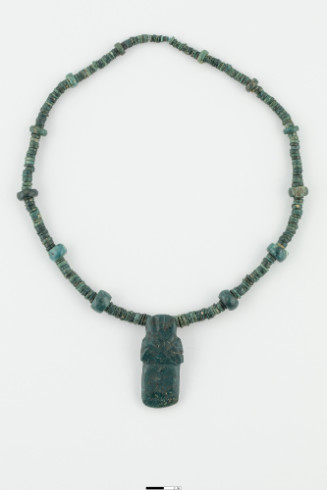
Necklace consisting of numerous small flat stone disks with holes in center, interspersed with larger, thicker disks with rounded sides. Rectangular pendant with flattened sides, one carved into roughly anthropomorphic shape by crisscrossing lines to form head and arms at side.
Chorotegan Artist
100-500
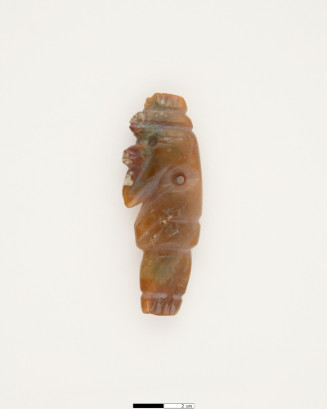
Small pendant in anthropomorphic form (bird) with a profile of a large head with jutting chin, drilled holes for eyes, crest on top of head. Arm depicted by two incised lines, single leg with foot depicted by short vertical lines.
Costa Rican Artist
300 BCE-700 CE
Carved stone head representing a jaguar; round face with extension of neck in back, features cut and grooved into smoothed surface.  Wide mouth, teeth showing with large incisors; nose indicated by two grooves, large donut-shaped eyes, stubby feline ears, low and rounded.  Traces of red pigment in grooved areas and pits of limestone.
Olmec Artist
800-1000
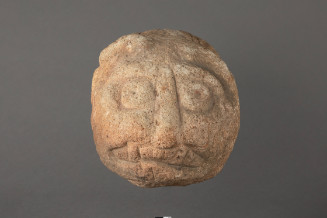
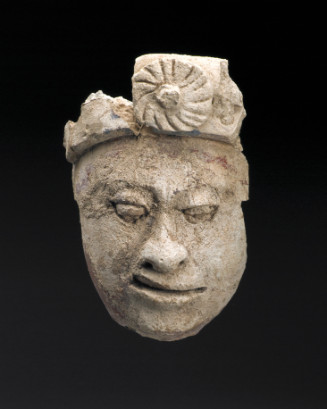
Stucco head with rounded features, large mouth with heavy lips; broad flat nose, eyes are puffed out with bottom half cut away, making appearance of double eye lids; heavy headdress with large thick brow band, central circular medallion with raised center and radiating grooves. (from accession worksheet)

White stucco molded over coarse aggregate; traces of red paint on the face, blue on headdress band.
Maya Artist
600-950
Human face figurine
Mezcala Artist
800 - 1200
Figure
Mezcala Artist
300-1 BCE
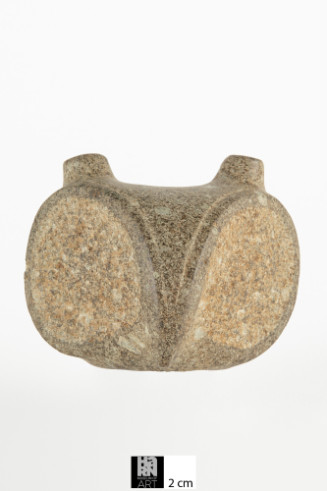
Spherical mace head with large cylindrical hole carved from top to bottom in center with simplified horned owl head design - cylindrical nubbins on top for ears, triangular hooked beak with large round eye panels, polished smooth surfaces
Costa Rican Artist
300-500
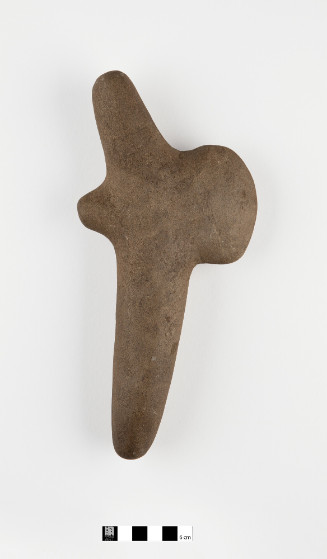
Axe with slightly curving handle; smooth, rounded surface; soft edge on blade.
c. 1000-1500
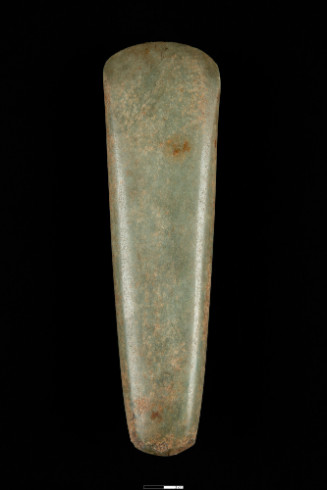
Polished stone celt, elongated axe head form with small oval butt, showing signs of wear widening gradually to chisel point. Rounded edges highly polished and smoothed. Polished greenstone.
Maya Artist
600-900
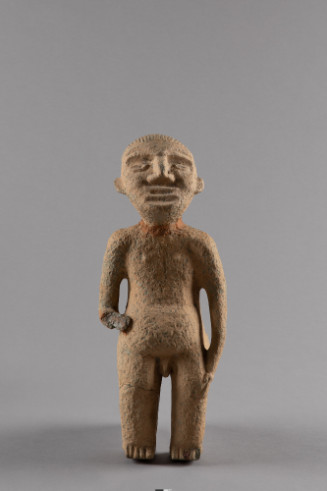
Standing figure with left hand on thigh and right arm resting on round stomach (hand missing); overall thick form with little detail; large head and facial features; carved linear design for hair.
Costa Rican Artist
undated
null