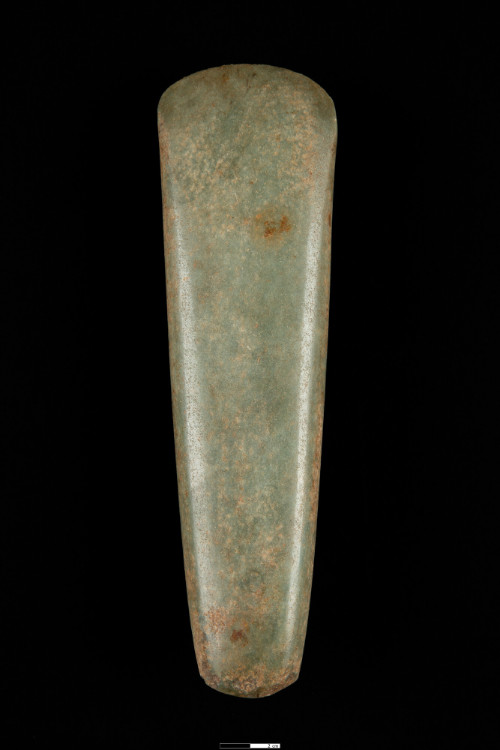
Polished stone celt, elongated axe head form with small oval butt, showing signs of wear widening gradually to chisel point. Rounded edges highly polished and smoothed. Polished greenstone.
Stone celt
Courtesy of the Harn Museum of Art, Photography by Foad Seyed Mohammadi

Stone celt

Artist Maya Artist
Date600-900
Place of originYucatan Peninsula, Guatemala, North and Central America
MediumJadeite
Dimensions8 1/4 x 2 3/8 x 1 1/8 in. (21 x 6 x 2.9 cm)
ClassificationsSculpture
Credit LineGift of Irvin Ebaugh
Object numberS-74-33
Collections
Visual DescriptionPolished stone celt, elongated axe head form with small oval butt, showing signs of wear widening gradually to chisel point. Rounded edges highly polished and smoothed. Polished greenstone.
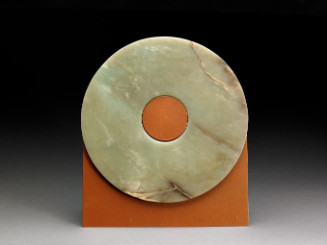
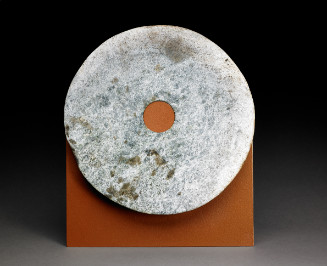
This large bi disc has been meticulously worked with a subtle concave rim rarely seen on bi discs of this size. Small circular bracelet-form jades from recent Liangzhu excavations show edges which are slightly concave in shape. This suggests an original bone-derived stylistic element. Although these wearable jades with concave edges are more frequently seen, this bi example of large size is most unusual. The surface of the bi disc is highly polished, and there has been much attention to both sha…
Chinese, Liangzhu culture
Neolithic period or later
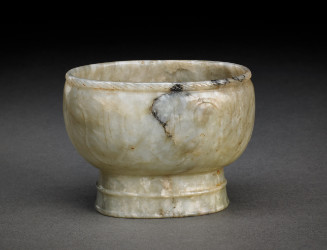
The deep, rounded sides carved on the exterior in shallow relief with a petal frieze pendant from a narrow rope-twist border at the rim, each petal incised with three vertical striations, the whole raised on a tall oval foot encircled by a bowstring band and with a raised border at the foot rim, the softly polished, semi-translucent stone of mottled grayish color
Chinese Artist
Song and Yuan dynasty (960-1368)
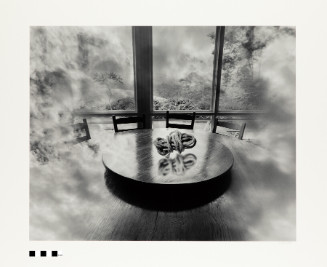
A black and white composite photograph of a round wooden table and chairs near a window. A knotted ball of rope sits in the center, reflecting on the polished surface. Cloud-like smoke overlays the edges, partially obscuring the room.
Jerry Uelsmann
1981
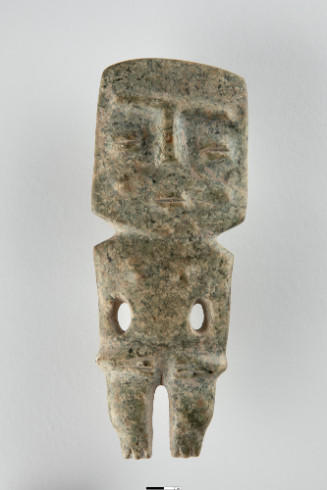
Standing female figure in the form of an axe head.  Feet form chisel end, with cut groove between, hands on abdomen, arms at side with drilled holes to separate arms from body.  Square head, nose and brow form T shape, coffee-bean eyes and mouth, cheeks and breasts are slight swells from body plane.
Chontal Maya Artist
300 - 700
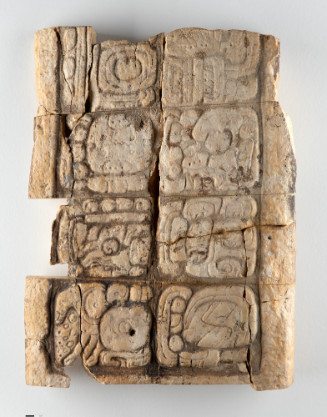
Carved stone panel containing eight Maya glyphs in two columns, border of smoothed, rounded stone on sides, small border on bottom, none on top.
Maya Artist
700-850
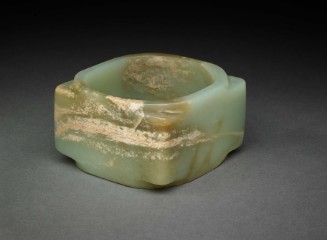
This semi-translucent stone of soft olive-green color with opaque buff mottling and some dark brown coloring in areas that show signs of alteration from burial, the inner and outer edges well finished and the stone with a high, soft polish, some chips
Chinese Artist
Zhou Dynasty (c.1050-256 BCE) or earlier
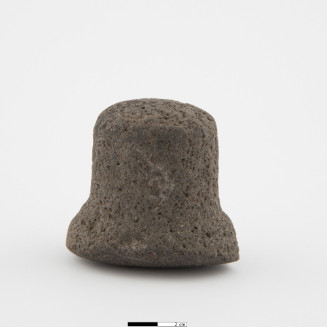
Small hand-sized pestle, cylindrical with end flaring to an oval butt, rounded by rocking back and forth motion.
Costa Rican Artist
300-1550
The yellowish-celadon stone well-polished and cut, of rectangular outline, the center with a circular aperture having a lip and base rising beyond the squared corners and forming a slight bevel, the stone with streaks of chalky inclusions and caramel colored patches
Chinese Artist
Zhou dynasty (1050-256 BCE)
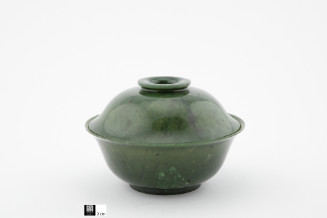
A polished, mottled dark green stone bowl with a matching domed lid. The bowl features flared sides and a small flat base, while the lid is topped with a raised, circular ring knob.
Chinese Artist
Qing dynasty (1644-1911)
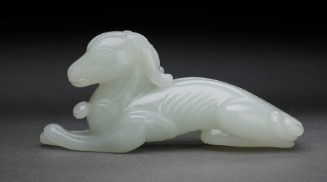
The graceful greyhound shown in a recumbent position with forepaws crossed and back legs tucked beneath the body, with long ears and coiled tail, one end of the long, bell-hung ribbon tied around the arched neck trailing beneath the belly, the slender body carved with pronounced ribs and backbone, the stone well polished and of even white tone.
Chinese Artist
Qing dynasty (1644-1911), 18th-19th century
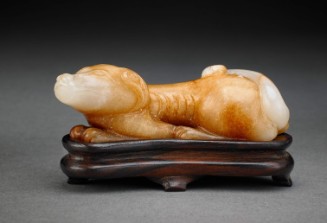
Well carved in a recumbent position with head raised above the front paws and long tail curled atop the back, the softly polished whit stone with extensive russet staining of varying intensity
Chinese Artist
17th-18th century or later
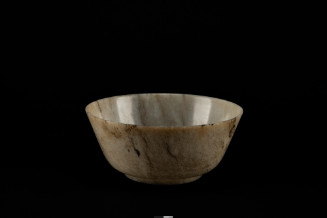
Well carved bowl with slightly flaring sides rising from a shallow foot ring, the stone of pale greyish-white tone with opaque white flecks and pale brown mottling and veining throughout, softly and evenly polished.
Chinese Artist
17th-18th century
null