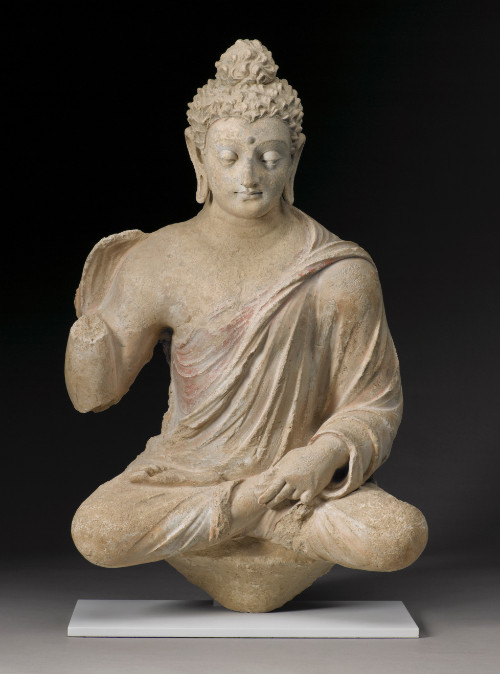
Seated Buddha, right forearm missing, his left hand holds the end of his robe, wearing a toga-like garment.
Seated Buddha
Courtesy of the Harn Museum of Art, Photography by Randy Batista

Seated Buddha

Maker Gandharan
Date4th-5th Century
Place of originPeshawar, Northwest Frontier, Pakistan, Asia
MediumStucco with traces of polychrome
Dimensions24 x 13 3/4 x 5 1/2 in. (61 x 34.9 x 14 cm)
ClassificationsSculpture
Credit LineMuseum purchase, gift of Michael A. Singer and funds provided by the Robert H. and Kathleen M. Axline Acquisition Endowment
Object number1997.12
Collections
Visual DescriptionSeated Buddha, right forearm missing, his left hand holds the end of his robe, wearing a toga-like garment.
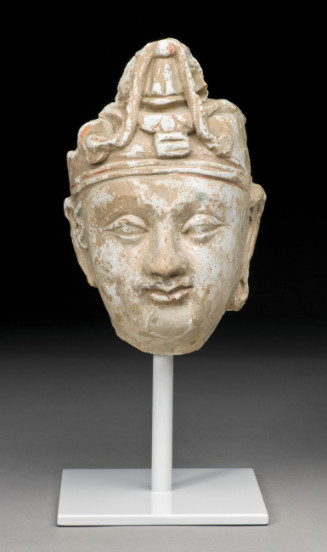
A head of the bodhisattva Maitreya with half-closed eyes and a small mouth. The painted wavy mustache shows the Classical features of Greco-Roman influence.
Afghani
4th-5th Century
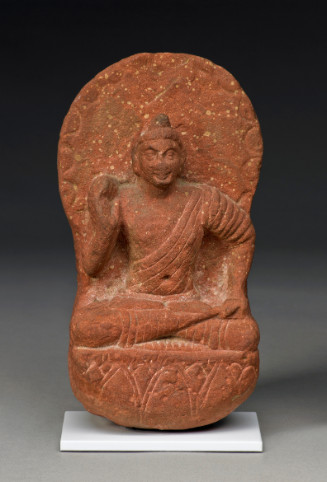
Sandstone sculpture depicting the Buddha siting on a throne with his robe worn over the left shoulder. His right hand is raised in the gesture of reassurance. A large halo is behind his head.
Indian Artist
Late 1st - early 2nd century
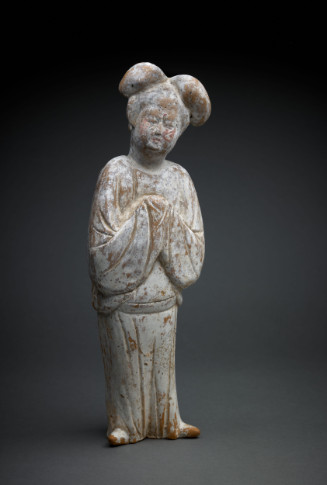
A fine pottery figure of an elegant court lady, standing, wearing a loosely fitted robe tied at the waist with a belt, the feet protruding from underneath the hen, the hands covered by the long sleeves. She tilts her head at an angle, the hair is dressed in two elaborate top knots. The buff pottery covered with a thin layer of white slip, the face with the remains of red pigment.
Chinese Artist
Tang dynasty (618–906), 8th century
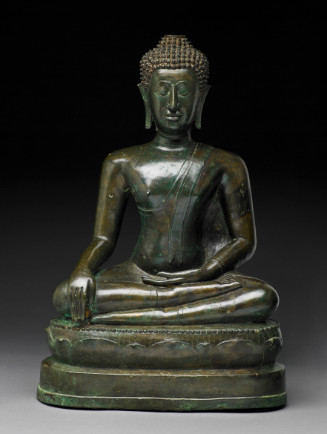
Seated historic Buddha Shakyamuni, with downcast eyes and his right hand pointing downwards in the earth-touching hand gesture (mudra).
Thai Artist
15th-16th century
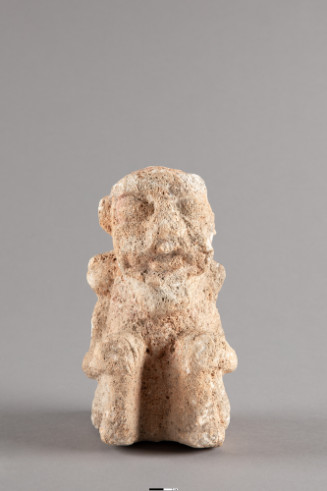
Seated male figure with legs flexed and pulled up torso, arms at side, hands on knees, wide bony shoulders, large head, jutting jaw, were-jaguar mouth with extended tongue, wide flat nose, bulbous rectangular eyes, low crown of head, back of figurine is very rough; traces of pigment on surface of figure.
Olmec Artist
1000-300 BCE
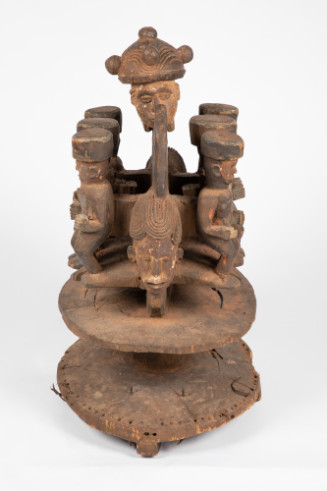
Double-tiered disk-shaped platforms that are surmounted by 6 (possibly young female) figures wearing pillbox style headgear, with bent knees and elbows, and hands with curled fingers; 3 of the identical figures are on either side of a large head with a helmet adorned with 4 spheres, and flanked below by mask-like faces with swirling hairdos. The head in the center, dominates the work and is inset between two vertical flanges. The bottom disk is perforated on the rim by 1/4 in holes all around. T…
Igbo Artist
19th century
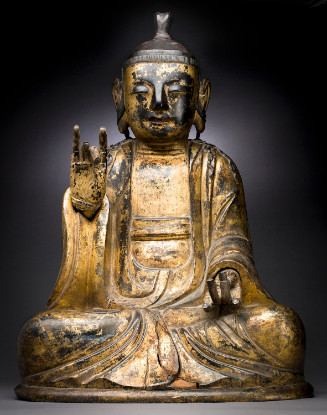
Gilt wood seated Bodhisattva accompanied by original sutra pages printed in red and black inks of the Lotus Sutra. Red ink sutra is written in Siddham language.
Korean Artist 작자미상 作者未詳
Joseon Dynasty (1392-1910), 17th century
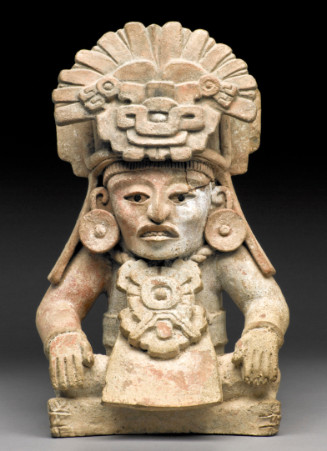
Seated male figure with legs crossed in front, hands on knees hollow cylindrical body with opening at top of headdress good proportions to figure, good modeling of features, wears  large ornamental headdress, ear spools, necklace with large pendant and bracelets.

White pigment on part of the face and body, also at spots in headdress and pendant.
Zapotec Artist
300 - 500
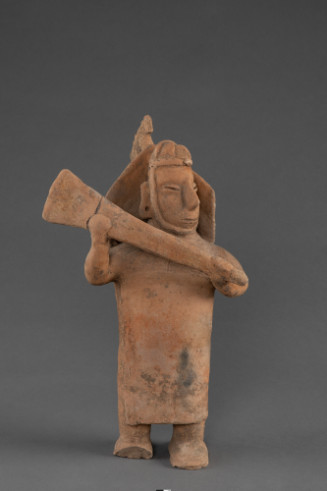
Standing male figure, arms raised, elbows bent, holding a large blade in both hands, wearing long cylindrical armor that extends up behind the head as flaps, with partial rounded crest extending from back towards head, headgear with chin strap; four diamond shapes in white located on upper shoulder region of back armor.
Mexican Artist
200 BCE -200 CE
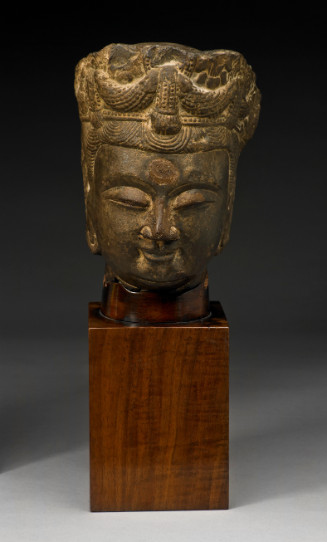
Head of a finely carved Bodhisattva with arched brows, elongated eyes, broad nose, and full lips. Wearing jeweled headdress held in place by a ribbon.
Chinese Artist
Northern Qi or Sui Dynasty, late 6th Century
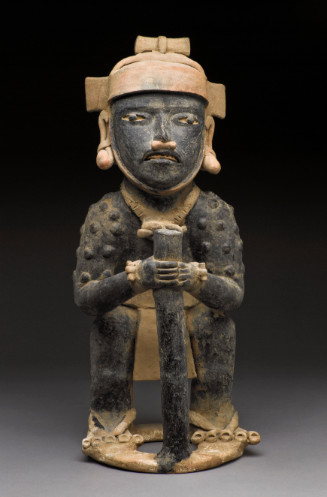
Holding a club to the front, wearing costume and helmet, painted black
Totonac Artist
150-450
null