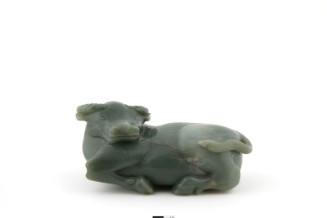
Water Buffalo
Water Buffalo
Courtesy of the Harn Museum of Art, Photography by Randy Batista

Water Buffalo

Artist Chinese Artist
DateQing dynasty (1644-1911), Qianlong period (1736-1795)
Place of originChina
MediumJade
Dimensions1 1/16 x 2 5/8 x 1 1/4 in. (2.7 x 6.7 x 3.2 cm)
ClassificationsSculpture
Credit LineBequest of Dr. David A. Cofrin
Object number2009.48.235
Collections
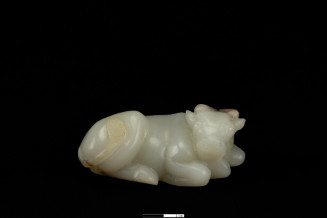
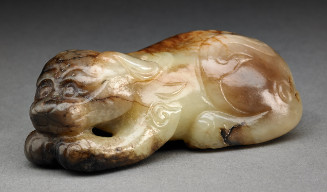
Visual DescriptionShown in a recumbent position with head raised and legs tucked under the fleshy body, with a delineated ridge following the curve of the back from between the curved horns to the top of a tail incised with fine hair markings, the stone with high polish and of soft yellowish-green tone with areas of pale brown coloring
Buffalo carved in a recumbent position with its forelegs tucked underneath and tail coiled to the front, with incised lines to depict details on the horns, tail and hooves, the stone of even white tone with areas of russet and black speckling highlighting the carving
Chinese Artist
18th century
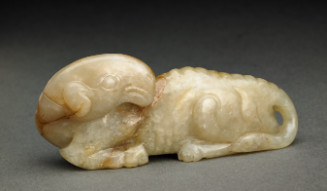
The thick stone carved as a recumbent buffalo following the form of the boulder, the legs tucked beneath the body, the head turned to one side, with broad snout and large curled horns, opposite the tail flicked to one side, the gray green stone with a broad suffusion of dark green and white on reverse.
Chinese Artist
19th century or later
The thick stone well carved as a recumbent buffalo following the form of the boulder, the legs ticked beneath the body, the head turned to tone side, with broad snout and large curled horns, opposite the tail flicked to one side, the grayish green stone infused with a patch of white, small chip
Chinese Artist
19th-20th century
With the hind legs and front left leg folded under the body, and the right front leg flexed as the creature prepares to rise, the tail colored around to rest on the left haunch, the belly and neck faintly ribbed to indicate folds, the head facing forward with well-defined horns above ears delineated with fine incising, the greenish-gray stone with pale mottling.
Chinese Artist
Qing dynasty (1644 -1911)
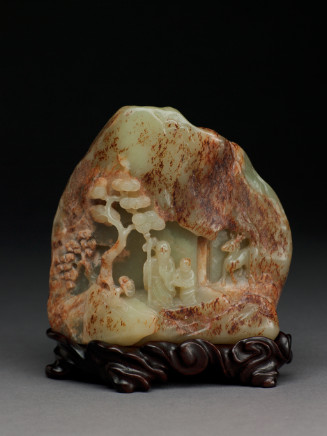
The boulder of irregular triangular shape, carved to one face with Shoulao and an attendant holding a peach, both on a path between a pine tree and lingzhi and a deer, the reverse with a boy beside a waterfall holding a peach branch opposite a peach tree and a crane, the stone of rich yellowish-green tones with extensive russet inclusions and a smooth polish
Chinese Artist
17th-18th century
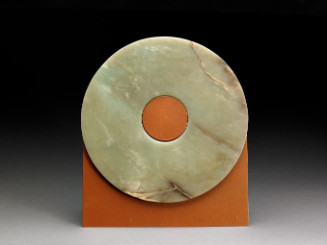
This semi-translucent stone of soft olive-green color with opaque buff mottling and some dark brown coloring in areas that show signs of alteration from burial, the inner and outer edges well finished and the stone with a high, soft polish, some chips
Chinese Artist
Zhou Dynasty (c.1050-256 BCE) or earlier
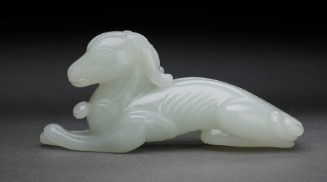
The graceful greyhound shown in a recumbent position with forepaws crossed and back legs tucked beneath the body, with long ears and coiled tail, one end of the long, bell-hung ribbon tied around the arched neck trailing beneath the belly, the slender body carved with pronounced ribs and backbone, the stone well polished and of even white tone.
Chinese Artist
Qing dynasty (1644-1911), 18th-19th century
A fine jade group of a pair of pomegranates worked in low relief with a bat and insect, the stone a subtle pale celadon green tone with russet markings
Chinese Artist
18th-19th century
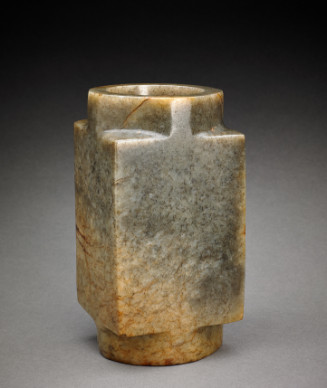
The semi-translucent stone of rich, dark olive-green color with brown mottling and veining, with areas of yellowish-buff color emanating from some of the veins and some opaque alteration from burial, carved as a rectangular block enclosing a cylindrical tube extending beyond the triangular shoulders at either end to form a collar, with a smooth satiny polish, some encrustation
Chinese Artist
Western Zhou dynasty (c. 1050-771 BCE)
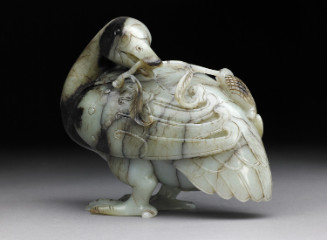
Shown standing with head turned backwards while grasping a millet stem in its beak, the wings carved with dots and curled tips, the tail feathers represented in two overlapping rows, the pale greyish-white stone with soft polish and blackish-brown staining
Chinese Artist
17th-18th century
Shown in a recumbent position with head resting on its front paws and tail tucked under the body, with bulbous eyes, floppy ears, slightly knobby backbone and scrolls outlining the haunches, the stone of pale yellow, pale brown and dark brown color.
Chinese Artist
Yuan and Ming dynasty (1279-1644)
The recumbent beast with head turned over its back, the face delicately carved and the fur markings simply delineating the body with light ribs and softly polished vertebrae
Chinese Artist
possibly Song Dynasty (960-1279)
null