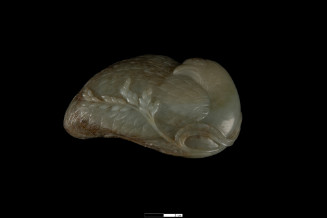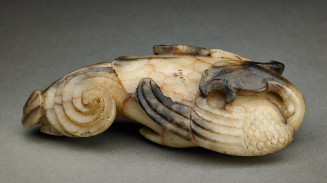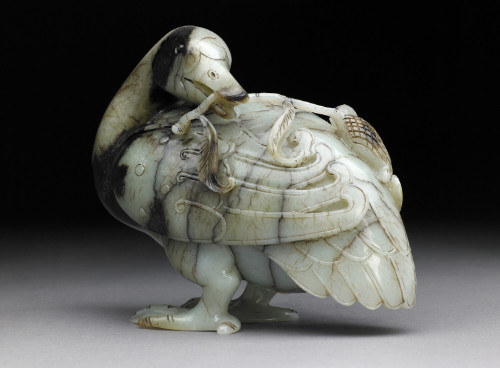
Shown standing with head turned backwards while grasping a millet stem in its beak, the wings carved with dots and curled tips, the tail feathers represented in two overlapping rows, the pale greyish-white stone with soft polish and blackish-brown staining
Duck
Courtesy of the Harn Museum of Art, Photography by Randy Batista

Duck

Artist Chinese Artist
Date17th-18th century
Place of originChina, Asia
MediumJade
Dimensions4 1/16 x 5 1/8 x 3 1/16 in. (10.3 x 13 x 7.8 cm)
ClassificationsSculpture
Credit LineBequest of Dr. David A. Cofrin
Object number2009.48.107
Collections
Visual DescriptionShown standing with head turned backwards while grasping a millet stem in its beak, the wings carved with dots and curled tips, the tail feathers represented in two overlapping rows, the pale greyish-white stone with soft polish and blackish-brown staining
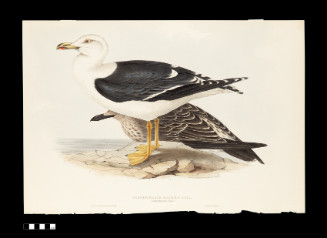
Lesser Black-Backed Gull
John Gould
1832-1837
The rounded pebble in the form of a nesting quail with head turned towards its back surrounded by a long leafy millet spray, carved overall with detailed overlapping feathers, the stone of deep celadon tone with brown accents
Chinese Artist
18th-19th century
Grasping a stem of millet in its beak
Chinese Artist
Song and Ming dynasty (960-1644)
Shown with head arched back and resting on its body, some small chips to wings and tail feathers
Chinese Artist
Song and Ming dynasty (960-1644)
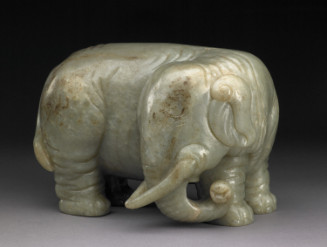
Of pale greyish-green stone, the standing elephant carved with head turned back, its trunk between its tusks meeting at the tips, its tail flicked forward on its right hind leg, its floppy ears and wrinkled skin well delineated
Chinese Artist
Ming dynasty (1368-1644)
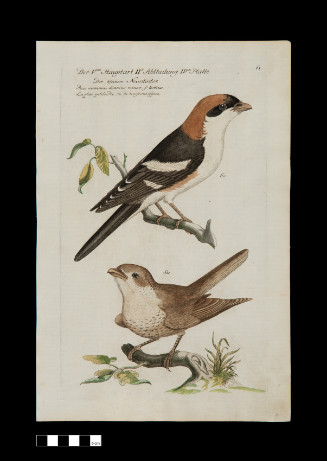
61 Der Heinere Neuntoder
Johann Leonhard Frisch
1817
Two Tetraophasis Obscurus (Mou-Pin Snow-Partridge) birds with brown feathers, red throats, and white on the tips of their tails, standing on rocks in a grassy field.
John Gould
1850-1883
Fulmar Petrel bird with blue wings with black tips, white body and head, and yellow beak and webbed feet, standing on a rock along the seashore.
John James Audubon
1839-1844
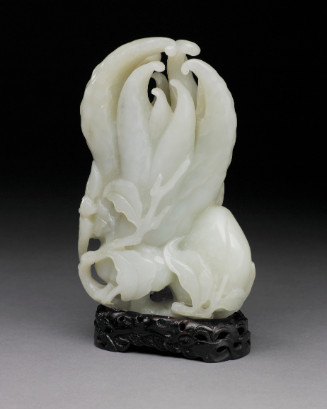
The emphasis on the smooth sensuous surface, fluidity of lines and the attention to detail are all typical elements of the eighteenth century carving tradition.  Fashioned of a pure white jade, the citron is entwined with leaves and accompanied by a bat and a peach. The long delicately carved tendrils bend gracefully at the tips, resembling Buddha's hand in the classic position. The citron symbolizes wishes for longevity as well as wealth, since it illustrates the gesture of grasping money. The …
Chinese Artist
18th-19th century
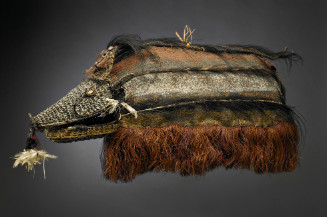
Body masquerade woven(?) horizontally of woven rattan.  Pig face with snout from which feathers, twine and fabric dangle.  Cowrie shell eyes.  Headdress of face.  Earrings ? object in nose dangle from ears.  Tusks extending from one side of mouth.  Rows of cassowary feathers extend length of body and fringe hangs at bottom. Highlighted with earth pigment.
Iatmul
20th century
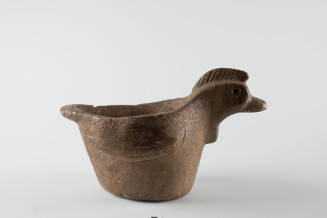
Stone bowl, flat bottom, circular, with walls sloping slightly outwards, effigy form of duck with crescent extension on rear rim for tail, raised panels shaped as wings wrap around upper side, head extending from front with rounded beak, drilled eye-holes, feather crest on head; carved lines delineating wings and tail, circling eyes, feather ridge, mouth opening.
Mississippian Artist
1000-1300
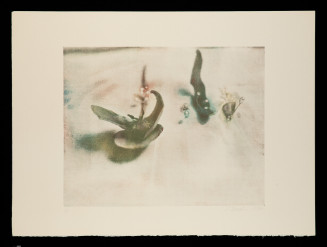
A hazy print of soft, abstract green and dark brown forms. A curled shape and two elongated vertical shapes are accented with small, bright white dots.
Lisa Mackie
1972 -1973
null