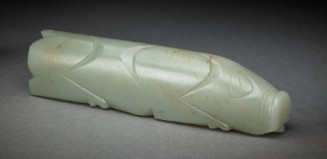
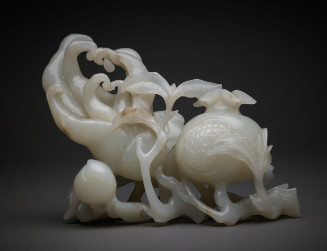
A fine jade group of a pair of pomegranates worked in low relief with a bat and insect, the stone a subtle pale celadon green tone with russet markings
Two Pomegranates
Courtesy of the Harn Museum of Art, Photography by Randy Batista

Two Pomegranates

Artist Chinese Artist
Date18th-19th century
Place of originChina
MediumJade
Dimensions4 1/2 in. (11.4 cm)
ClassificationsSculpture
Credit LineBequest of Dr. David A. Cofrin
Object number2009.48.224
Collections
Visual DescriptionA fine jade group of a pair of pomegranates worked in low relief with a bat and insect, the stone a subtle pale celadon green tone with russet markings
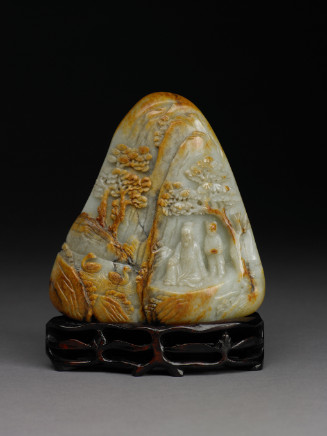
A rare and unusual jade boulder of natural form, the front with a scene of a sage and boy attendant observing twin aquatic birds as they swim. The whole sculptured with rocks and trees; the stone a pale celadon tone with russet markings.
Chinese Artist
Qing dynasty (1644-1911), late 18th century
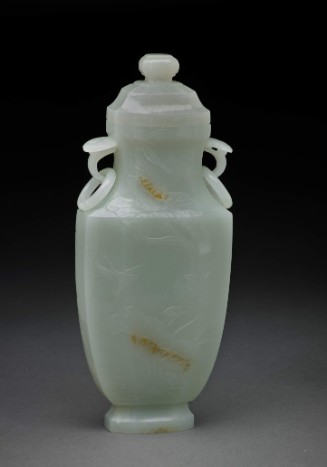
This striking octagonal vase is delicately worked from icy white jade with pale yellow surface skin markings. The artist has expertly incorporated the subtle yellow inclusions of the material with the edges of the broad graceful lotus leaves. The design extends the length of the vase to the concave neck. On either side, the covered vase is graced by handles in the shape of ruyi, or wish granting scepters. From each handle, circular rings are worked from the same jade boulder. In our opinion, the…
Chinese Artist
18th-19th century
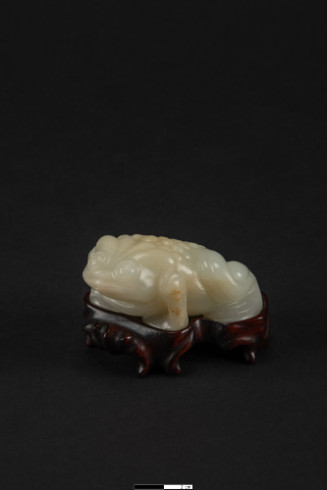
A jade figure of a crouching toad, its back, face and features well defined and modelled, the stone a mellow celadon tone with light brown markings.
Chinese Artist
Qing Dynasty (1644-1911)
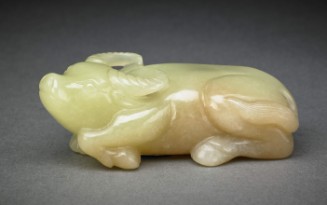
Water Buffalo
Chinese Artist
Qing dynasty (1644-1911), Qianlong period (1736-1795)
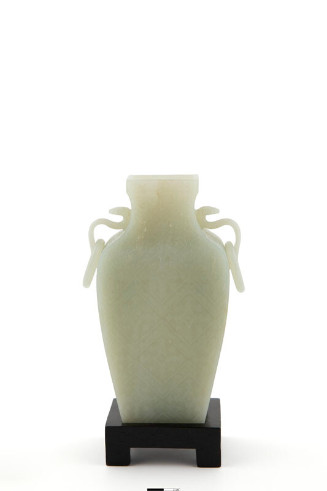
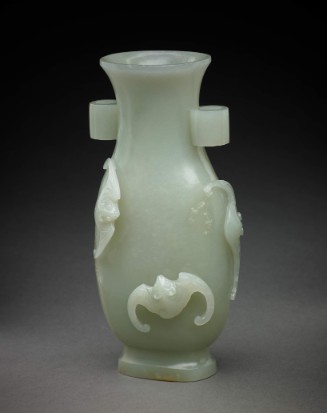
A jade vase of rectangular section, the sides gently tapering towards the slightly recessed base, the waisted neck with straight mouth rim, and worked in relief with two ruyi-sceptre handles from which loose rings are suspended. They body decorated overall in sunken relief with a geometric design of chevrons, clouds and squares. The stone a pale celadon stone. The base with an incised six-character reign mark Qianlong yu yong (for imperial use).
Chinese Artist
18th-19th century
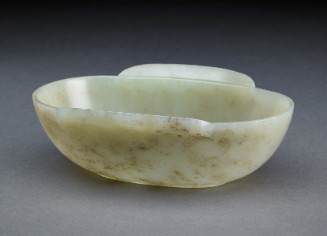
This ear cup reflects the Song period's profound interest in history in its characteristic design found in jades of the late Han period (206BC-AD220). The thinly worked oval cup has two flat handles projecting just below the rim at the longer sides, resting on an oval base with a raised foot ring. The highly translucent yellow jade possesses darker russet brown inclusions creating a desirable "skin" throughout the cup. The ear cup is of a fine, smooth polish. In our opinion, this ear cup is a fi…
Chinese Artist
Qing dynasty (1644-1911) or later
A fine jade arrow vase of celadon tone.  The sides carved with bats in high relief.
Chinese Artist
Qing dynasty (1644-1911), 18th-19th century
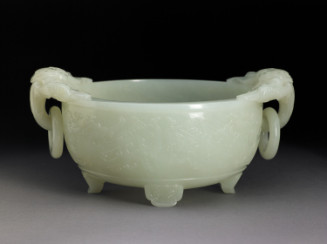
Of circular form, well-carved with two loop handles suspending rings formed from a pair of bats on either side of a ruyi-shaped terminal, the body carved in light relief with two pairs of diffused and stylized dragons and supported on four small scrolled feet, the stone of even white tone.
Chinese Artist
Qing Dynasty (1644-1911), Qianlong period (1736-1795)
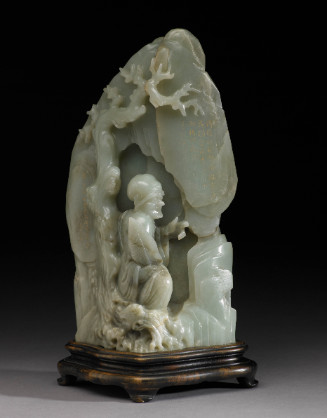
This large celadon jade boulder with darker inclusions is worked in full relief with the figure of the eleventh lohan, Chota-Pantanthaka, or Pantha the Younger, seated in a rocky grotto.
Chinese Artist
18th-19th century or later
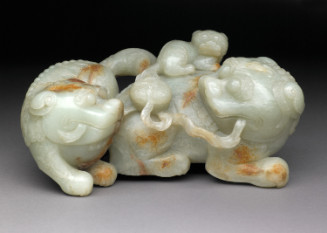
The massive stone well carved as a pair of recumbent fu lions turned to face each other, a beribboned brocade ball trailing from one of the lion's closed jaws, the 'snail' curled mane trailing over each lion's back to meet the bushy tails, one small cub poised on the back, the underside detailed with clawed feet, the stone of celadon tone with patches of russet highlights
Chinese Artist
17th-18th century
The crouching animal carved with deep slashes to the flat snout, haunches, eyes and tail, the stone of pale celadon tone with russet rivering
Chinese Artist
Han dynasty (206 BCE-220 CE)
Sanduo Carving
Chinese Artist
Qing dynasty (1644-1911), 18th-19th century
null