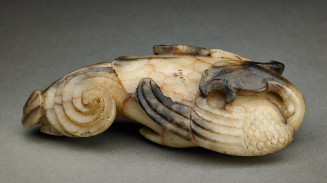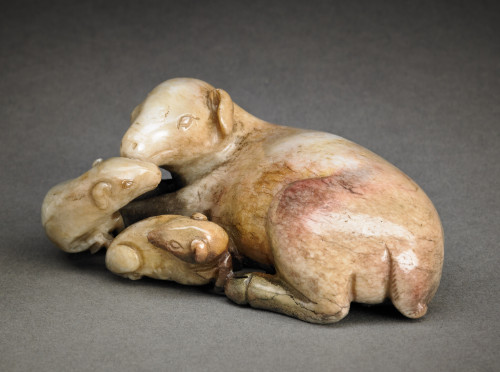
Burnt jade carving of three sheep, the mother shown nuzzling one of the kids
Three Sheep
Courtesy of the Harn Museum of Art, Photography by Randy Batista

Three Sheep

Artist Chinese Artist
Datelate Ming dynasty (1368-1644)
Place of originChina, Asia
MediumJade
Dimensions1 3/8 x 3 1/2 x 1 15/16 in. (3.5 x 8.9 x 4.9 cm)
ClassificationsSculpture
Credit LineBequest of Dr. David A. Cofrin
Object number2009.48.4
Collections
Visual DescriptionBurnt jade carving of three sheep, the mother shown nuzzling one of the kids
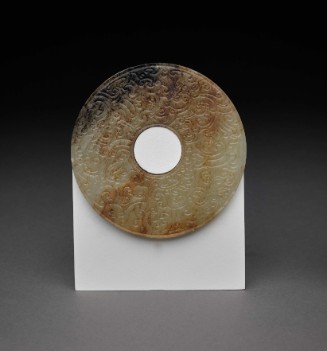
Disc with Cloud Pattern
Chinese Artist
Eastern Zhou dynasty (770-256 BCE)
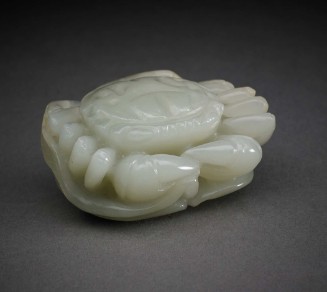
A miniature carving in pale celadon jade of a crab resting on a lotus leaf.
Chinese Artist
Qing dynasty (1644-1911)
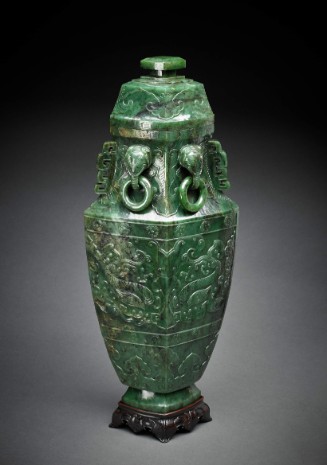
Carved with archaistic motifs
Chinese Artist
19th century
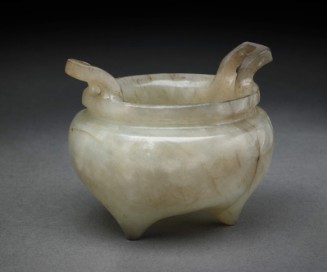
A fine miniature jade water vessel of modified archaic bronze gui form, the round body, supported on three low conical feet, the mouth rim set with two rectangular handles flared steeply out from the rim. The jade warm greyish-white color with darker striations.
Chinese Artist
Qing dynasty (1644-1911), 17th-18th century
Shown with head arched back and resting on its body, some small chips to wings and tail feathers
Chinese Artist
Song and Ming dynasty (960-1644)
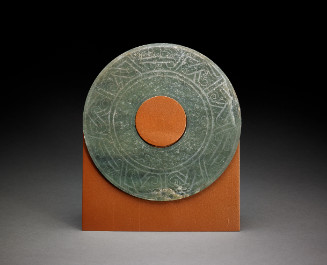
Carved from a light green jade with black inclusions, both sides of the disc are divided into two finely executed concentric decor zones. The inner band contains a grid of low relief curls within elevated hexagonal units, bordered by three "Bucraniums" that embellish the outer band. They stylized dragon forms are fluidly shaped from thick and thin incisions in a curvilinear pattern and separated by incised double brackets. Consistent with the practice of the time, cinnabar was applied to enhance…
Chinese Artist
Han Dynasty (206 BCE-220 CE)
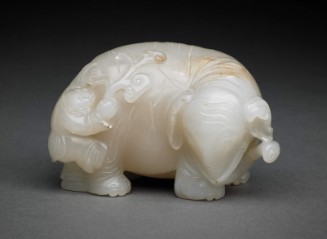
The beast well carved standing four square with the head turned to one side with a boy clambering over its back clasping a lotus sprig, the white jade with brown inclusions
Chinese Artist
Qing dynasty (1644-1911) or later
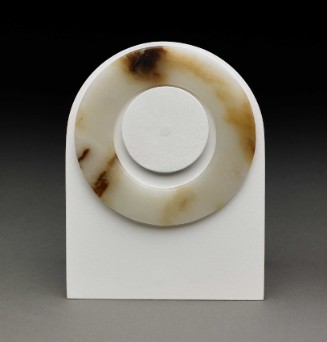
Of flattened slightly irregular form, of uneven thickness and with a faint carving line on one side, the translucent white stone with some dark inclusions
Chinese Artist
Neolithic Period or later
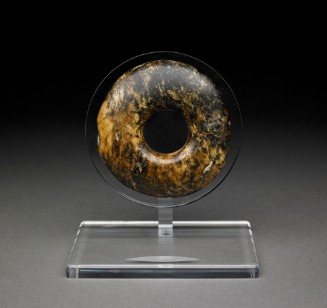
Disc
Chinese Artist
Neolithic Period or later
null