The massive stone well carved as a pair of recumbent fu lions turned to face each other, a beribboned brocade ball trailing from one of the lion's closed jaws, the 'snail' curled mane trailing over each lion's back to meet the bushy tails, one small cub poised on the back, the underside detailed with clawed feet, the stone of celadon tone with patches of russet highlights
Buddhistic Lion Group
Courtesy of the Harn Museum of Art, Photography by Randy Batista

Buddhistic Lion Group

Artist Chinese Artist
Date17th-18th century
Place of originChina, Asia
MediumJade
Dimensions4 x 8 7/8 x 5 1/8 in. (10.2 x 22.5 x 13 cm)
ClassificationsSculpture
Credit LineBequest of Dr. David A. Cofrin
Object number2009.48.35
Collections
Visual DescriptionThe massive stone well carved as a pair of recumbent fu lions turned to face each other, a beribboned brocade ball trailing from one of the lion's closed jaws, the 'snail' curled mane trailing over each lion's back to meet the bushy tails, one small cub poised on the back, the underside detailed with clawed feet, the stone of celadon tone with patches of russet highlights
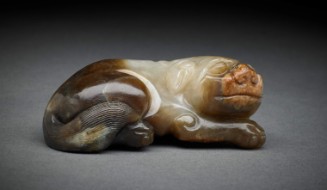
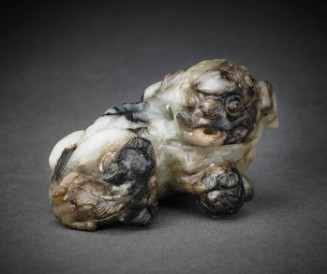
Carved as a recumbent lion, its paw resting on a brocade ball and head turned to one side, its long ears laid back flanking tufts of hair falling on either side of the ribbed backbone, opposite the tail flicked to one side, accompanied by a cub, the stone of mottled, black brown and white tones
Chinese Artist
18th-19th Century or later
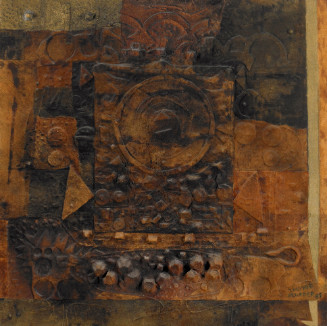
Relief of geometric shapes; motifs include central rectangular panel with circle, surrounded by flat cut outs and high relief conical forms; low relief abstracted lions in lower corner. Various shades of brown, low contrast.
Skunder Boghossian
1981
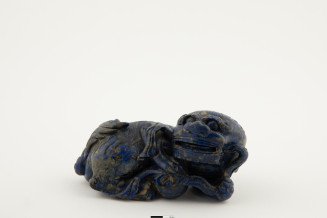
The large lion carved holding a ribbon unraveling from a brocade ball, the brows and mane with tight curls, the backbone and tail carved with long combed fur.
Chinese Artist
Qing dynasty (1644-1911), 18th-19th century
cleverly carved using the natural inclusions of the stone, its head turned to one side, its combed mane trailing over its ribbed back, opposite the tail flicked to one side, the underside detailed with padded paws, the stone of mottled brown, beige and white tones
Chinese Artist
Ming dynasty (1368-1644)
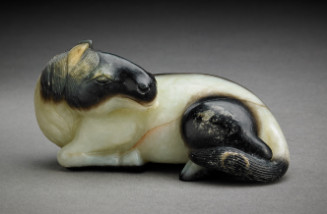
Well carved along the natural curves of the stone, the head turned towards the back, the face framed by long locks of gently incised mane, seated on its haunches with its tail swished to one side, the underside well detailed hooves, the stone of white tone with dark brown highlights
Chinese Artist
Ming dynasty (1368-1644)
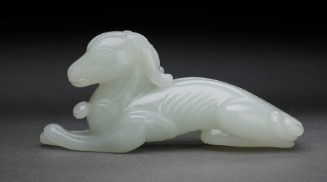
The graceful greyhound shown in a recumbent position with forepaws crossed and back legs tucked beneath the body, with long ears and coiled tail, one end of the long, bell-hung ribbon tied around the arched neck trailing beneath the belly, the slender body carved with pronounced ribs and backbone, the stone well polished and of even white tone.
Chinese Artist
Qing dynasty (1644-1911), 18th-19th century
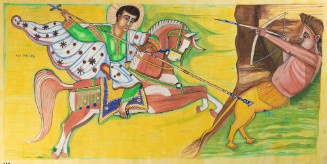
A scene featuring two figures. The first, on horseback, plunges a spear through the second, a half-lion person, who points back at the first figure with a bow and arrow. The largely yellow background features a green patch with what looks like a tree.
Adamu Tesfaw
2003
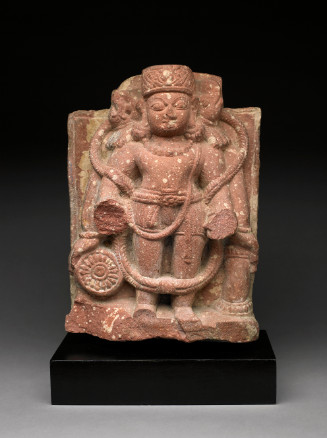
A sandstone high relief of a four-faced Vishnu. The central face is flanked by two faces in the form of a lion and a boar at either side. The fourth face is implied at the back. The ends of feet are broken off as well as two of four arms, at the elbow.
Indian Artist
Late 3rd - early 4th century
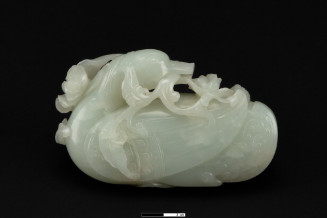
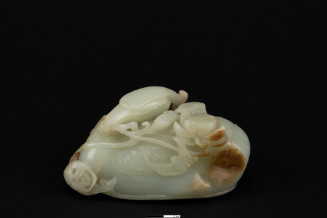
Finely carved with its head turned back over its wings folded back and incised with archaistic decoration, a long leafy lotus spray trailing from its beak, the underside detailed with webbed feet, the stone of even tone.
Chinese Artist
18th century
The recumbent animal holding in its beak a leafy branch of blossoming lotus bloom enclosing a stylized shou medallion, the elaborately patterned wings swept back close to the body, the underside detailed with billowy waves, the stone of even tone with russet skin highlights.
Chinese Artist
17th-18th century
null