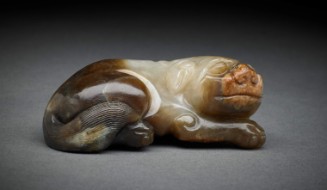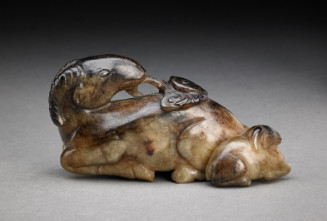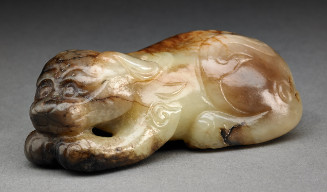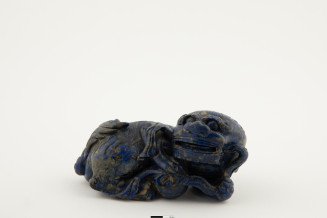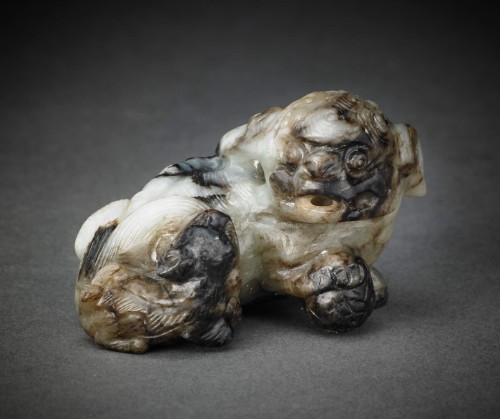
Carved as a recumbent lion, its paw resting on a brocade ball and head turned to one side, its long ears laid back flanking tufts of hair falling on either side of the ribbed backbone, opposite the tail flicked to one side, accompanied by a cub, the stone of mottled, black brown and white tones
Buddhistic Lion Group
Courtesy of the Harn Museum of Art, Photography by Randy Batista

Buddhistic Lion Group

Artist Chinese Artist
Date18th-19th Century or later
Place of originChina, Asia
MediumBrown and white jade
Dimensions1 5/8 x 2 5/16 x 1 1/2 in. (4.1 x 5.9 x 3.8 cm)
ClassificationsSculpture
Credit LineBequest of Dr. David A. Cofrin
Object number2009.48.289
Collections
Visual DescriptionCarved as a recumbent lion, its paw resting on a brocade ball and head turned to one side, its long ears laid back flanking tufts of hair falling on either side of the ribbed backbone, opposite the tail flicked to one side, accompanied by a cub, the stone of mottled, black brown and white tones
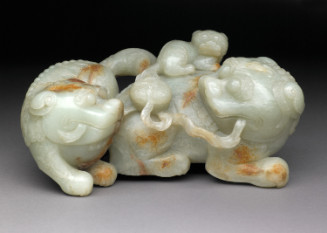
The massive stone well carved as a pair of recumbent fu lions turned to face each other, a beribboned brocade ball trailing from one of the lion's closed jaws, the 'snail' curled mane trailing over each lion's back to meet the bushy tails, one small cub poised on the back, the underside detailed with clawed feet, the stone of celadon tone with patches of russet highlights
Chinese Artist
17th-18th century
cleverly carved using the natural inclusions of the stone, its head turned to one side, its combed mane trailing over its ribbed back, opposite the tail flicked to one side, the underside detailed with padded paws, the stone of mottled brown, beige and white tones
Chinese Artist
Ming dynasty (1368-1644)
cleverly using the natural inclusions to depict a large recumbent horned ram, its head turned to one side and spewing forth a cloud vapor and yinyang medallion, accompanied by two young rams.
Chinese Artist
Ming dynasty (1368-1644)
Shown in a recumbent position with head resting on its front paws and tail tucked under the body, with bulbous eyes, floppy ears, slightly knobby backbone and scrolls outlining the haunches, the stone of pale yellow, pale brown and dark brown color.
Chinese Artist
Yuan and Ming dynasty (1279-1644)
The large lion carved holding a ribbon unraveling from a brocade ball, the brows and mane with tight curls, the backbone and tail carved with long combed fur.
Chinese Artist
Qing dynasty (1644-1911), 18th-19th century
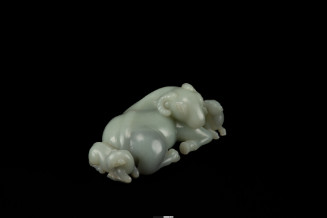
The recumbent ram finely carved in gently rounded form with its head turned to the side, flanked by two young tucked along its side, the stone of even celadon color with grey streaks
Chinese Artist
18th century or later
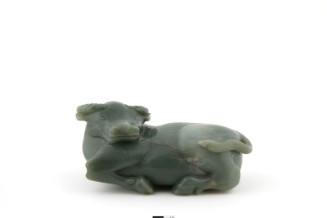
The thick stone carved as a recumbent buffalo following the form of the boulder, the legs tucked beneath the body, the head turned to one side, with broad snout and large curled horns, opposite the tail flicked to one side, the gray green stone with a broad suffusion of dark green and white on reverse.
Chinese Artist
19th century or later
The thick stone well carved as a recumbent buffalo following the form of the boulder, the legs ticked beneath the body, the head turned to tone side, with broad snout and large curled horns, opposite the tail flicked to one side, the grayish green stone infused with a patch of white, small chip
Chinese Artist
19th-20th century
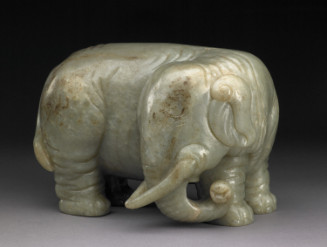
Of pale greyish-green stone, the standing elephant carved with head turned back, its trunk between its tusks meeting at the tips, its tail flicked forward on its right hind leg, its floppy ears and wrinkled skin well delineated
Chinese Artist
Ming dynasty (1368-1644)
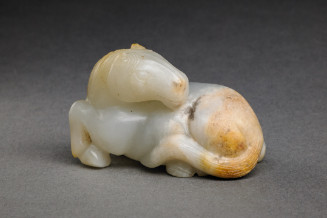
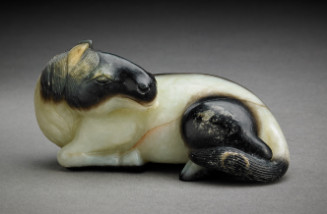
A small mottled white jade figure of a recumbent horse, with head turned to rest on its back, possibly Ming Dynasty
Chinese Artist
Ming dynasty (1368-1644) or later
Well carved along the natural curves of the stone, the head turned towards the back, the face framed by long locks of gently incised mane, seated on its haunches with its tail swished to one side, the underside well detailed hooves, the stone of white tone with dark brown highlights
Chinese Artist
Ming dynasty (1368-1644)
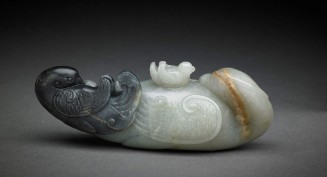
Carved as a large recumbent phoenix with a small phoenix perched in its back and another phoenix at its rear carved from a dark blackish-grey section of the stone
Chinese Artist
18th century
null