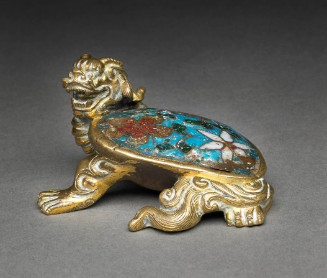
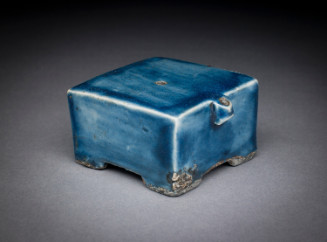
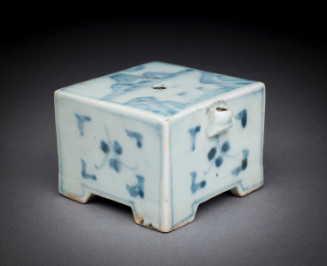
Wear to gilding on snake, little wax infill to forehead of turtle
Water Dropper
Courtesy of the Harn Museum of Art, Photography by Randy Batista

Water Dropper

Artist Chinese Artist
Date18th - 19th Century
Place of originChina, Asia
MediumMetal and enamel
Dimensions2 5/16 x 4 7/8 x 2 3/8 in. (5.9 x 12.4 x 6 cm)
ClassificationsSculpture
Credit LineBequest of Dr. David A. Cofrin
Object number2009.48.52
Collections
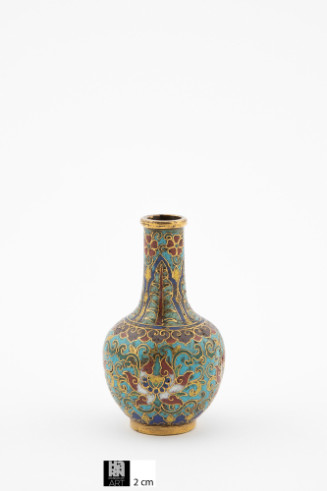
Visual DescriptionWear to gilding on snake, little wax infill to forehead of turtle
A fine cloisonné enamel vase of globular bottle form with a cylindrical neck and low gilt foot rim, decorated with ruyi-head lappets at the foot and around the shoulder; the body decorated with formalized lotus flowers, leaves and stems; the neck decorated with flowers above tall leaf-form lappets; all enameled in red, yellow, white, lapis blue, light and dark green, and aubergine on a turquoise ground.
Chinese Artist
18th Century
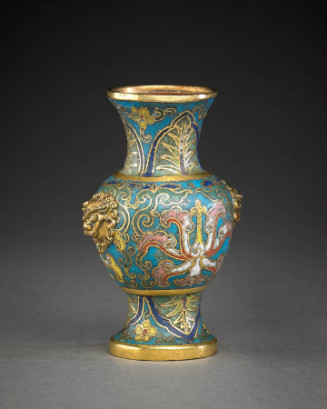
A fine miniature cloisonné enamel vase of baluster form, the rounded body set with two high relief gilt-bronze mask handles and decorated with lotus flowers and leaves, the tall flared foot decorated with flower heads and leaf lappets, the tall flared neck similarly decorated. All enameled in red, yellow, white, light and dark green, pink, and lapis blue on a turquoise blue ground.
Chinese Artist
18th Century
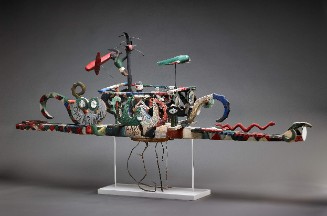
Headpiece with carpentered and painted (red, green, blue, black, pink, white) figures atop  a plank  with projecting stems with affixed round mirrors. Scenes depicted include a  palm wine tapper on a tree, two airplanes and a tailor at his machine. The word Opu Arunpu are painted on the side.
Ekpeye Artist
c. 1970
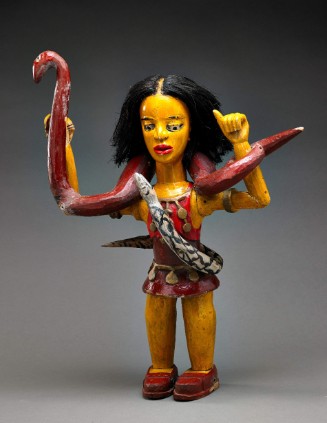
Standing figure with oversized head, polychromed with yellow skin, red dress; dark brown hair made of coconut or other fiber; snake over left shoulder.
Anang Artist
1970-1971
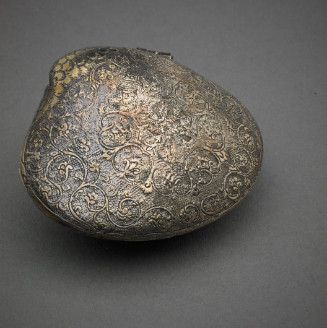
Realistically formed inside and out as a clam shell, each side engraved with a large central flower head encircled by a border of eight foliate lobes surrounded by leafy foliate scroll, all reserved on a ring-punch ground, the hinged area engraved with feathers bearing traces of gilding
Chinese Artist
Tang dynasty (618-907)
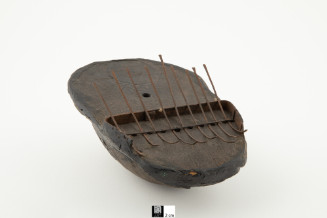
Turtle shell with wood covering, metal keys over a metal rod, black tar (bitumen?)  used as sealant on seam of shell and sound board.
Congolese Artist (Democratic Republic of Congo)
c. 1980
Heavily and finely cast as a three-legged bixi, a mythological dragon-tortoise with dragon-like head with forked antlers and bushy tail, the carapace inlaid with a cloisonné enamel fragment of 16th century date decorated with thee flower heads and green leafy tendrils reserved on a turquoise-blue ground
Chinese Artist
17th - 18th Century
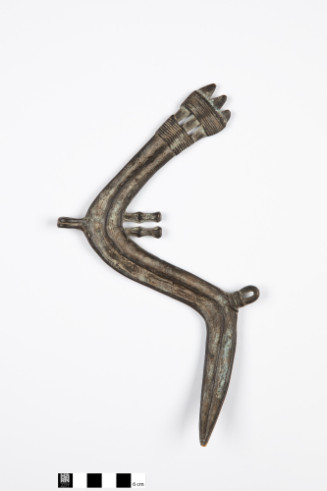
Two or three headed serpent form, made of a plate with raised lines in shape of a stretched out N, with splayed ends; areas on the ends have twisted wire wrapping in two sections. Two knobs on the large inside curve, and a loop on the opposing side, similar loop on the top of the tail end. Color varies from silvery to bronze; surface has whitish patina and material appears to be a lost-wax casting using cuprous metal.
Lobi Artist
20th century
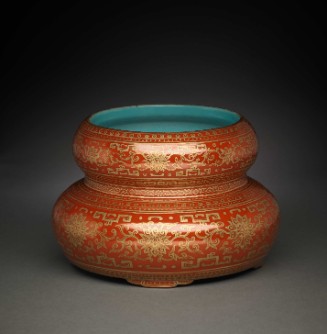
The compressed body raised on four shallow ruyi supports and painted in gilding with bands of lotus sprays and fretwork set within multiple decorative borders, all reserved on a deep coral ground continuing onto the base, the interior covered in a rich matte turquoise glaze
Chinese Artist
Qing dynasty (1644-1911), Qianlong period (1736-1795)
null