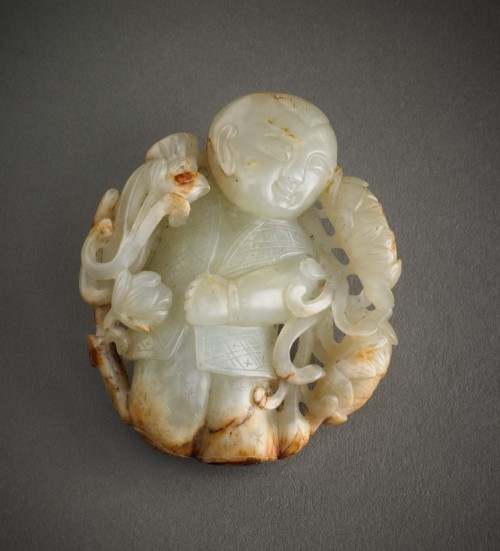
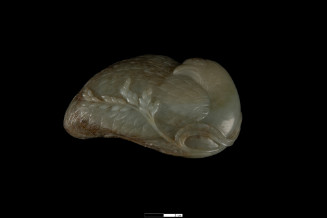
Standing and carrying a lotus branch across his shoulders, conveying the good wish of having sons consecutively, the stone of a celadon tone with edges stained to reddish brown
Boy
Courtesy of the Harn Museum of Art, Photography by Randy Batista

Boy

Artist Chinese Artist
Date17th-18th century
Place of originChina, Asia
MediumJade
Dimensions2 7/16 x 2 1/16 x 3/4 in. (6.2 x 5.2 x 1.9 cm)
ClassificationsSculpture
Credit LineBequest of Dr. David A. Cofrin
Object number2009.48.82
Collections
Visual DescriptionStanding and carrying a lotus branch across his shoulders, conveying the good wish of having sons consecutively, the stone of a celadon tone with edges stained to reddish brown
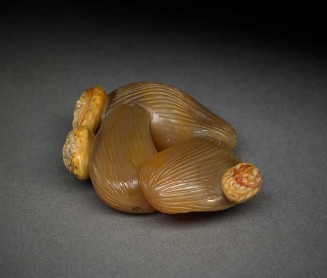
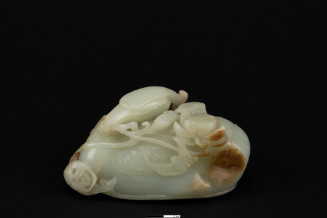
In the form of three Chinese dates with yellowish sections picked out as peanuts, conveying the rebus zao sheng gui zi (Having sons early)
Chinese Artist
19th Century
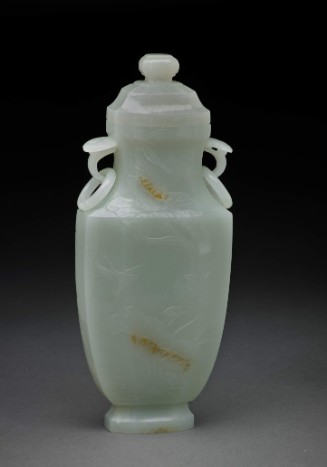
This striking octagonal vase is delicately worked from icy white jade with pale yellow surface skin markings. The artist has expertly incorporated the subtle yellow inclusions of the material with the edges of the broad graceful lotus leaves. The design extends the length of the vase to the concave neck. On either side, the covered vase is graced by handles in the shape of ruyi, or wish granting scepters. From each handle, circular rings are worked from the same jade boulder. In our opinion, the…
Chinese Artist
18th-19th century
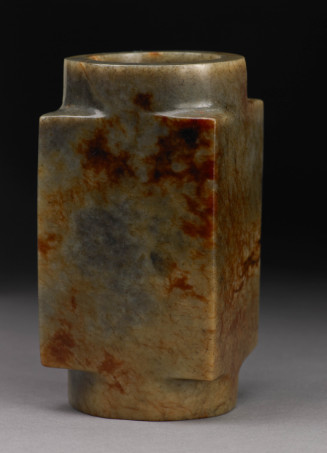
Carved from black-flecked, gray stone shading to buff with areas and veins of russet coloring in the form of a rectangular block surrounding a hollowed cylinder extending beyond the sharp triangular shoulders at either end to form a collar, the interior showing evidence of having been carved from both ends
Chinese Artist
Western Zhou dynasty (c. 1050-771 BCE)
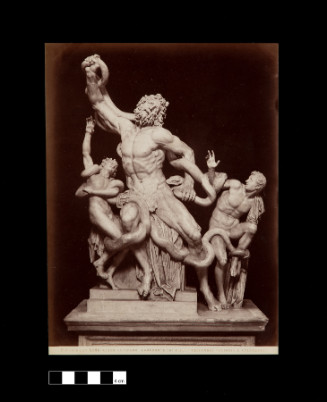
A sepia-toned photograph of the sculpture Laocoön and His Sons (Hellenistic Greece, marble, Vatican Museums). The central figure of Laocoön and his sons flanking him struggle to free themselves from serpents. Their writhing bodies create sinuous lines that convey movement.
Unknown
undated
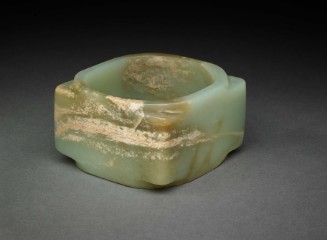
The yellowish-celadon stone well-polished and cut, of rectangular outline, the center with a circular aperture having a lip and base rising beyond the squared corners and forming a slight bevel, the stone with streaks of chalky inclusions and caramel colored patches
Chinese Artist
Zhou dynasty (1050-256 BCE)
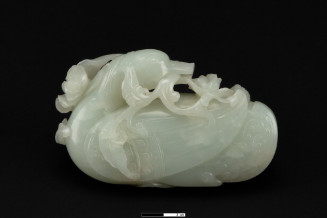
The recumbent animal holding in its beak a leafy branch of blossoming lotus bloom enclosing a stylized shou medallion, the elaborately patterned wings swept back close to the body, the underside detailed with billowy waves, the stone of even tone with russet skin highlights.
Chinese Artist
17th-18th century
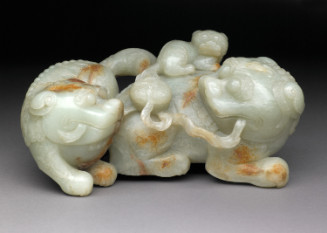
The massive stone well carved as a pair of recumbent fu lions turned to face each other, a beribboned brocade ball trailing from one of the lion's closed jaws, the 'snail' curled mane trailing over each lion's back to meet the bushy tails, one small cub poised on the back, the underside detailed with clawed feet, the stone of celadon tone with patches of russet highlights
Chinese Artist
17th-18th century
Finely carved with its head turned back over its wings folded back and incised with archaistic decoration, a long leafy lotus spray trailing from its beak, the underside detailed with webbed feet, the stone of even tone.
Chinese Artist
18th century
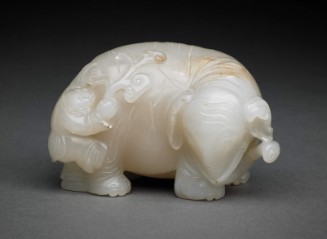
The beast well carved standing four square with the head turned to one side with a boy clambering over its back clasping a lotus sprig, the white jade with brown inclusions
Chinese Artist
Qing dynasty (1644-1911) or later
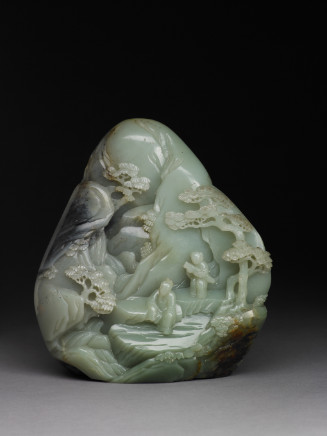
The massive boulder carved with a scholar at rest under a pine tree in front of a cascading waterfall, accompanied by a young acolyte holding an instrument in attendance, all surrounded by a tree-lined rocky moutainscape, the reverse boldly carved with further pine trees growing from jagged rockwork, the underside detailed, the stone of dark celadon tone with areas of black and cream highlights.
Chinese Artist
Qing dynasty (1644-1911)
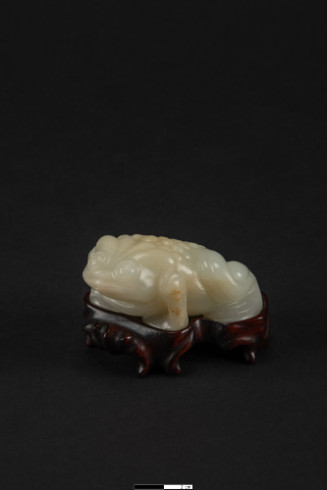
A jade figure of a crouching toad, its back, face and features well defined and modelled, the stone a mellow celadon tone with light brown markings.
Chinese Artist
Qing Dynasty (1644-1911)
The rounded pebble in the form of a nesting quail with head turned towards its back surrounded by a long leafy millet spray, carved overall with detailed overlapping feathers, the stone of deep celadon tone with brown accents
Chinese Artist
18th-19th century
null